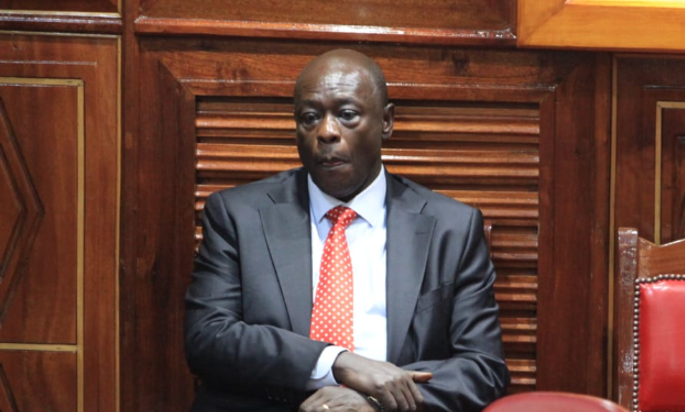


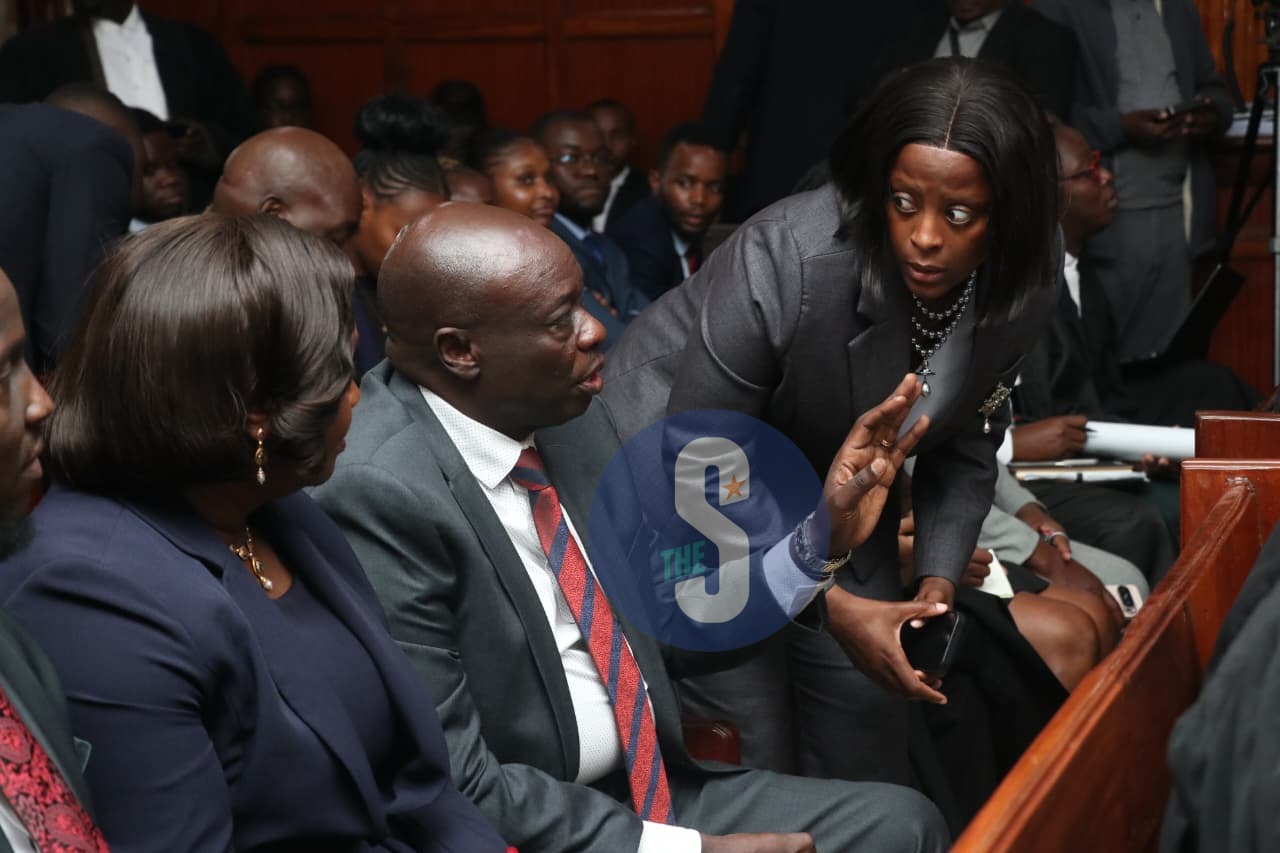
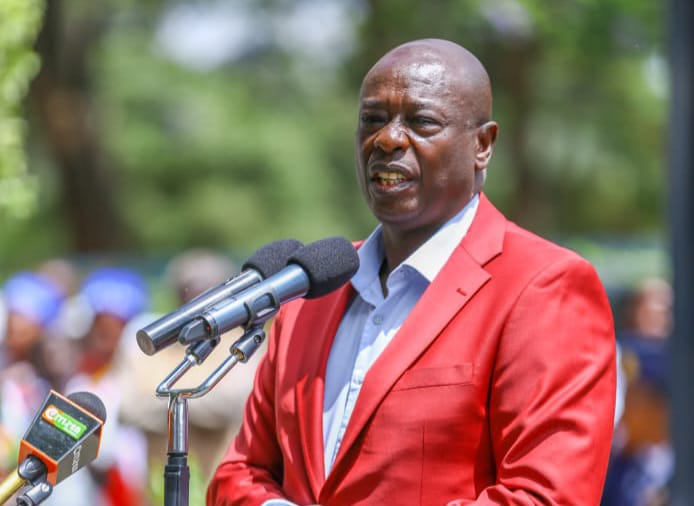
 Former Deputy President Rigathi Gachagua in court during the cross-examination of his doctor, Dr Daniel Gikonyo on May 13, 2026. /LEAH MUKANGAI.
Monday's High Court decision to uphold Rigathi Gachagua's impeachment despite finding that his constitutional right to a fair hearing was violated has triggered intense debate within Kenya's legal fraternity, many of whom say the judgment leaves difficult constitutional and procedural questions unresolved.
In a landmark ruling that lasted more than 10 hours, a three-judge bench comprising Justices Eric Ogola, Anthony Murima and Freda Mugambi declined to overturn Gachagua's October 2024 impeachment, even after concluding that the Senate violated his rights when it refused to adjourn proceedings after he was taken ill and admitted to hospital.
The judgment has drawn mixed reactions from senior lawyers and constitutional experts, many of whom argue that the court's findings and ultimate conclusion appear difficult to reconcile.
The court found that Gachagua's right to a fair hearing was infringed when the Senate declined to postpone the proceedings despite his hospitalisation.
"We have found that the fair trial rights of His Excellency Gachagua were infringed when the Senate declined to allow the adjournment," the judges said.
However, the bench held that the violation alone could not invalidate the impeachment because a new deputy president had already been lawfully appointed, making reversal of the process constitutionally problematic.
"The constitution is the grundnorm (a legal system that outweighs all other laws), and where that grundnorm deliberately and clearly limits the power of the court, that limitation must be respected," the judges stated.
The judges warned that overturning the impeachment at this stage could create uncertainty by raising the prospect of two individuals laying claim to the office of Deputy President.
That reasoning has become the focal point of criticism from a section of legal practitioners who contend that a constitutional violation of such magnitude should have attracted a more consequential remedy.
Law Society of Kenya president Charles Kanjama described the ruling as confusing and said it leaves several critical legal questions unanswered.
"My interpretation is that because the court has found that there has been a violation of the right to a fair hearing, of necessity, the fruits of the impeachment cannot all be sustained. The finality in terms of bringing in a new DP has been sustained, but the other fruits of impeachment, which is to stop the DP from running again, cannot be sustained. The outcome is fairly confusing."
Kanjama argued that the judgment did not clearly address whether the impeachment carries future legal consequences for Gachagua, including his eligibility to seek elective office.
"The court was not clear on it; it could have been clear by making a declaration that the outcome of the impeachment will not have any consequence," he added.
Having found that Gachagua's rights were violated, the court awarded him Sh50 million in compensation.
Gachagua's lawyer, Ndegwa Njiru, termed the decision a "judicial absurdity" and faulted the judges for failing to nullify the impeachment after establishing that his constitutional rights had been infringed.
"They say Gachagua's rights were violated and instead of doing what is constitutionally right – to quash –they avoid."
Although Gachagua had amended his petition and dropped his bid for reinstatement, Njiru argued that the court should nonetheless have invalidated the impeachment.
"We are going to the Court of Appeal," he declared.
Constitutional lawyer Willis Otieno also supported an appeal, saying the judgment raises fundamental legal questions that require clarification by a higher court.
"A finding that a person was denied a fair hearing ordinarily goes to the heart of the decision-making process. Fair hearing is not a peripheral right that can be separated from the outcome; it is a constitutional prerequisite for the validity of the process itself. That is why many legal observers will ask: if the impeachment process was tainted by a violation of due process, how does the resulting Senate determination remain unaffected?" he said.
Otieno argued that the relationship between procedural fairness and the validity of an outcome requires further judicial explanation.
He also questioned the practical implications of the judgment.
"If the impeachment process is found to have suffered constitutional defects, what does that mean for the legal disabilities arising from that process? Does the judgment remove them, preserve them, or leave the matter for another court to determine?" he posed.
In his view, constitutional litigation should ultimately provide certainty. "Where a judgment simultaneously identifies a violation of fundamental rights while preserving the consequences flowing from the impugned process, questions are bound to arise regarding the coherence of the legal reasoning."
Speaking on KTN shortly after the ruling, lawyer Evans Monari argued that the right to a fair hearing cannot be subordinated to political considerations.
"All the other rights under the constitution find their lives on the right to fair trial, it does not matter whether heavens fall. In fact, a five-judge bench already found that even in a case of terrorism and state of emergency, the right to fair hearing cannot be derogated," he said.
Monari acknowledged that Article 145(7) of the constitution makes a Senate impeachment decision final, but argued that the provision applies only where the process itself is constitutionally sound.
"But where there has been a constitutional infraction, nothing stops the High Court from adjudicating and undoing that violation."
He further argued that compensation alone was insufficient where the violation related to a non-derogable constitutional right.
"When it goes to the rule of natural justice, the court has no free hand. Once the court found that the right to fair hearing had been violated, the court had no option but to undo the effect of that impeachment."
Monari' also dismissed the court's concern that overturning the impeachment could have created a constitutional crisis involving two deputy presidents.
"We cannot butcher the constitution in the manner the three-judge bench did because the next time, the next non-derogable right, let's say the right not to be subjected to torture, will be violated by a state agency and the court will use this precedent and say although you were tortured, the best we can do is compensate you."
Former Law Society of Kenya President Nelson Havi also questioned the court's reasoning on that aspect.
"In employment law, courts have time without number found a termination to be unlawful without ordering reinstatement. What was so difficult in making such an order?" he posed.
Senior Counsel Donald Kipkorir said the ruling effectively presents the Court of Appeal with a straightforward choice.
"The High Court has given the Court of Appeal an easy bifurcated choice: affirm the violation and nullify the impeachment or set aside the alleged violation and confirm the impeachment."
Toronto-based lawyer Miguna Miguna similarly argued that the court should have invalidated the impeachment once it established that Gachagua's right to a fair hearing had been violated.
In his view, the former deputy president still has a strong chance of success on appeal.
"He ought to win based on the finding that he was denied a fundamental right when his adjournment request was rejected after all senators admitted that he was ill," he said.
Senior Counsel Ahmednasir Abdullahi also questioned the legal foundation of the ruling, noting that Article 25(c) of the constitution classifies the right to a fair trial as a non-derogable right that cannot be limited or suspended under any circumstances.
"So how can the court make quasi constitutional excuses on amorphous grounds in its refusal to set aside the impeachment of Hon Rigathi Gachagua? The Gachagua judgment in my humble opinion is on a shaky, shallow, soggy and sandy soil."
With Gachagua's legal team now headed to the Court of Appeal, the debate ignited by the judgment is unlikely to end soon.
The next phase of the battle could prove just as consequential, not only for the former deputy president's political future but also for the evolving jurisprudence surrounding impeachment, due process and the limits of judicial intervention in constitutional disputes.



![[PHOTOS] Ruto pushes for stronger Kenya-EU economic ties in Brussels](https://cdn.radioafrica.digital/image/2026/06/3aebc395-285b-441c-8aa4-33cb538f8d44.jpg)