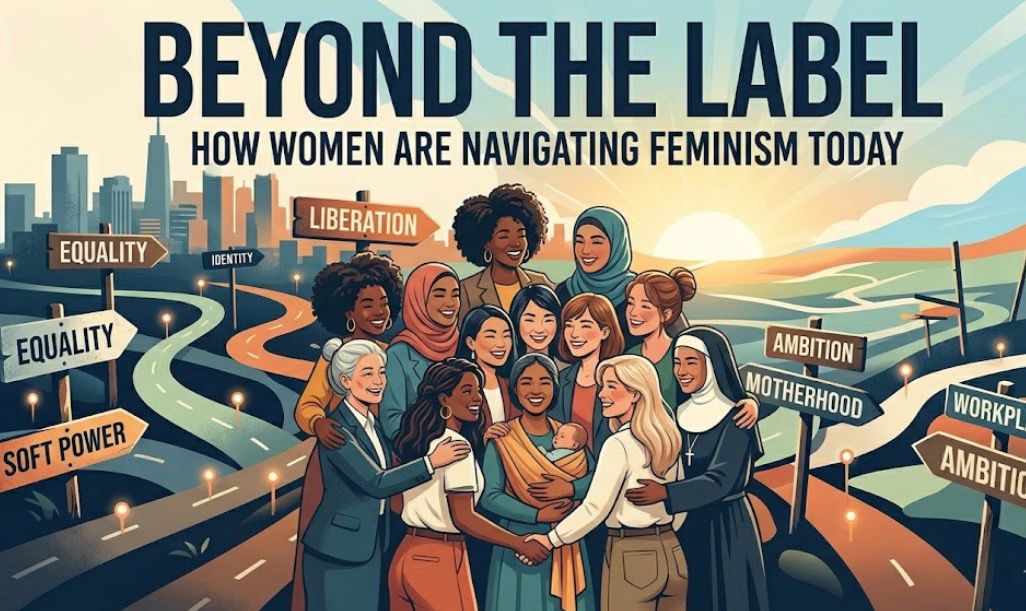
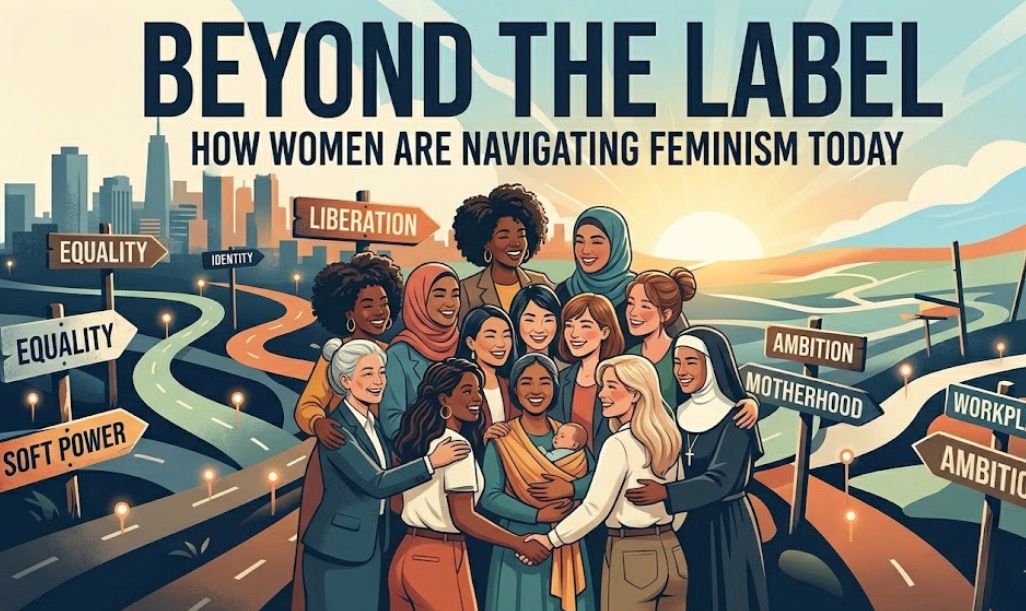
For decades, feminism was largely understood as the fight
for women’s equality, the belief that women deserve the same rights,
opportunities and freedoms as men. But in 2026, especially online, feminism no
longer feels like a single movement with a single definition.
Across TikTok, podcasts and social media discussions, young
women are increasingly questioning what empowerment actually looks like in
practice. Conversations, once centred mainly on workplace equality and legal rights, have expanded into debates about beauty standards, femininity, motherhood, religion, and the pressure to optimise oneself constantly.
At the centre of these discussions is a growing tension: are
women genuinely making free choices, or are those choices still shaped by
patriarchal expectations?
In a viral video, Amy Lee, a social media influencer, admitted
she no longer knew where she stood between liberal feminism and radical
feminism.
“The goal of radical feminism is to abolish patriarchy,” she
said.
“Whereas liberal feminism is known to repackage ways women are oppressed
to seem empowering.”
She questioned whether beauty culture, hyper-sexualisation
and the pressure to constantly enhance appearance could ever be separated from
societal conditioning.
“But I also know we are just playing the cards we have been
dealt,” she added.
“So what is the true solution if either route is dictated by
our oppressor?”
That uncertainty has become increasingly visible,
where feminism is no longer treated as a fixed ideology but as an ongoing
negotiation between freedom, identity and expectation.
But online discourse does not reflect every woman’s reality.
For Regina Oduor, a university student, many modern feminist
spaces feel alienating.
While she believes women deserve dignity and opportunity,
she questioned whether some feminist conversations place too much emphasis on
competition between men and women rather than coexistence.
“I’d rather live in a world that is fair, but not equal,”
she said.
“A world that honours the uniqueness of men and women, where our
strengths complement one another instead of competing with each other.”
To Regina, equality and equity are not necessarily the same
thing. While equality focuses on sameness, she believes equity recognises that
men and women experience different realities and expectations.
“True empowerment doesn’t come from wanting what men have,”
she said.
“It comes from understanding our differences and the balance between
us.”
Her perspective reflects a growing number of women who feel
disconnected from mainstream feminist labels while still advocating for women’s
dignity and independence.
“Sometimes it feels like success for women is only validated
when it mirrors men,” Regina said.
“But I don’t think strength only looks one
way.”
Those contradictions are not only ideological. For many
women, they shape everyday experiences in workplaces and public life.
That tension between empowerment and expectation is
something Maimuna Hassan knows well.
Raised by a single mother she describes as both “mother and
father at the same time,” the Kitale-based businesswoman said her
understanding of womanhood was shaped by faith, sacrifice, resilience and
responsibility.
“What comes to my mind is motherhood and nurturing,” she
said when asked what feminism meant to her.
“Like the old-fashioned way that I
saw my mum. Sacrificing everything for the family and the kids.”
After earning a Scholarship through academic
performance, Maimuna entered the business world, believing hard work alone would
determine success. Instead, she said she quickly realised how often women in
leadership are forced to repeatedly prove themselves in male-dominated spaces.
“Sometimes when you give instructions, they don’t take you
seriously,” she said.
“When they hear the same instruction from a man, they
take it.”
She recalled clients asking to speak to “the owner,” despite
her being the co-owner herself.
“It’s passive-aggressive,” she said. “But my mum raised me
to be tough. I simply won’t back down.”
Her experience reflects broader workplace realities. Data from UN Women confirms that female leaders frequently endure higher levels of public scrutiny, persistent gender biases, and credibility challenges compared to their male peers.
At the same time, Maimuna rejects the idea that faith,
femininity or motherhood are inherently incompatible with empowerment.
“I’m proof that you can be a hijabi and work,” she said.
“Neither my faith nor gender has ever stopped me from doing anything.”
For many young women, however, the pressure surrounding
womanhood extends beyond authority and competence. Appearance and perception
have increasingly become part of the equation, too.
Mercy Njuguna, a Nairobi-based corporate professional,
described feeling caught between visibility and credibility.
“Pretty privilege is very real, but it’s complicated,” she
said.
“Sometimes being attractive opens doors socially, but it can also make
people underestimate your intelligence or assume you didn’t work hard to get
where you are.”
She explained that many women enter professional spaces
believing merit alone will determine how they are treated, only to discover how
heavily appearance shapes perception.
“As women, especially young women from humble backgrounds,
you grow up already feeling like you have to work twice as hard just to be
noticed,” she said.
“Then you enter the corporate world and realise competence
is not always the first thing people see.”
Her experience reflects concerns commonly raised within
liberal feminist conversations around workplace equality and gender bias, while
also touching on newer critiques surrounding beauty culture online.
“If you don’t make an effort with your appearance, people
can see you as lazy or unprofessional,” Mercy said.
“But if you’re too
glamorous or feminine, suddenly you’re not taken seriously.”
Experiences like Mercy’s reflect broader workplace
inequalities. According to the World Economic Forum’s Global Gender Gap Report,
women remain underrepresented in leadership positions globally despite
increased participation in the workforce.
Many women interviewed also pointed to social media as one
of the biggest forces shaping modern womanhood today.
“Nothing is ever enough now,” Maimuna said.
“Social media
has shown girls how to dress, how to look, where to eat, and where to go. It adds
more pressure.”
She worries young girls are constantly measuring themselves
against curated online lifestyles and unrealistic beauty standards.
“In our time, you could go out without makeup and feel okay,”
she said.
“Now you feel like you constantly have to look a certain way.”
Concerns around digital pressure have increasingly been
reflected in global research.
UNESCO has warned that comparison-driven online
culture can negatively affect self-esteem and mental well-being among young
people, particularly girls and young women.
Perhaps that is where the modern conversation around
feminism now sits, not within one ideology, but within a generation of women
trying to define freedom for themselves in ways that often overlap, contradict
and evolve.
For many young women today, empowerment is no longer
something easily categorised. It can look like ambition and softness,
independence and faith, femininity and resistance, sometimes all at once.
And maybe that is what makes the conversation so emotionally
exhausting for many women today: the feeling that no matter which version of
womanhood they choose, they are still being measured against someone else’s
definition of what empowerment should look like.
And underneath it all, one question continues to surface:
What does true freedom actually look like?





![[PHOTOS] Ruto pushes for stronger Kenya-EU economic ties in Brussels](https://cdn.radioafrica.digital/image/2026/06/3aebc395-285b-441c-8aa4-33cb538f8d44.jpg)