

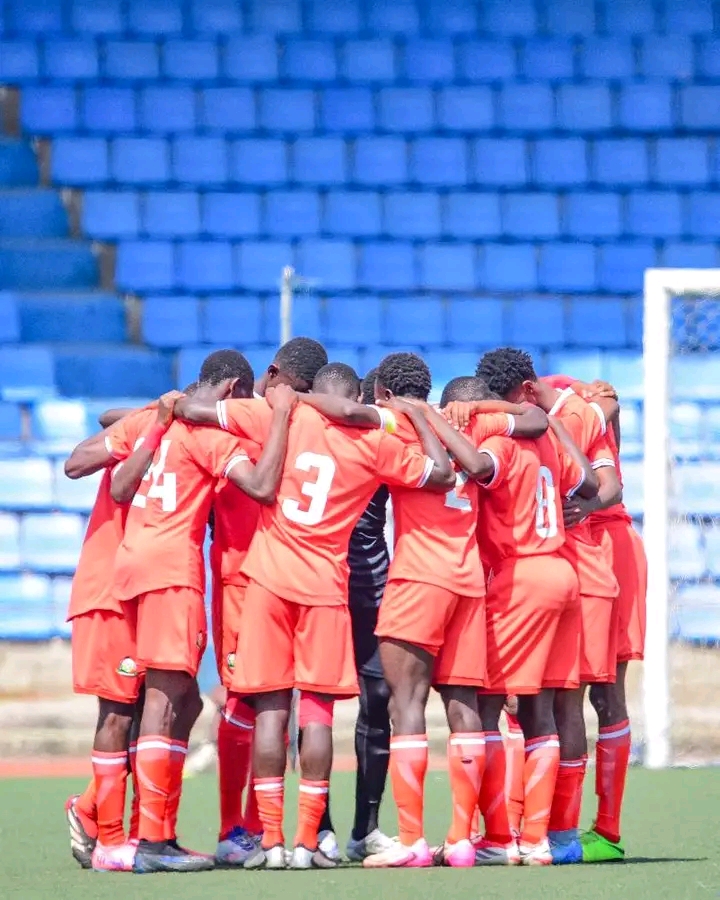
 Kenya Under-17 team during the Cecafa Afcon qualifiers in Ethiopia.HANDOUT
Kenyan football is drifting into an existential crisis. The recent sequence of failures is no coincidence, not a temporary wobble, not a blip. It is a systemic signal.
Kenya is not merely losing matches; it is losing competitiveness, credibility and confidence. Unless decisive structural intervention occurs, co-hosting the Africa Cup of Nations in 2027 will invite humiliation rather than prestige.
For years, Kenyan football has lurched between flashes of talent and a chronic inability to convert potential into consistent performance. The technical fundamentals remain weak, youth pathways threadbare, governance reactive, and the psychological resilience of our national sides disturbingly fragile.
The outcomes have become painfully predictable: brittle squads, incoherent systems, and failure under pressure.
Consider the past 12 months. The first indication came in September at Nairobi’s Moi Stadium, Kasarani. Kenya Police Bullets FC, representing the country in the CAF Women’s Champions League CECAFA qualifiers, succumbed 4-2 on penalties to Tanzania’s JKT Queens.
On paper, penalties can be cruel. In practice, they often reward preparation, psychological assurance and tactical clarity. The Bullets lacked these. At home, against a regional rival, they did not show continental readiness.
Later, the Harambee Stars were eviscerated 8–0 by Senegal — a loss that corrodes morale, weakens Kenya’s voice in continental football corridors and calls into question the credibility of its technical brain trust.
The match was billed as a test, not a massacre. Yet what unfolded was a technical, tactical and organisational rout. Senegal imposed structure; Kenya capitulated. Friendly matches are supposed to refine strategy. Instead, Kenya revealed a strategic void.
Two weeks later, another Kenyan side faltered. The Under-17 national team exited qualification for the 2026 CAF U-17 Africa Cup of Nations after a 3-1 defeat to Tanzania. The significance transcends the scoreline.
The club game provides no refuge. Nairobi United’s continental campaign demonstrated how fragile Kenyan football becomes when tested against well-ordered programmes.
A 3–0 loss to Wydad exposed technical naivety; a 1–0 defeat at Nyayo Stadium to AS Maniema Union exposed psychological vulnerability. These were not budget mismatches; they were mismatches of preparation, planning, and football literacy. These defeats are not isolated. They reflect decisions — or the absence of decisions — made years earlier.
Nations do not collapse on the pitch overnight. They collapse because youth programmes are neglected, coaching capacity is underdeveloped, talent identification is inconsistent, and federations operate without strategic discipline.
National teams are emblematic. When they falter, they corrode public confidence, erode a sense of collective ambition, and diminish a country’s international posture. Kenya cannot afford symbolic inferiority just two years from a continental showcase that will attract investors, broadcasters, sponsors, and scrutiny.
Afcon 2027 is a test of sporting capability, governance culture and national organisational discipline. Today, Kenya is unprepared.
But this crisis is not irreversible. Countries have turned around their sporting fortunes before. Japan, with far fewer natural athletes than Kenya, built a world-class football infrastructure within two decades through planning, coaching development, youth academies and compulsory technical standards.
Rwanda re-engineered its football governance and created a domestic league environment that attracts investment and consistent talent growth. Uganda is building a coherent youth-development pipeline. There is no reason Kenya cannot emulate these models — except for a lack of resolve. Three strategic interventions are essential.
First, Kenya must establish a national football development blueprint anchored in youth academies with uniform training standards. A 10-year plan is not optional. It should include school-based scouting, regional academies, and biometric tracking of player development. A nation blessed with athletic talent cannot continue to rely on random discovery.
Second, elite coaching must be professionalised. Kenya needs a tiered coaching certification system linked to technical benchmarks, with mandatory continuing education.
We need fewer motivational speeches and more tactical literacy. Coaches should graduate through structured pathways, not political selection.
Third, governance must shift from reactive patronage to data-driven decision-making. The Football Kenya Federation must publish performance metrics, talent development targets and accountability frameworks.
Technical reports must be treated as policy documents, not filing-cabinet clutter. Financial resources are not the issue—structural discipline is.
The urgency is not hypothetical. When the world descends on East Africa in 2027, it will expect professionalism, competence and competitiveness.
AFCON must not become an expose of unpreparedness. The country must choose whether the premier continental showpiece will be a moment of national pride or a public reckoning. The work begins now.