

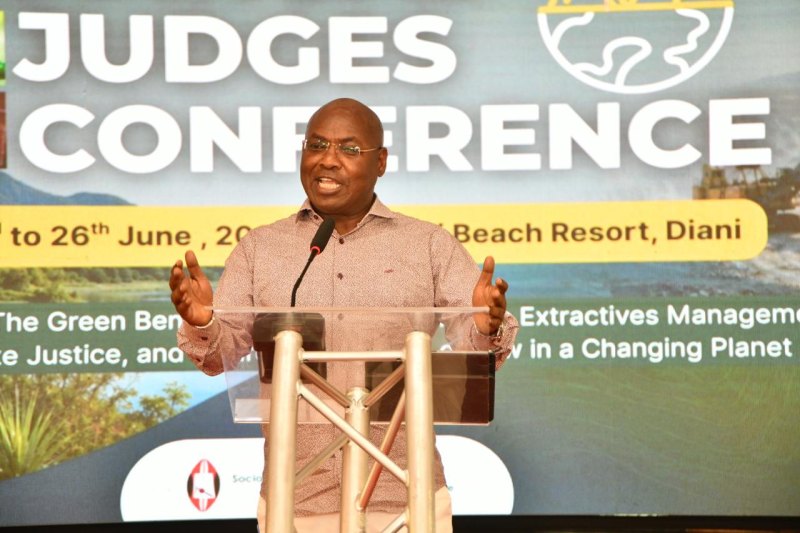
Principal Secretary for Mining Harry Kimtai has reaffirmed the State Department for Mining’s commitment to working closely with the Judiciary to strengthen governance, accountability, and sustainability within Kenya’s mining sector.
Speaking during the closing ceremony of the three-day Environment and Land Court Judges Conference in Diani, Kwale County, Kimtai said the ministry values the Judiciary as a critical partner in ensuring responsible management of the country’s mineral resources.
The conference, held under the theme “The Green Bench: Advancing Sustainable Extractives Management, Climate Justice, and Environmental Rule of Law in a Changing Planet,” brought together judges, regulators, legal experts, environmental specialists, industry practitioners, and community representatives to deliberate on emerging issues affecting environmental governance and extractive industries.
Present at the closing ceremony were Deputy Chief Justice and Deputy President of the Supreme Court Justice Philomena Mwilu, National Land Commission Chairperson Dr Abdillahi Alawy, National Land Commission Chief Executive Officer Kabale Tache Arero, and Principal Judge of the Environment and Land Court Justice Oscar Angote, FCIArb.
Kimtai underscored the Judiciary’s vital role in shaping Kenya’s extractive governance framework through sound jurisprudence and balanced judicial decisions.
“The State Department for Mining leaves this conference with a renewed sense of partnership with the Judiciary. We do not govern this sector alone — and we do not wish to. The quality of Kenya's extractive governance is directly shaped by the quality of the jurisprudence that oversees it,” he said.
The PS noted that judicial decisions have a direct impact on the sector, influencing investor confidence, environmental protection, community rights, and regulatory compliance.
“Every well-reasoned judgment, every order carefully calibrated to protect rights without obstructing lawful activity, every decision that holds the State and investors accountable to their obligations — these are as consequential to this sector as any licence we issue or regulation we enforce,” Kimtai said.
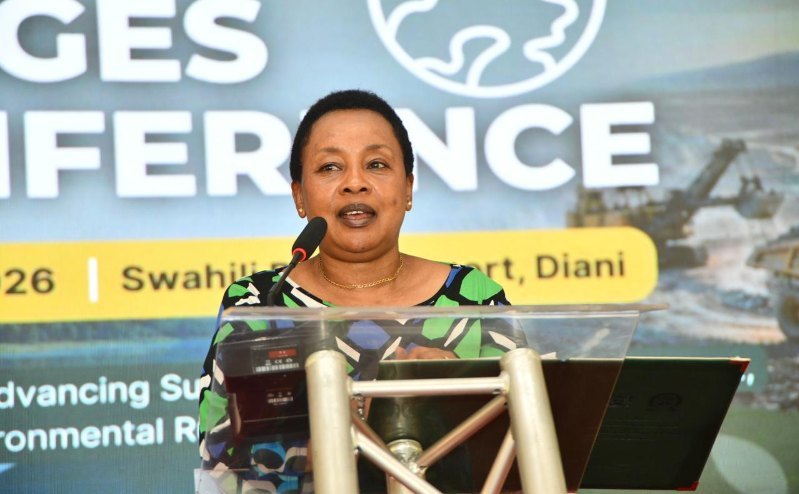
Mwilu said the partnership between the Judiciary and the State Department for Mining collaboration is borne of the close alignment between their complementary ambitions.
She explained that sustainable investment in the extractive sector depends not only on sound regulations but also on a credible justice system, one that is capable of resolving disputes fairly, protecting constitutional rights, enforcing environmental standards and providing certainty to investors and communities alike.
“I commend both the State Department for Mining and the Environment and Land Court for co-convening this conference. This conference is a good example of how careful designed collaboration can strengthen judicial effectiveness through equipping judges with the technical understanding necessary to determine the increasingly otherwise complex disputes with greater confidence, accuracy and consistency,” she said.
Kimtai pledged continued collaboration between the State Department for Mining and the Judiciary, emphasising the importance of sustained engagement beyond the conference.
“We make a commitment, as we depart Kwale, to remain a willing and available technical partner to the Judiciary. The conversations begun here must not end here — they should outlive this conference,” he added.
Kimtai further observed that Kenya’s mineral resources belong to all citizens and that the Judiciary plays a crucial role in safeguarding the public interest.
“Kenya's mineral wealth is held in trust for all its people. You are among its most important trustees,” he told the judges.