New partnership to replenish 76,000m³ of Nairobi’s water
The Upper Tana watershed supplies approximately 95 per cent of Nairobi’s water and around 50 per cent of Kenya’s hydropower
by GILBERT KOECH
Audio By Vocalize
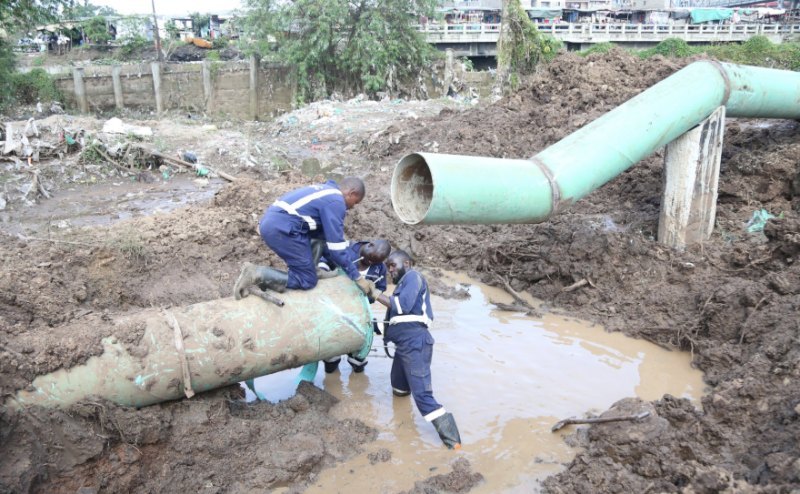
Nairobi Water and Sewerage Company technical team fixing destroyed water pipes/NWSC
A leading consumer health company has announced a three-year
partnership to support ongoing efforts to secure Nairobi's long-term water
supply.
Haleon and the Upper Tana–Nairobi Water Fund have partnered
to replenish 76,000m³ of water annually for Nairobi residents.
The partnership also seeks to improve livelihoods and ecosystem
health in the Upper Tana watershed.
"Water is fundamental to health, communities and
sustainable growth. Through this partnership with the Upper Tana–Nairobi Water
Fund Trust, Haleon is proud to support practical, nature-based solutions that
help protect vital water resources while strengthening resilience for
communities across the Upper Tana watershed," Haleon Sub-Saharan Africa
general manager Himanshu Raj said.
The Upper Tana watershed supplies approximately 95 per cent
of Nairobi's water and about 50 per cent of Kenya's hydropower.
However, it faces increasing pressure from land degradation,
population growth and climate variability.
Nairobi currently faces persistent water shortages because
demand exceeds 900 million litres per day against a supply of only 525 million
litres. The situation is compounded by damaged infrastructure and water leaks.
The city's water sources include Thika, Sasumua and Ruiru
dams, as well as the Ng'ethu treatment plants.
Unsustainable farming on steep slopes has also contributed
to soil erosion, river and reservoir sedimentation, higher water treatment
costs and reduced productivity for smallholder farmers.
Through this partnership, Haleon is investing in
nature-based solutions that address these challenges at the source while
supporting Haleon's water neutrality goal for its Nairobi site.
The project is designed to deliver measurable water
replenishment, improve water quality and support long-term water security
within the Upper Tana watershed.
Key interventions will include agroforestry, soil
conservation terraces, grass strips on farmland, riparian buffer restoration,
farmer training and extension support.
Over the project period, the partnership will work with
7,660 smallholder farmers, restoring and improving the management of 131
hectares of farmland and 1.5 kilometres of riparian corridors.
Using Volumetric Water Benefit Accounting (VWBA) and the
Curve Number hydrological method, the project is expected to generate
approximately 76,000m³ of water replenishment annually attributable to Haleon
by the third year.
This will contribute directly to Haleon's commitment to
replenish the water used at its Nairobi operations.
"Through this partnership with Haleon, we are advancing
our shared commitment to water stewardship by working collaboratively and
investing in practical solutions backed by robust measurement,” said Patrick
Nyaga, chief executive officer of the Upper Tana–Nairobi Water Fund Trust.
“Ultimately, it's about investing in solutions that deliver
lasting value for communities, businesses and the environment."
Beyond volumetric water benefits, the project is expected to
deliver wider shared value by reducing sediment loads and downstream water
treatment costs, enhancing farm productivity and incomes upstream,
strengthening community stewardship, and restoring watershed ecosystems that
are critical to long-term public health and economic resilience.
Overall, the Upper Tana–Nairobi Water Fund partnership
exemplifies Haleon's approach to collective action on water stewardship by
using nature-based, community-led solutions to manage risk, protect health and
secure sustainable water resources for both people and nature.
Kenya was the first country in Africa to establish a Water
Fund in 2015, inspiring the growth of 17 Water Funds across 11 African
countries.
Along the Upper Tana watershed, the fund supports farmers in
soil conservation, water harvesting, agroforestry and riparian protection.
More than four million Nairobi residents are enjoying
improved water quality as a result of enhanced conservation efforts within the
Upper Tana catchment area.
Already, 196,000 acres of land have been placed under
sustainable management, while 318 kilometres of riparian land have been
protected.
The Tana River supplies 95 per cent of Nairobi's water and
serves another five million people living within the watershed.
It also supports one of the country's most important
agricultural regions and provides half of Kenya's hydropower output.
With Nairobi contributing 60 per cent of the country's GDP,
the Tana River plays a critical role in driving Kenya's economic growth.
Since the early 1970s, forests on steep hillsides and
wetland areas have been converted into agricultural land, removing natural
systems that store runoff water and retain soil.
As a result, rainfall has washed soil into the river,
reducing farmland productivity and increasing sediment in the waterways.
The increased sedimentation can clog water treatment and
distribution facilities, causing service disruptions lasting days or even
weeks.
The challenge required an innovative approach to protect the
Tana River, improve downstream water quality and quantity, and deliver benefits
to tens of thousands of farmers within the watershed.
In 2015, The Nature Conservancy launched the Upper Tana–Nairobi
Water Fund to help secure Nairobi's water source.
Water Funds are founded on the principle that preventing
water problems at the source is more cost-effective than addressing them
downstream.
Public and private donors, together with major downstream water
users, contribute to the fund to support upstream soil and water conservation
measures, resulting in improved water quality and supply.
The Upper Tana–Nairobi Water Fund allows urban users to
invest in upstream watershed conservation for the benefit of farmers,
businesses and more than nine million Kenyans who depend on the Tana River for
fresh water.
On September 1, 2021, the trust became an independent
Kenyan-registered entity.
More than 51,000 farmers are now applying soil conservation
and water-saving methods.
As a result of the ongoing interventions, agricultural
yields for smallholder farmers have increased by more than US$3 million (Sh342
million) annually.
Some 8,500 coffee farmers have also been certified by the
Rainforest Alliance.
Over the next five years, the fund aims to expand its farmer
outreach programme by an additional 20,000 households, up from the current
50,000 beneficiaries.
It also plans to install another 5,000 water pans, adding to
the existing 15,000.
In addition, it intends to plant three million more trees to
reach a target of seven million by 2026.