CJ unveils five-year plan to slash court backlog, digitalise system
Move seeks to make justice faster, fairer and more accessible for all Kenyans
by CATHY WAMAITHA
Audio By Vocalize
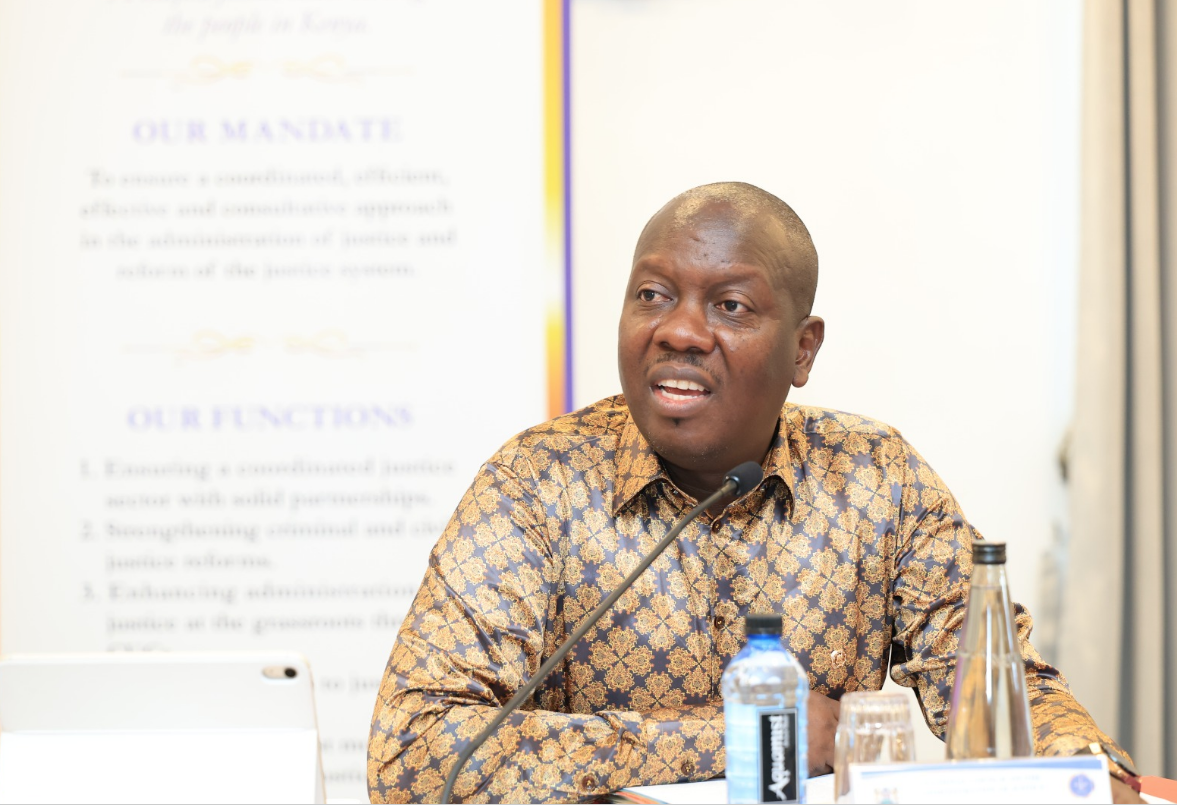
Director of Public Prosecutions Renson Ingonga at the NCAJ meeting in Mombasa on Tuesday, February 24, 2026 /HANDOUT
The National Council on the Administration of Justice has
convened a summit in Mombasa to orchestrate a radical overhaul of the justice
system.
The move seeks to make justice faster, fairer and more
accessible for all Kenyans.
The 35th NCAJ council meeting, held on Tuesday,
served as a critical strategic reflection point as the council prepares to
transition from its current plan to an ambitious 2026–30 roadmap.
Chaired by Director of Public Prosecutions Renson Ingonga on
behalf of Chief Justice Martha Koome, the gathering brought together justice
sector leaders to confront persistent challenges.
These include chronic case backlogs, fragmented paper-based
systems and barriers that have historically barred millions from seeking legal
redress.
“We are not gathered merely to take stock of routine
performance,” Ingonga told delegates, warning that the public’s patience with
delays has worn thin.
“We are called upon to reflect honestly on our progress,
interrogate areas where we have underperformed, draw lessons from
implementation challenges and, more importantly, to chart a clear and
forward-looking trajectory for our Strategic Plan 2026–2030. This process demands
candour, collective ownership and institutional courage from each of us.”
Central to the new vision is a “people-centred justice”
approach, which insists that court users must feel the impact of reforms in
tangible ways rather than only reading about them in policy documents.
Ingonga said unresolved delays erode public trust and
undermine institutional legitimacy, stressing that efficiency is not an
operational target but a constitutional obligation under Article 159, which
mandates that justice shall not be delayed.
“The public ultimately judges us not by the policies we
draft, but by the speed, fairness and accessibility of justice delivered,” he said.
The DPP acknowledged that while significant gains have been
made—including expanded Court Users Committees, e-filing systems and digitised
legal repositories—the system remains hampered by infrastructure constraints
and unsatisfactory time-to-disposition [timeliness in resolving cases] in
criminal matters.
The push for digital transformation featured prominently in
the deliberations, with leaders agreeing that technology is no longer optional
but foundational to the justice system of the future.
Ingonga called for investment in compatible digital systems
across services, warning that continued reliance on fragmented and paper-based
processes places unnecessary strain on already limited human resources.
“We must systematically address the causes of adjournments,
strengthen prosecutorial and investigative readiness,” he said.
“We should also leverage Artificial Intelligence responsibly
and invest in inter-operable digital systems across policing, prosecution,
adjudication, corrections and probation services,” he said.
“Digital transformation is not optional; it is foundational
to the justice system of the future.”
To address the persistent challenge of court case backlogs,
the NCAJ is transitioning its focus towards 'people-centred justice'.
This involves a shift toward a restorative, rather than a
purely punitive, legal system.
In a restorative system, the goal is not simply to punish
offenders but to repair harm, rehabilitate individuals and reintegrate them
into the community as productive members.
This approach recognises that harsh, punitive measures often
fail to address root causes of crime—such as poverty, trauma, or substance
abuse—and can perpetuate cycles of offending rather than breaking them.
In practice, a people-centred system involves prioritising
non-custodial sentences like probation, community service orders and diversion
programmes for suitable offenders, keeping them out of overcrowded prisons
where rehabilitation is difficult.
The approach also promotes engaging victims, offenders and
communities in dialogue to acknowledge harm, agree on restitution and find
constructive resolutions.
It focuses on rehabilitation and reintegration, equipping
offenders with skills, counselling and support to address the factors that
contributed to their behaviour, thereby reducing chances of relapse.
The system also ensures processes are accessible and
understandable, with legal aid, simplified procedures and support for
vulnerable groups like children and survivors of gender-based violence.
Key in this roadmap is the national scale-up of digital
transformation, which includes the integration of electronic filing (e-filing)
and automated case management systems across all justice agencies to prevent
file loss and reduce manual delays.
Additionally, prioritising Alternative Dispute Resolution and
Alternative Justice Systems, including court-annexed mediation, will divert
thousands of commercial and family disputes from the formal trial process.
With mediation already achieving a 90 per cent conclusion
rate, this strategy aims to resolve disputes outside the formal court system,
thereby decongesting it. The expansion of Court Users’ Committees from 266 to
293 has also been pivotal in resolving local bottlenecks and has already
contributed to a 13 per cent improvement in case disposal speeds.
Current data from the 2024/25 period reflects significant
progress despite a high volume of new filings.
The Judiciary maintained a Case Clearance Rate of roughly 99
per cent, successfully resolving 57,546 civil cases against 45,817 new filings,
which resulted in a seven per cent reduction in the pending civil backlog.
However, the criminal
justice system faces a steeper challenge, with a pending workload of 288,316
cases despite resolving over 263,000 matters in the same period.
To combat this, the sector is shifting toward non-custodial
management, placing over 59,000 offenders under probation or community service
orders to decongest both the courts and prisons.
Moving forward, the NCAJ aims to eliminate cases older than
five years by ring-fencing ICT funding and finalising legislative reforms such
as the Sexual Offences Bill 2025 to streamline high-impact litigation and
implementing the Children Act rules to expedite cases involving vulnerable
groups.
The people-centred agenda extends beyond courtrooms and
digital platforms, reaching into communities where justice has often felt
distant or unattainable.
The Chief Justice has long championed the Social
Transformation through Access to Justice (STAJ) blueprint, which seeks to
position the Judiciary as a connector of justice champions rather than a
dispenser of rulings only.
Speaking at the third Annual Alternative Justice Systems
Conference at Kabarak University on January 29, Koome outlined how the
Judiciary is working to make Kenyans agents of their own justice by expanding
routes outside traditional courtrooms.
“These novel methods must ensure the justice seeker remains
at the centre of reform efforts,” Koome told participants in Nakuru.
“This means that we re-commit to persistently focus on
people’s justice needs and the outcomes they need.”
She noted that a 2017 survey found only 10 per cent of
Kenyans approach courts to settle disputes, with the vast majority turning to
alternative avenues, underscoring the urgent need to formalise and strengthen
community-based resolution mechanisms.