Sudan war: Military defections, intelligence and alleged Saudi connection
Riyadh has repeatedly denied backing any side in the war
by STAR REPORTER
Audio By Vocalize
This photo taken on April 18, 2023, shows a street view after armed conflicts in Khartoum, Sudan. Fierce fighting broke out between the Sudanese Armed Forces (SAF) and the paramilitary Rapid Support Forces (RSF) on April 15, 2023. (Photo by Mohamed Khidir/Xinhua)
As Saudi Arabia promotes itself internationally as a mediator for peace in Sudan and a host for negotiations between rival factions, unfolding security and political dynamics point to a more complex reality behind the scenes.
Saudi Arabia has faced allegations from some analysts and observers of backing the Sudanese Armed Forces, including claims of weapons support.
Riyadh has repeatedly denied backing any side in the war and maintained that its role is focused on mediation and regional stability.
Saudi Arabia has recently faced accusations of allegedly assisting SAF leader Gen. Abdel Fattah al-Burhan through intelligence cooperation and outreach to military defectors, claims that have not been independently verified.
Al-Burhan is known to be a close ally of Saudi leaders. He visited Riyadh last month in what the two countries described as efforts to strengthen relations between them.
At the centre of this fresh controversy is Ali Rizq Allah, also known as “Al-Safana,” a former commander in the Rapid Support Forces (RSF). Al-Safana has reportedly relocated to Riyadh, deepening controversy over Saudi Arabia’s role. Al-Safana, once responsible for RSF operations in Kordofan, is no ordinary military defector.
Born in 1990 and affiliated with the powerful Rizeigat tribe, he built influence through years of tribal warfare and armed conflict across Sudan’s western regions. His departure from Sudan — reportedly through India before arriving in Saudi Arabia — has been widely interpreted not as a simple medical or personal relocation. It is seen as part of a carefully coordinated security arrangement. There has been no confirmation, however, that Saudi Arabia was involved in his relocation.
Some regional analysts have suggested that Al-Safana’s reported presence in Riyadh could reflect broader geopolitical interests in Sudan.
With deep tribal connections and operational knowledge extending across Darfur and Kordofan, Al-Safana represents a strategic intelligence asset. His value lies not only in his battlefield experience but also in his ability to influence local networks and fracture existing RSF loyalties.
Despite officially maintaining a neutral stance, critics have accused Saudi Arabia of politically favouring the Sudanese army, including through alleged indirect support, claims the kingdom denies.
“On the SAF’s side is Saudi Arabia, whose relationship with Sudan goes back to the 1950s. Saudi leaders have cultivated a relationship with SAF leader Gen. Abdel Fattah al-Burhan, who also is Sudan’s de facto leader,” ADF Magazine, published by the US Africa Command, stated in April last year.
Critics and rights advocates claim some former combatants accused of abuses are being incorporated into new military structures, although these claims remain contested.
Critics warn that such policies risk institutionalising impunity rather than resolving the conflict. Instead of dismantling militia structures, they argue, these efforts merely recycle armed actors under different banners while preserving the same networks of violence and influence.
Human rights advocates have increasingly expressed concern that geopolitical interests are overshadowing the pursuit of accountability in Sudan.
Reports documenting atrocities in Darfur, Kordofan and other regions continue to emerge, yet figures linked to these conflicts appear able to secure protection and political rehabilitation through shifting alliances.
Some Sudanese observers fear that shifting alliances could undermine accountability efforts.
The result is a growing perception that regional powers are shaping Sudan’s future not through peacebuilding, but through intelligence competition and proxy influence. Ultimately, the story of Al-Safana in Riyadh symbolises a broader transformation of Sudan’s war.
What began as an internal struggle has increasingly become intertwined with regional intelligence agendas and geopolitical rivalries.
In this environment, negotiations and peace initiatives risk becoming secondary to the pursuit of influence, while justice for victims remains indefinitely postponed.



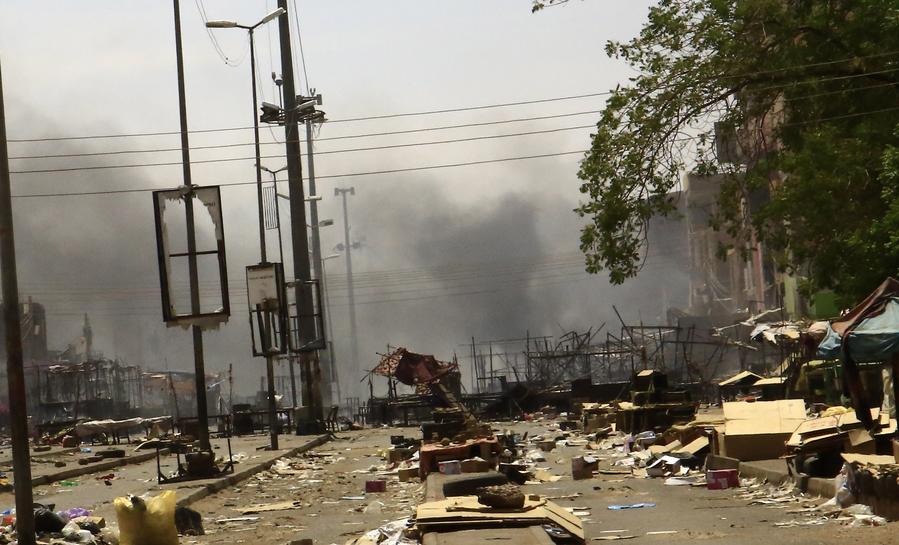 This photo taken on April 18, 2023, shows a street view after armed conflicts in Khartoum, Sudan. Fierce fighting broke out between the Sudanese Armed Forces (SAF) and the paramilitary Rapid Support Forces (RSF) on April 15, 2023. (Photo by Mohamed Khidir/Xinhua)