

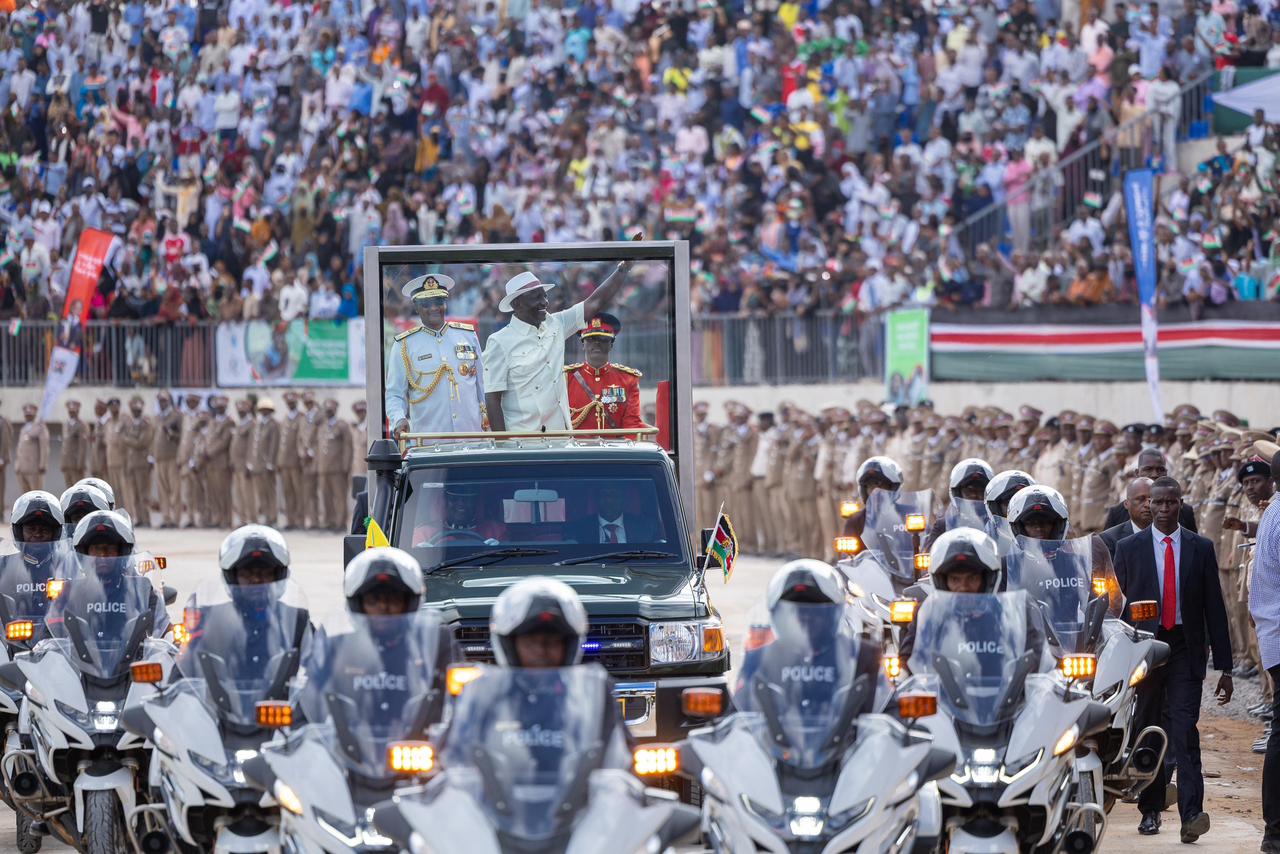
President William Ruto used this year's Madaraka Day
celebrations in Wajir County to underscore his administration's efforts to
reverse decades of historical marginalisation and discrimination against the
people of Northern Kenya.
The president, speaking at Wajir stadium, reaffirmed the government's commitment to inclusive development and equal opportunity for all Kenyans.
The President revealed that the government is implementing projects worth more than Sh38 billion across the region, including housing units, markets, classrooms, police housing, and other critical infrastructure.
Among the flagship initiatives is the 750-kilometre Northern Kenya Gateway Corridor linking Isiolo, Wajir, and Mandera, which he described as the most significant road investment in the region since independence.
"For decades, distance was used to justify exclusion. Today, we are defeating distance," President Ruto stated.
In a speech marked by reflection, apology, and renewed commitment, President Ruto delivered a heartfelt public apology to residents of the North Eastern region for years of exclusion from the country's development agenda.
"On behalf of the people of Kenya, today, as I stand here as President and leader of our great nation, I want to apologise to the people of Northern Kenya for this marginalisation," President Ruto declared to a jubilant crowd at Wajir Stadium.
"It was never meant to be this way. This has been a very emotional moment for me."
The President described the decision to host Madaraka Day celebrations in Wajir as more than a symbolic gesture, saying it represented a national commitment to equality, dignity, and inclusion.
"Madaraka was never meant for some Kenyans and not for others. It belonged, still belongs, and will forever belong equally to every single Kenyan," he said.
Reflecting on Kenya's development history, President Ruto criticised policies that concentrated resources in so-called "high-potential areas" while neglecting regions such as the former Northern Frontier District.
He noted that decades of inadequate infrastructure, limited access to education and healthcare, and systemic discrimination had left many communities feeling excluded from the national development agenda.
As part of efforts to address these injustices, the President highlighted his administration's February 2025 Presidential Declaration that abolished discriminatory vetting procedures for the issuance of national identity cards and birth certificates in Northern Kenya.
"We did not abolish verification of citizenship. We abolished discrimination," he emphasised.
President Ruto also recounted the struggles faced by many residents in obtaining identification documents, citing the story of Ibrahim Osman, a Wajir native who endured years of bureaucratic hurdles despite being Kenyan by birth.
The Head of State outlined a series of transformative investments being implemented across Wajir, Garissa, and Mandera counties under the government's Bottom-Up Economic Transformation Agenda.
The projects include major road construction, affordable housing developments, expanded healthcare coverage, teacher recruitment, school infrastructure, digital connectivity, and youth empowerment programmes.
Education, the central theme of this year's Madaraka Day celebrations, featured prominently in the President's address.
He announced that more than 100,000 teachers have been employed nationally over the past three years, with thousands of local teachers trained and recruited specifically for Northern Kenya.
To further expand access to education, President Ruto directed the Ministry of Education to begin consultations aimed at formally integrating Madrasa, Dugsi, and pastoralist education pathways into Kenya's education framework.
"Every child deserves a door into learning. It is our duty to open every door," he said.