In the old days, you had to get it right first time to avoid wasting film.
by WILLIAM INGANGA
Audio By Vocalize
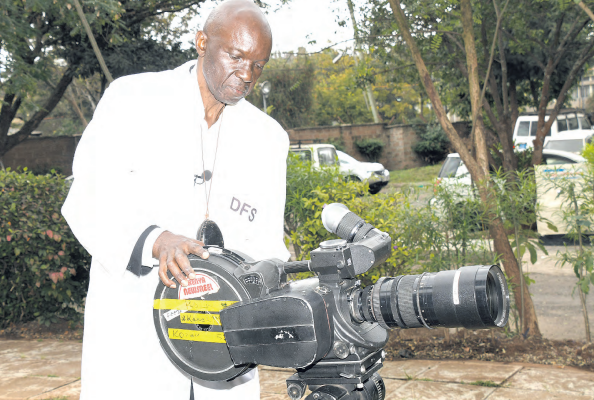
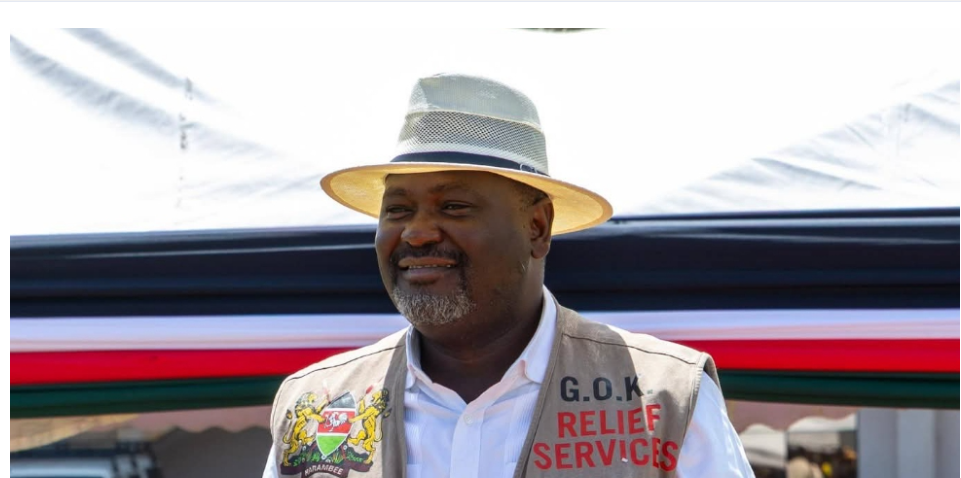
Henry Bwoka ready to ‘shoot’ with his camera /KNA
It’s a presidential function at Uhuru Park in 1982.
The President
is the late Daniel Arap Moi. A
battery of journalists is eager to
document the event. Security agents
are intermingled with the crowd and
journalists.
One cameraman, Henry Bwoka,
unwittingly commits a near-grievous,
verbal error. He urges his soundman
to prepare.
“Let me know when you
are ready so that when the President
begins delivering his speech, I ‘shoot’
him,” he says.
Instantly, a smartly dressed, sharpeared man sternly demands clarification, “Unasema nini wewe (What are
you saying)?”
Bwoka is jolted to his senses.
He
clarifies, “No! I mean filming.”
Around that time, it wasn’t fictitious to imagine two or more young
filming students animatedly chatting
about magazines, loading, cartridges
and worse, as in Bwoka’s case, shooting!
These youngsters would be easy
prey for hawk-eyed officers’ stealth
stalking, aimed at having them
whisked to nearby security installations for ominous interrogation.
At
that time, several clandestine movements, such as Mwakenya, had been
outlawed.
Words had to be carefully
weighed lest they be misconstrued to
imply that one was a renegade who
merited being locked out of sight.
It’s the students’ instructors who
would have come to their rescue by
confirming that those filming terms
had no relation to ballistics.
Many
expressions used by filmmakers took
a while to be assimilated by populations outside the filming realm.
“The shooting ratio for film was
1:1,” Bwoka says. “Each action was
to be shot only once. You either got
it or never. In a filming sense, a cameraman had to be a marksman!”
A lecturer at the Technical University of Kenya, Mbarack Ambe, was a
film producer in the 1980s and 1990s
in the Voice of Kenya (VoK).
“Deletion was unknown,” he says. “These
days, shoot, preview and delete if the
image isn’t satisfactory are the norm.”
Bwoka, a farmer in Bungoma
county, retired as a filmmaker in 2016.
He worked in the Ministry of Information for more than three decades.
He partly does freelance filming.
Although many colleges in Kenya purport to offer courses in film production, arguably speaking, there’s
none.
The original definition of film
renders credence to this thought.
Bwoka understands why.
WHAT FILM IS
Film is a thin flexible strip of material coated with a light-sensitive
emulsion (silver halides) on one side.
The emulsion could be silver bromide,
chloride or a combination of the two
— silver bromochloride.
The other
side has a gelatinous base.
Older generations of filmmakers
refer to film as celluloid, to distinguish it from the later entrant, video.
What’s currently taught in colleges is
either video or television production.
The principal medium of image registration is not film.
Bwoka joined the film industry in
the late 1970s as a trainee at the Kenya Institute of Mass Communication
(KIMC) where there was the Film
Production Training Department.
A German institution, the Friedrich
Ebert Foundation established the facility. Bwoka was among the second
group. That was from 1979-81.
Five classes covered techniques in
production, camera, sound, editing
and the laboratory. Bwoka vividly
recollects his orientation through
all the sections.
These furnished
him with a broad understanding of filming. KIMC used to be fondly described as the only college of its kind
south of the Sahara and north of the
Limpopo.
During Bwoka’s time, each class
had no more than 10 trainees of
different nationalities. In Bwoka’s
camera class, there were two Kenyans and three foreigners from Zambia,
Ethiopia and the Gambia.
Nowadays, the market is flooded
with different brands and models
of present-generation digital video
cameras. The film production training
that Bwoka went through covered the
16 and 35mm film gauges.
Bwoka thinks it’s unfair to compare film with video. He believes,
“Film is superior. The celluloid used
to manufacture raw film stock is special. The picture quality is very high.”
He adds that film cameras require
minor servicing, whereas video ones
have several parts that easily wear out.
Film production was much more
expensive than video. “I think a
35mm camera in the 90s was going
for about Sh50 million,” he says, adding, “Hollywood has stuck to film.”
When film was master, a cameraman was understood to be one who
operated a motion-picture camera.
Still camera operators were photographers.
At present, photography
has been expanded to include both
motion and still camera operations.
The director of photography in a
motion-picture production calls the
shots.
The movie cameras that Bwoka
was trained to operate are the Arriflex 35ST and 35BL, released in 1972.
They were built to last. They are in
the annals of filming history as having dominated scenes for almost 20 years.
The 35BL weighed about 20kg,
including a standard lens. Its tripod,
12kg heavy, was sturdy. Any smaller tripod would draw the analogy
of “an elephant sitting on a pickup
truck”, Bwoka says. “It was important to have a friendly sound operator
to help me carry the tripod.”
FILM FOOTAGE
The cameras’ final version, the
35BL4S, was birthed in 1989. Bwoka’s operations outlived the cessation
of the 35mm camera series’ production.
The most well-known raw film
stock manufacturers were the Eastman Kodak Company of the US, Fuji
of Japan and Agfa Gevaert of Germany. Material from Kodak was the
most dominant.
These films were supplied in 200,
400, 800 or 1,200 feet. It’s from
these feet that film donated the word
footage to video. The raw films were
mostly for black and white negative
and positive, colour reversal, negative
and positive.
“Around [the year] 2000, one roll
of 35mm 400ft was costing about
Sh20,000,” Bwoka says. “Imagine
having gone out with two rolls and
you mess one.”
“Once raw film was exposed to
light, that would be the end of it. It became fogged,” he says. “Unless exposed film was processed, it, too, was
to be treated with utmost caution.”
Since film raw stock was sensitive
to light, it was loaded into a magazine in pitch darkness, either in a
darkroom or a black loading bag. The
bag was also employed to offload an
exposed film and securely place it in
a can.
After loading the magazine, Bwoka mounted it onto the camera and
engaged the transport claws to dip in
and out of the sprocket holes as the
film ran through the camera gate.
The
film wound around a take-up spool.
Picture and sound could either be
recorded separately or jointly, depending on the camera. During the
first three months of training, Bwoka
was in sound.
“We used to record
using the Nagra 4.2, powered by 12
size D batteries,” he says. “The recording was reel-to-reel and was of
very good quality.”
He later narrowed his focus on the
camera. His sound operator took care
of the audio. Sometimes a cable connected the camera to the Nagra for
synchronisation.
A clapperboard was labelled with
the date, take, scene and roll. When
the board was slammed while the
camera rolled, the contact of the two
sides guided the picture, matching
with the sound produced. During
post-production, the picture and
independently recorded sound were
merged.
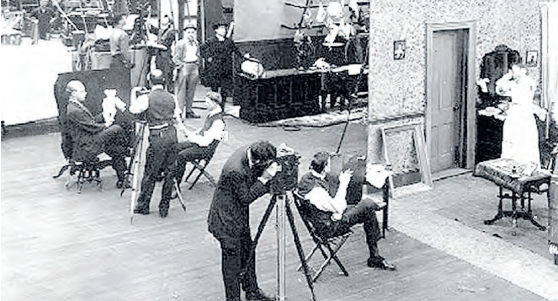
Filmmakers
during a filming
session /FILE
MOTION PERCEPTION
Instead of using a cable to sync the sound with the picture, the alternative was to use synching gadgets that were inserted in the Nagra and the camera.
A retired soundman, Lawrence Musyoka says, “There was the double-system, where the pictures and sound for a scene were recorded separately.” He adds, “A signal was sent to the camera to trigger the recording of synchronous picture and sound.”
This is the method that Bwoka and his colleague used at Uhuru Park, before ‘shooting’ the President. The mode was ideal because of the masses of people crisscrossing around. Automatic settings were non-existent on 35mm film cameras.
Every operation was manual. Before Bwoka took his shots, a handheld exposure metre determined for him the amount of light falling on a subject or scene. Calibration of the light metre was contingent on the sensitivity of the film measured in ASA (American Standards Association).
“We had high-speed material for indoor and low-speed for outdoors. The light metre guided the operator on the correct aperture,” Bwoka says.
A 200 ASA film was less sensitive to light than a 500 ASA. The lens general aperture opening was from 2.4 to 16. Even though Bwoka was shooting ‘motion pictures’, the movement was and still is in video, just a notion. There is no movement.
Shooting with film enabled one to understand this concept best. The camera Bwoka used to operate had the standard option of shooting a filmstrip at 24 frames per second. A frame is a single still picture.
The frame divisions on a film are distinguishable. If there were some actual movements registered with the eye, the 24 frames were a series of 24 still pictures that were each slightly different
from preceding ones.
When all these
frames were projected in one second,
motion perception arose.
“If I recorded 12 frames per second,
that would be fast motion,” Bwoka
says. “If I were to get slow-motion,
then I would calibrate the camera to
50 frames per second.”
For 16mm film, the camera Bwoka used was the Bolex series. “The
16mm is ideal for documentaries because it’s meant for room projection,”
he says.
“The 35mm is for big screen
projection, like in theatres.”
Cinemas such as Kenya, Nairobi, 20th Century, Cameo, Odeon
and Fox Drive-in had silver screens.
Before the main movie’s projection,
Bwoka’s 12-minute documentary
shots were viewed. These shows were
known as the Kenya Newsreel.
Regarding the content of the newsreel, Bwoka says, “I used to travel
outside the country to cover presidential functions for posterity purposes.”
This was especially during President
Moi’s tenure.
FILM PROCESSING
By that time, it was evident that
Bwoka’s shots were harmless to the
President. “The presidential team
would do it for TV news, and my colleague and I on 35mm film,” he says.
Bwoka fondly reminisces about his
visit to Swaziland. “I was the only one
with a 35mm film camera,” he says.
“One white journalist came over to
me, parted my back and said, ‘Gentleman, you are the only one here with a
camera. The rest have toys.’” Bwoka
understood what his admirer meant.
“I just told him, ‘Thank you.’”
Before illuminating the silver
screens, there was a long process of post-production.
After exposure, the
images were latent; they couldn’t be
seen unless processed.
KIMC had one of the three 16mm
film-processing laboratories. The
other two were at the broadcasting
houses in Nairobi and Mombasa.
Ambe, the producer, recollects
one Safari rally shooting.
A racing
car veered off its track and spectacularly ploughed into a mound. His
crew instantly fast-forwarded to a
juicy news item.
“We stopped filming
and alerted the laboratory staff at the
Broadcasting House that we had a
great clip to be processed.”
The laboratory technician, Sylvester Okondo (now deceased), processed the film. “He told us, “I can’t
see anything.”’ Ambe was bewildered.
“I asked, “What?””
When previewing, only a tiny spec
of light flashed. The shot was a miss.
“Nobody went to the newsroom to
tell those guys that there was no
picture,” Ambe says. “We just quietly went home.”
Disappointment
masked their faces.
Kenya never had a 35mm laboratory. The material that Bwoka shot
and the corresponding soundtracks
were initially processed in Austria
and later in Great Britain.
“In 1985,
my colleague (now deceased) and I
visited the Austria lab. Editing, laying
of the sound and commentary took
place there,” Bwoka says.
“The two-week trip was fascinating.”
In 2000, the running of Kenya
Newsreel ceased because of the high
costs involved. The creeping in of
cheaper tape-based camcorders further compounded the problem. Video would be edited in Kenya. A sign
portending a death knell for film was
on the horizon.
“I was still glued to
film,” Bwoka says. “I had no choice
but to join the video group.”
In Africa, the last countries to
operate on film were Kenya, South
Africa and Zambia. Though film has
been shot dead by video in Kenya,
the medium remains firmly etched
in Bwoka’s memory.
This is premium content
Subscribe to Continue Reading
Help us continue bringing you unbiased news, in-depth investigations, and diverse perspectives. Your subscription keeps our mission alive and empowers us to provide high-quality, trustworthy journalism. Join us today to make a difference!