

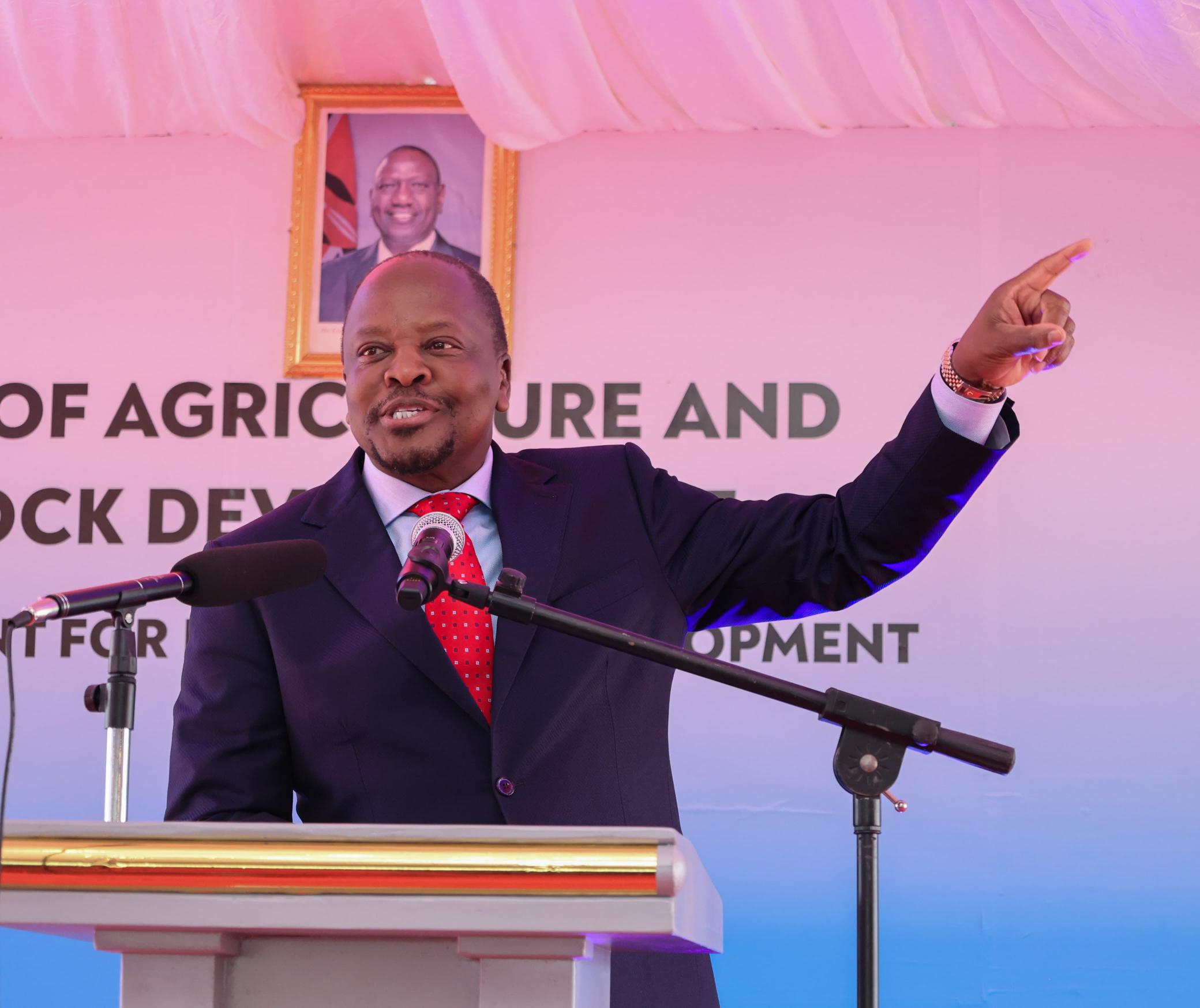
 Livestock Development Cabinet Secretary Mutahi Kagwe talks to dairy farmers during the release of 25
solar-powered milk coolers to farmers /HANDOUT
Livestock Development Cabinet Secretary Mutahi Kagwe talks to dairy farmers during the release of 25
solar-powered milk coolers to farmers /HANDOUTRising costs of animal feed, electricity and farm inputs are threatening the profitability and sustainability of dairy farming across the country.
The Kenya Dairy Board said the cost of producing a litre of milk currently ranges between Sh30 and Sh37, depending on the farming system and scale of production.
Farmers say the rising cost of feeds remains the biggest challenge, especially for those practising zero-grazing dairy farming, where animals rely entirely on purchased feed.
“Feeds are extremely expensive and yet milk prices are not increasing at the same rate,” a dairy farmer from Kiambu county.
“Sometimes you barely break even after paying for feeds, labour, water and veterinary services. If a farmer is lucky, they can make a profit of between Sh10 and Sh14 per litre.”
The farmer said the situation has forced some small-scale farmers to reduce the number of cows they keep, while others are abandoning dairy farming altogether.
Data from KDB shows that Kenya remains one of Africa’s leading dairy producers, ranking second after Egypt in milk production.
The quantity of recorded marketed milk increased by 11.5 per cent to 1.013 billion litres in 2025, while processed milk and cream rose by 13.4 per cent to 704.4 million litres.
Despite the increase in production following the long rains, farmers say the gains are being eroded by the soaring cost of production.
Speaking during the release of 25 solar-powered milk coolers to farmers, Livestock Development Cabinet Secretary Mutahi Kagwe acknowledged the burden facing dairy farmers and said the government was implementing measures to lower production costs.
“We are intent on reducing the cost of production for our livestock farmers,” Kagwe said.
“That is why, under our land commercialisation initiative, we are inviting investors and farmers who can undertake large-scale farming of yellow maize and soya so that the cost of animal feeds can come down.”
The CS added that the government is leasing public land for feed production in a bid to reduce dependence on costly commercial feeds, which account for the largest share of dairy farming expenses.
The government is also investing in solar-powered milk coolers to help farmers reduce post-harvest losses and lower electricity costs associated with milk preservation.
“That is why you hear us bringing solar-driven coolers, so that farmers do not have to pay too much for power,” Kagwe said.
The government first launched milk coolers distribution programme in 2017 to address challenges facing the dairy sector.
Joshua Chepchieng, Secretary Administration, State Department for Livestock, said that between 2017 and 2023 the government procured and installed 350 milk coolers worth Sh2.3 billion in 38 counties.
“Since 2023, the government has planned to procure 230 additional coolers for 41 counties. So far, 95 have already been installed and today we have released another 25 coolers to farmers,” Chepchieng said.
He added that the remaining coolers are at different stages of procurement and are expected to be delivered before the end of the current financial year.
Farmers welcomed the intervention, saying the coolers had come at the right time when milk production had increased due to favourable weather conditions and improved pasture.
However, they urged the government to also guarantee fair and stable milk prices to ensure dairy farming remains viable.
Kagwe said the government is also working with the National Treasury to allow duty-free importation of milk powder processing equipment to support value addition and stabilise milk prices during periods of surplus production.
The CS said
expanding milk powder processing capacity would help Kenya access export
markets such as Algeria and reduce losses associated with milk gluts.
“Milk powder is what many African countries want to import from Kenya. When we expand our processing capacity, it means there will always be demand for milk and farmers will be protected from price drops.”
At the same time, Kagwe warned against milk hawking, saying unregulated milk trade poses health risks and undermines value addition in the dairy industry.
“Hawking is
dangerous because we cannot guarantee the safety of unprocessed milk.
Processing allows us to ensure consumers are getting safe and quality milk,” he
said.