

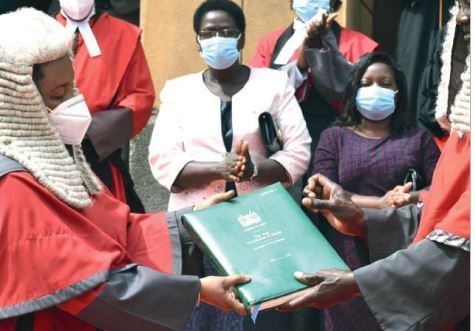
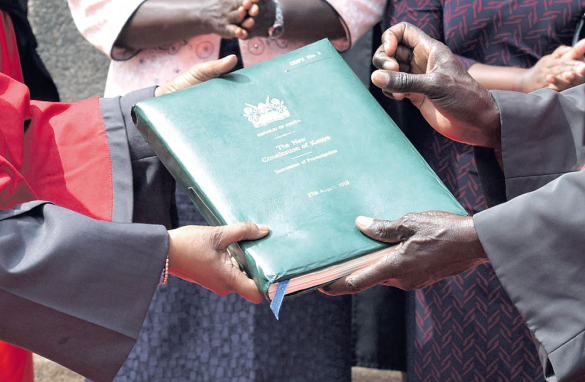
“Values and principles” sounds like some well-meaning, but woolly, concept that would not have much impact in practice, when faced with the realities of power. That was definitely not the intention of the people who made the Constitution of Kenya.
Constitution’s structure
It is likely that many readers focus on one or two Articles of the Constitution at a time, or perhaps a Chapter (such as Chapter 6 on Leadership and Integrity). But there is something to be learnt from the whole structure of a constitution. This piece is published on Jamhuri Day (December 12) ¾ marking the day when, in 1964, one year after Independence, Kenya became a republic.
In 1969, a new Constitution was adopted. After the declaration of a Republic and the Constitution, it moved immediately to the President, the Cabinet and their powers, followed by Parliament, then the courts. Only then came the chapter on human rights, followed by citizenship, revealing the priorities of the government of the time.
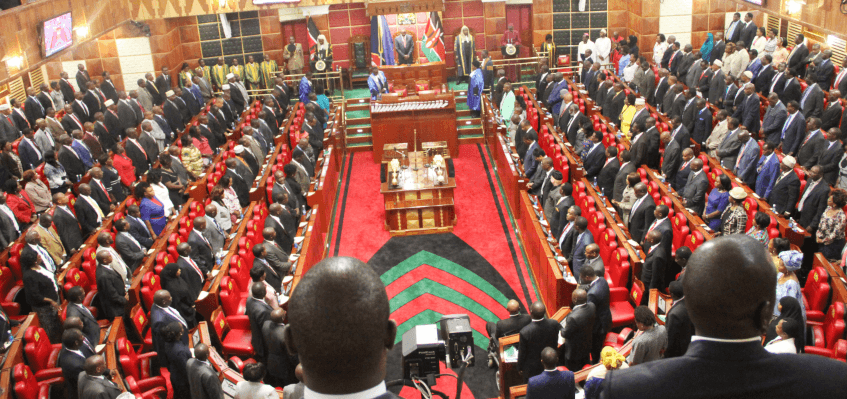
The current, 2010 Constitution has a preamble, talking of the past, and a vision of the future. There follow a short chapter on the sovereignty of the people and the Constitution, then one on the republic (including the values), then citizenship, then human rights. Chapters on land and environment, and leadership and integrity, come before “representation of the people”. Only then does it go to the structures of power, beginning with Parliament not the Executive.
The values and principles appear briefly in the Preamble (which has limited legal effect) but are very much part of the operational provisions.
At the Bomas constitutional conference, CKRC (Constitution of Kenya Review Commission) member Kavetsa Adagala said about the values provisions, “We are deciding what Kenya would be and what direction it would take.” And commissioner Isaac Lenaola (now a Supreme Court justice) referred to the provision about the President reporting annually to Parliament and nation on the national values and principles in the context of mechanisms to enforce the Constitution.
The values are to be taken seriously, and are not just flowery additions.
What are values?
An individual’s values guide their decisions in life. One author says, “People’s values form an ordered system of priorities that characterise them as individuals.”
They are not necessarily positive. What should we make of the many people who profess religious commitments (which would undoubtedly include not lying or stealing) ¾ but are involved in the massive theft of public resources? Clearly their dominant value is greed and self-benefit.
The national values are derived from what Kenyans told the constitution-making bodies about the government and society they hoped for. Article 10 says that they “bind” everyone or body applying the Constitution, making or applying law, or making or implementing government policy decisions.
Several relate to how government machinery works, like devolution, rule of law, participation. Some relate to government accountability like integrity, transparency and that popular phrase “good governance”. Some to the rights of and respect for all people, including human rights, equity and equality, inclusiveness.
“Sustainable development” suggests that there must be “development” but without mortgaging the future for the benefit of the present, nor benefiting only some now, to the detriment of others.
How are the values supported?
The “values” concept has generated a quite remarkable amount of bureaucratic machinery and activity.
The Directorate of Social Cohesion and Value has existed since 2008. (Its website is a good source for Values and Principles documents). It runs training programmes on the values, and it puts together documentation for the President’s annual report. There is a network of values committees and focal persons in government bodies.
In 2013 a policy paper allocated responsibilities to various government agencies for the achievement of values.
The Public Service Commission was behind the Public Service (Values and Principles) Act of 2015, which focuses on Article 232 ¾ values for the public service. And the Commission complies with Article 234 of the Constitution, producing an annual report “on the extent to which the values and principles mentioned in Articles 10 and 232 are complied with in the public service”. This comes with hundreds of pages of detail.
In the past, the Kenya Institute for Public Policy Research and Analysis has prepared material for the President’s report.
Then there are reports from the human rights commissions and civil education material from bodies, including KIPPRA (autonomous Kenya Institute for Public Policy Research and Analysis) and Uraia, a premier National Civic Education Organisation in Kenya.
The President’s report
This was supposed to be an address to the people (not Parliament) on Article 10, and to be supplemented by a written report (Article 132(1)(c)). Presidents have done only the latter.
It is a very bureaucratic exercise, with the Directorate of Social Cohesion and Values writing to all departments and government agencies ¾ this year, 442 of them ranging from State House to the Mandera Technical Training Institute. They have to follow a template giving information about how they have followed certain government policies, and also one on their response to the national values.
The Directorate gave them scores. A majority scored 100 per cent. The rest were marked down for not having supplied information, or supplying irrelevant or inadequate information, but it is not clear what they had not done.
The President’s Report
This has grown from 98 pages in 2013 to 600+ or 700+ recently. Perhaps the President feels it is impossible to produce an address to the people of Kenya that makes sense of this mass of material.
Everything is there. Patriotism and national unity were advanced by the President flagging off our football team to Afcon. Devolution was advanced by the Government Pres, printing 500 copies of the County Supplementary Appropriations Act.
“To promote equality, the Betting Control and Licensing Board carried out 117 inspections across the country involving inspection of principal gaming premises for new licence applicants, new betting shops and relocation to new premises.”
To advance human rights, the Kenya Prisons Service provided 40,000 inmates with uniforms.
“The Kenya National Highways Authority (KeNHA) promoted human dignity by designing 12 bridges and footbridges.”
It seems that everything public bodies do can be linked to some national value.
Apparently, this bureaucratic process is carried out every year in the same way, generating a huge amount of anecdotal information, but it is hard to use this to analyse progress.
What can be done?
A radical change is needed. Maybe each year a particular national value could be reported on. And the work of a limited number of government agencies. And an effort should be made to assess how far agencies have actually improved in terms of national values.
A set of indicators could be devised to measure achievements in achieving values, and changes from year to year. Is the country becoming more equal? Is devolution becoming more effective? Is development sustainable? Are Kenyan prisons getting more humane?
Ideally it should be possible to show how public bodies design their decision making to factor in the national values.
This whole exercise was designed to be, not a trumpet blowing exercise, but an accountability one. But it is now set up to publicise (if anyone reads it) what has been decided or has been done, but not what the impact is. Internal government inspectorates should report on progress, or the reverse. Maybe external evaluations should be invited - such as from the human rights commissions.
Oxfam is telling us, “The richest 125 Kenyans hold more wealth than 77 per cent of the population, equivalent to 42.6 million people and on average a CEO in the 10 largest companies earns 214 times more than a teacher.” (To take just one value, equality). This whole expensive recital of actions taken or supposed to be taken, seems remote from the realities of the country.
The values support a vision of Kenya and help provide a way to achieve it -more relevant than presidential dreams of Singapore.