

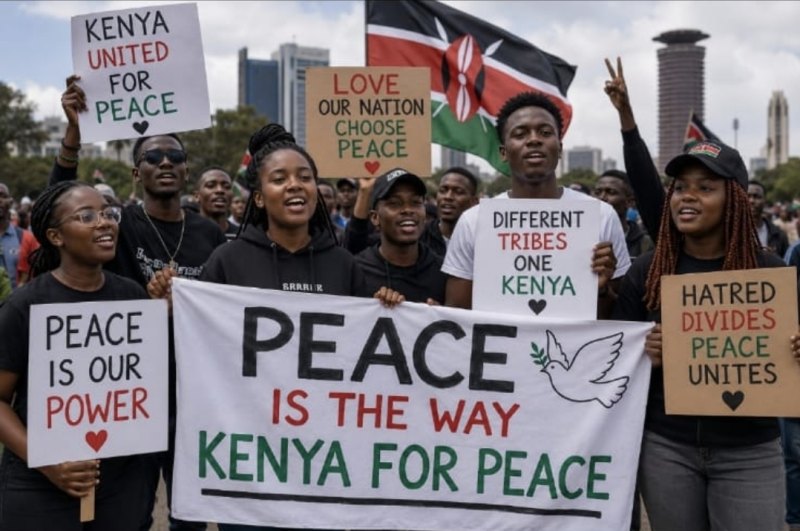
 AI ILLUSTRATION
Since 2024, June 25 has gradually taken on a heavy meaning in Kenya’s public memory. What began as a moment of civic expression and collective remembrance has, in several instances, become associated with tension, confrontation, destruction and the painful loss of young lives. As the country once again approaches another June 25, we are compelled to return to a question that is no longer rhetorical, but deeply urgent: Is it worth it? Ni worth kweli?
Every year, thousands of young Kenyans take to the streets. They are not strangers to the realities they are protesting. They are directly affected by governance decisions, economic pressures, unemployment, the rising cost of living and questions about accountability. Their participation is not accidental or careless; it is driven by lived experience and a strong belief that their voices must be heard. In a constitutional democracy, this right to assemble and express dissatisfaction is not only protected, but essential.
However, experience has also shown that when demonstrations escalate beyond their intended purpose, mambo huharibika. What begins as peaceful expression can quickly spiral into confrontation, chaos and destruction. At that point, the meaning of the protest is often overshadowed by the consequences that follow. The country, as a whole, pays a heavy price.
The most devastating cost is the loss of life. Each life lost represents more than a statistic. It is a young person with aspirations, responsibilities and a future that will never be realised. Behind every incident is a family suddenly thrust into grief. A mother waits for a child who will never return home. A father is left grappling with unanswered questions. Friends are left in shock, repeatedly asking, “Ilikuwa lazima ifike hapo?”
These are not just emotional reactions; they are the human reality of public unrest turning tragic. Even when individuals survive such incidents, many are left with injuries that permanently alter their lives. Hospitals become silent witnesses to pain that does not make headlines. Long after the crowds disperse and news coverage fades, families continue to live with trauma that does not heal easily.
Beyond the human toll, there is a significant economic impact that affects communities far beyond the protest sites. When streets shut down, businesses close. When tensions rise, normal activity grinds to a halt. The consequences are felt immediately and most sharply by ordinary Kenyans who depend on daily earnings.
The small trader in Gikomba who stocked goods expecting a busy day, the mama mboga in Kayole relying on daily sales to feed her children, the boda boda rider in Kisumu whose income depends on movement, and the kiosk owner in Mombasa all experience the same disruption. For many households, kukosa kazi ya siku moja si mchezo; ni chakula cha familia kimeenda. It is not simply about lost income; it is about disrupted survival.
Public infrastructure also bears the burden. Roads, street lights, public offices and other facilities are sometimes damaged in the course of unrest. These are not abstract assets; they are funded by taxpayers. When they are destroyed, they are rebuilt using public money that could have been directed elsewhere—towards schools, healthcare or development projects. Ultimately, it is ordinary citizens who shoulder the cost of repairs.
Yet, acknowledging these realities does not mean dismissing the grievances that drive young people to the streets. That would be both unfair and untrue. The concerns raised—about jobs, governance, accountability and the future—are legitimate. In fact, they are central to the health of any democracy. Silence is not an option, and apathy is not a solution.
The challenge, therefore, is not whether young people should speak out. The real question is how their voices can be heard in a way that does not result in irreversible loss. Je, tunaweza kusema tumeshinda ikiwa mwisho wa siku vijana wetu wanarudi nyumbani wakiwa majeruhi au hawarudi kabisa? That question sits at the heart of the national conversation.
A society must constantly evaluate whether its methods of expression are producing the outcomes it desires. If the objective is accountability, reform and change, then the means used must not destroy the very people expected to inherit that future. There is a thin line between powerful civic action and destructive escalation, and that line must be carefully protected.
As Kenya reflects on the meaning of June 25 and the events that have followed since 2024, there is a need for honest introspection across all sides. Protesters, leaders, security agencies and institutions all carry responsibility in shaping outcomes. When tensions rise, communication gaps widen and mistrust deepens, the risk of escalation becomes even greater. Preventing that outcome requires restraint, dialogue and a shared commitment to protecting life above all else.
It is also important to recognise that history rarely remembers only the intention of a protest. It remembers the outcome. It remembers whether change was achieved or whether communities were left grieving and rebuilding in the aftermath. That is why the question Ni worth kweli? cannot be ignored or reduced to a passing slogan. It demands reflection.
At the core of this reflection is a simple but powerful truth: the value of human life is not negotiable. No political cause, no matter how justified, can recover a life once it is lost. No demand, however urgent, can replace the presence of a son, daughter, brother or sister.
In the end, perhaps the most difficult but necessary reminder is this: Maandamano yanaweza kuisha, siasa zinaweza kubadilika, lakini maisha yakipotea hayarudi.