

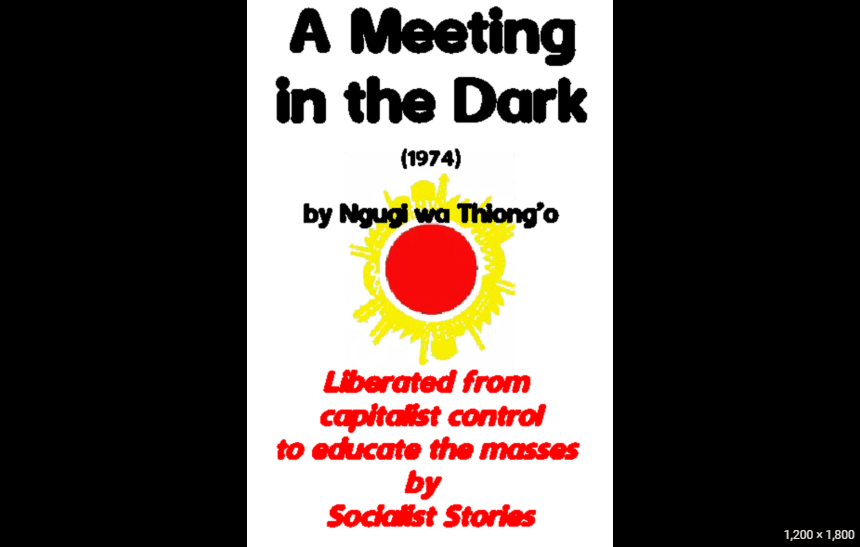
Ngũgĩ wa Thiong’o’s 1974 book A meeting in the dark is a stirring debut that punches its emotional truth straight into the heart; a tale of hope, betrayal and the brutal fractures colonialism leaves on land, families and dreams. It is not just a coming-of-age story, it is a reckoning.
Set in Kenya during the turbulence of the 1950s, the novel follows a young boy, Njoroge, as his world begins in hopeful light and steadily drifts closer to shadow. His dream is simple yet radical for his time: to go to school, to learn, to rise. But his family’s past is buried in ancestral land that was taken away, in gods and spirits and prophecy, in a father, Ngotho, who toils on British-owned soil, waiting, watching, hoping.
His eldest brother Boro grows impatient, angry, disillusioned with waiting for deliverance while violence brews around them. Meanwhile, Njoroge is friends with Mwihaki, the daughter of Chief Jacobo, a rare bridge across the chasm between coloniser-collaborator and the colonised. This adds tenderness to the tension, a quiet ache in the storm.
Education becomes both a lamb to the slaughter and a torch in the darkness. Family loyalty, love and duty pull each character in different directions, some to uplift, others to revolt. The Mau Mau uprising looms like an approaching storm, and the novel forces readers to confront how ideals fare when the ground trembles with injustice, vengeance and loss.
The author’s prose is deceptively clear, almost spare in places, but beneath that simplicity runs a river of complexity and symbolism. He uses the form of a coming-of-age story not just to chart Njoroge’s personal growth but also to explore the collective inner world of a colonised people: torn between tradition and modernity, loyalty and betrayal, the land once rooted, now lost.
His use of language — plain in structure, rich in metaphor — means moments of lyricism hit with surprising force. The land is not a setting but a heartbeat, a living entity that remembers. The journey through education is not simply schoolwork, but a portal toward dignity or disappointment.
His tone shifts tenderly between hope and fury, sorrow and grace. He does not shy away from the brutality of colonialism or from the betrayals within his own people. Yet he still carries a fragile seed of hope, imagining a brighter day that might, someday, break through the dark.
Two passages capture this push and pull between despair and endurance. The first is when Ngotho tells his son:
“Education is everything,” Ngotho said. Yet he doubted this because he knew deep inside his heart that land was everything.
In that line lives the central conflict, the pull between education as progress and land as identity. It is both literal and symbolic, a father’s wish tangled with his pain.
The second moment comes from Njoroge’s own heart: “Surely this darkness and terror will not go on forever. Surely there will be a sunny day, a warm, sweet day after all this tribulation.”
Here, the author allows hope to flicker against the backdrop of despair. Njoroge’s words hold the trembling optimism of youth, but also the universal longing for light after suffering. They resonate because they ask what every reader wonders: how long can we wait for the dawn?
What moves most in A meeting in the dark is its ability to embody the personal within the political. You feel every tear, every betrayal, every deferred dream. The author draws his characters with such intimacy that none of them stand as mere symbols, they are human, haunted, moral, afraid.
He refuses false resolution; instead, he ends the story in a way that leaves readers hollow yet reverent. The duality of education as both salvation and illusion is handled with quiet brilliance.
Yet the novel is not flawless. Its pacing wavers during the eruption of political violence. After such an immersive, slow-burning first half, the sudden crescendo can feel abrupt, the characters’ responses slightly rushed. Because we have been drawn so deeply into their fragile hopes, the descent into chaos hits with shocking speed, and one wishes the author had lingered longer in that devastation to let it truly bleed.
Still, A meeting in the dark remains unforgettable. It is not merely historical fiction, it is a mirror held up to colonial Kenya, a study of faith tested by despair, and a meditation on the fragile price of freedom.
The author’s style, clean yet profoundly symbolic, makes it both accessible and emotionally searing. It never pretends that darkness will not come, but it refuses to believe that the dawn will not follow. The story ends, but its ache, its beauty and its defiant light stay with you long after the final page.