

Before streaming platforms, before viral TikTok sounds, before millions of YouTube views, Kenyan hip-hop was built in small studios, dusty streets, and raw talent. It was born from struggle, identity and the hunger to be heard.
What started as an underground culture in the early 1990s has now grown into one of Africa’s most powerful urban music movements. Different eras came with different sounds, but the mission remained the same: telling the Kenyan story through beats and bars.
In the early 1990s, Kenyan hip-hop slowly found its voice through pioneers like K-South, led by Bamboo Maiko and Abbas Kubaff. Their hit song ‘Tabia Mbaya’ became one of the first tracks to push rap into the Kenyan mainstream.
At a time when recording studios were few and music quality was still developing, Kenyan rap was often dismissed as “too urban” and “not marketable”. Despite the criticism, these artistes laid the foundation for a culture that would later dominate the continent.
At the same time, groups like Kalamashaka transformed the streets with hardcore Sheng rap. Their legendary anthem ‘Fanya Mambo’ became more than just a song; it became the voice of Kenyan youth. The trio, also famous for ‘Tafsiri Hii’, introduced raw storytelling, street slang and fearless lyricism, proving that Kenyan rap could carry its own identity without copying the West.
Various groups carried the baton from Kalamashaka, with Mashifta capturing the imagination with ‘System ya Majambazi’ and Ukoo Flani Mau Mau dropping hard-hitting rhymes in ‘Punchlines Kibao’.
Female artists also showed their strength in the industry. Nazizi was the ‘First Lady’ of Kenyan reggae and urban music because of her unique style mixing rap with dancehall. She announced herself with ‘Nataka kuwa famous’, and went on to thrill the industry with songs such as ‘Furahia’ and ‘Give it to me’.
By the early 2000s, Kenyan hip-hop had begun entering the mainstream. E-Sir emerged as one of the most influential artistes of this era. His smooth lyrical flow, unique delivery and modern sound reshaped urban music in Kenya and inspired an entire generation of rappers and singers. His hits included ‘Kamata’ and ‘Moss Moss’, songs that still play in clubs up to date.
As Kenya underwent political transformation, rap duo Gidi Gidi Maji Maji, who stood out for rapping in mother tongue, released ‘Unbwogable’, which became a political anthem for the opposition, before collaborating with Wicky Mosh on ‘Atoti’. Other notable groups to emerge in the 2000s included Kleptomaniax (famous for ‘Tuendelee’), Necessary Noize (‘Kenyan Boy, Kenyan Girl’), Longombaz (‘Dondosa’), Deux Vultures (‘Mona Lisa’) and the all-girl group ‘Tattu’ (‘Teso’).
While they released club bangers, the likes of Mwafreeka kept underground hip-hop alive, releasing ‘Itakuaje’ that spoke to the perennial headache of youth unemployment in Kenya.
Even with the rise in popularity of Kenyan
hip-hop, the industry faced major challenges. Piracy was everywhere, CDs and
cassettes were copied and sold cheaply on the streets, and studio sessions remained
too expensive for many upcoming artists.
During the same era, Nameless helped commercialise urban music through the rise of the Kapuka sound, blending rap and catchy melodies into radio-friendly hits, including his massive collabo with E-Sir, ‘Boomba Train’. On the other hand, Prezzo introduced a flashy and entertaining style to Kenyan hip-hop. Songs like ‘Naleta Action’ turned him into one of the country’s biggest stars and proved that rap could dominate commercially.
Then came Jua Cali, one of the most important figures in Kenyan urban music history. Through Genge music and Sheng lyricism, he connected directly with the streets. Songs like ‘Kwaheri’ and ‘Shughuli’ featuring Nameless became national anthems. His music represented everyday Kenyan life, and for many young fans, including an entire generation growing up in the 2000s, Jua Cali was more than an artiste, he was the soundtrack of the youth.
Nonini followed closely in his tracks, flipping the script from social issues to seductive rap with ‘Wee Kamu’. He influenced the emergence of P-Unit, whose breakthrough hit ‘You Guy (Dat Dendai)’ brought video vixen Vera Sidika to the limelight.
Meanwhile, other female rappers emerged in the industry. STL (Stella Mwangi) made her presence felt with ‘Take it slow’ and ‘Biashara’. Lady S also represented the ladies with hit songs such as ‘Niaje’ and ‘Hold up’.
DIVERSIFICATION
The 2010s era introduced a completely different wave. Kenyan hip-hop became more diverse, expanding into politically conscious rap, trap, drill and Gengetone.
Juliani released a protest classic for the ages in ‘Utawala’, which resonates with Kenyans to this day. The former Ukoo Flani member pushed activist music to the mainstream, inspiring other artistes to release politically conscious songs.
Khaligraph Jones, popularly known as the OG, also became a star in this era. With aggressive delivery, international-level production and lyrical dominance, he pushed Kenyan rap onto the continental stage. Songs like ‘Mazishi’ announced his arrival, while ‘Yego’ became a massive African hit that earned him international recognition. For many upcoming rappers, Khaligraph represented confidence, ambition and proof that Kenyan hip-hop could compete globally.
At the same time, Nyashinski (ex-Kleptomaniax) redefined versatility in the industry. He balanced rap and melody effortlessly, delivering timeless songs like ‘Malaika’, ‘Aminia’ and ‘Marathon Runner’. His music carried emotional depth, motivation and maturity, making him loved across different generations. Tracks like Marathon Runner especially stood out as a message of patience, consistency and long-term vision.
King Kaka is another artiste who staked a claim to the crown of hip. He was known for deep storytelling, poetic lyrics and music that reflects real social issues in Kenya. He made a legacy with hit songs such as ‘Wajinga Nyinyi’, ‘Niko na reason’ and ‘The takeover’. He's seen as one of the voices that made Kenyan hip-hop more meaningful and socially aware up to date.
As the industry entered the modern Gen Z era after 2016, the sound evolved again. This generation was powered less by radio stations and more by YouTube, social media and street influence. The rise of underground authenticity gave birth to artistes like Virusi Mbaya, whose music focused on survival, pain and the reality of street life. Songs like ‘Hood Mentality’ and ‘Sixteen’ helped him rise from underground.
More female rappers stood up to the counted. Femi One was among them, releasing songs like ‘Utawezana’ and ‘Brikicho’ that pushed her to the top of the industry. Ssaru was also another female rapper who earned recognition at the time. She made hit songs such as ‘Kaskie vibaya’, ‘Nyama’ and ‘Nimerudi tena’, making her part of the new generation carrying Kenyan street rap culture forward.
Maandy was another female rapper who rocked the industry, making her voice heard with hits such as ‘Shash na lipgloss’ and ‘Sirudi home’ making her among the top female rappers in the industry.
Another major name shaping the modern movement is Toxic Lyrikali. Known for his rapid flow, deep Sheng storytelling, and heavy wordplay, Toxic represents the raw hunger of underground Kenyan rap. Songs like ‘Chinje’, ‘Hood’, ‘Long Story’ and lately song ‘Hate’ became anthems for many Gen Z listeners who relate to his authenticity and street-driven message.
No conversation about modern Kenyan rap is complete without mentioning Wakadinali. The drill and rap collective changed the sound of urban music with their unique personalities, sharp lyricism and street-inspired energy. Tracks like ‘Geri Inengi’ and ‘Sikutambui’ turned them into one of the biggest rap groups in Kenya, still maintaining the same pace in the industry up to now. Their recent hit ‘Last Dance’, crossing millions of views within a month, proves their continued dominance and the growing global appeal of Kenyan drill music.
ROOM FOR IMPROVEMENT
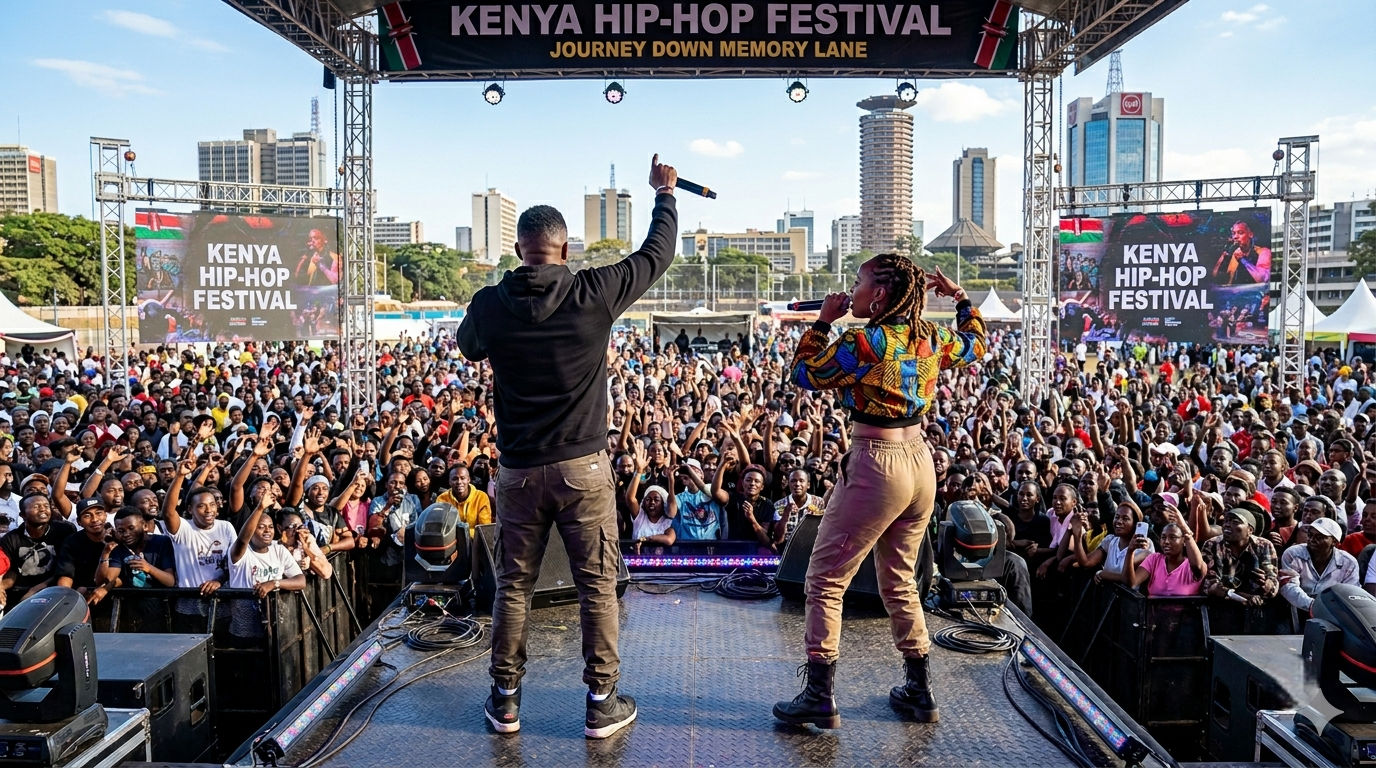
Today, Kenyan hip-hop stands stronger than ever before.
From cassette tapes and pirate CDs to streaming platforms and sold-out shows,
the journey has been long and powerful. Different eras brought different
sounds, but each generation carried the dream forward. Kenyan rap is no longer
fighting to be recognised, it is demanding its place on the world stage.
More than entertainment, Kenyan hip-hop is a story of survival, identity, ambition and expression. Every beat carries the struggles of the streets. Every lyric reflects a generation trying to be heard. From K-South and Kalamashaka to Khaligraph Jones and Wakadinali, the culture continues to evolve, while honouring the voices that built it.
The sound may change, but the message remains
the same: Kenyan hip-hop is not just growing; it is building a legacy.
On the other hand, there is a big question that arises when it comes to our music industry. In a country full of talent, why do foreign artistes often get more stage time and higher pay than local artistes?
Kenya has no shortage of talent. From hip-hop to genge, Afrobeat to reggae, our artistes are carrying culture, language and real stories of the streets. But sometimes, when big shows come, foreign artistes are given more spotlight, bigger stages and higher pay than the very artistes who live and breathe this culture every day.
It raises another question: Are we investing in our own sound enough? Local artistes build the foundation of our music industry. They struggle with production costs, promotion and recognition. Yet when international acts come, they are celebrated, sometimes at the expense of homegrown talent. This is not about competition but balance. The industry can grow when both local and foreign artistes are given fair platforms. Supporting local talent doesn’t mean rejecting global music; it means building confidence in our own voices. Because before the world recognises our sound, we must first fully recognise it ourselves on our stages, in our studios and in our own country.