

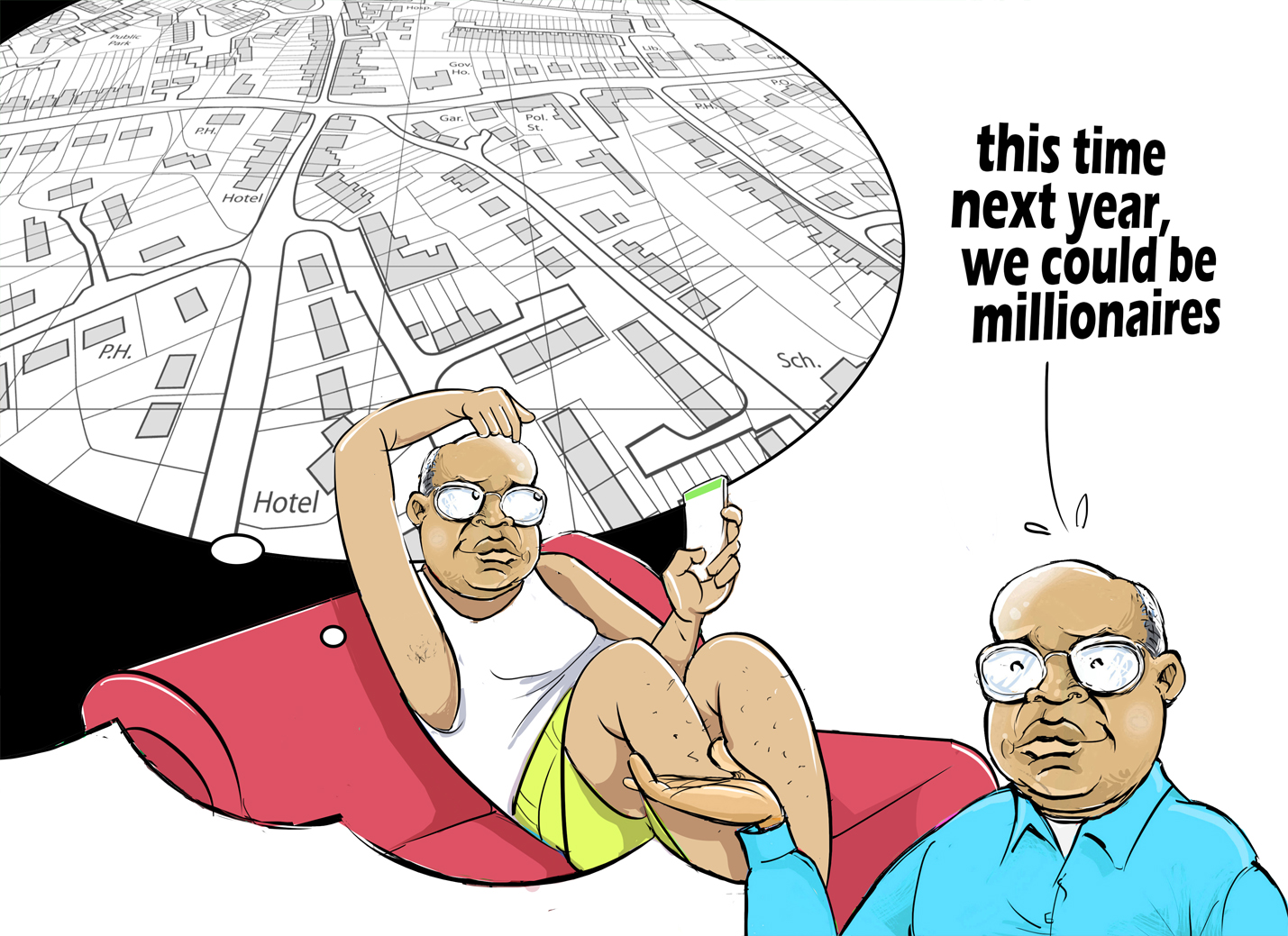
Even as I break out in a cold sweat every time my rent is due, I have recently been fantasising about buying an actual town.
This latest daydream of mine has its roots in a recent news item announcing that the entire town of Middelpos in the Northern Cape, South Africa, is up for auction on May 22.
It may sound crazy, but it is true. The 103,260ha (255,161 acres) property is being marketed by a South African real estate firm as “an authentic, historic Karoo village offering development potential in tourism, residential and commercial sectors”.
For those unfamiliar with South Africa, the Karoo is a vast semi-desert natural region known for its arid, sparse landscape, which stretches across large parts of the Western, Eastern, Northern and Free State provinces. It is characterised by sparse population, sheep farming and clear skies, making it a major location for stargazing and astronomy.
Some market commentators suggest that, given its development potential as a tourism hub near the Tankwa Karoo National Park, the final price for Middelpos could range from R12-14 million (Sh94-109 million), depending on market interest.
Somehow, I doubt that even my recently increased Fuliza can stretch to that amount, and so on that front, I suppose I face a technical knockout.
Nevertheless, curious about how such a sale by auction was even possible, I did a little research and found that in South Africa, a ‘town for sale’ typically refers to the disposal of a large, privately owned property, often a historic village or a ‘company town’, that was originally established by a single entity like a mining company, a farming estate or a private developer.
In Kenya, these sorts of towns would include developments set up by multinational tea companies, which historically created company-town-like structures in Kericho. These areas were designed with housing, social amenities and sports grounds for workers.
In the Sugar Belt, towns like Mumias, Muhoroni, Miwani and Chemelil were anchored by their respective sugar companies, which, at their peak, supported nearly all local economic activity.
In South Africa, a town like Middelpos comes onto the market when a private landowner, whether a person or a legal entity such as a company, association or government body, decides to sell the entire property. This sale includes not just the land, but also all the infrastructure on it, such as houses, shops and streets.
As to the legal standing of a town such as Middelpos, South African law holds that, while a town may be privately owned, it must still operate within South Africa's constitutional and regulatory framework across the three spheres of government (municipal, provincial and national).
When a privately owned town like Middelpos changes hands, residents are protected by several South African laws that prevent immediate displacement or arbitrary changes to their living conditions.
The sale of the land does not automatically clear the people living on it. The same situation may exist in Kenya, but between you and me, dear reader, we know just how rapacious people who acquire land are and how quick they are to evict long-term residents who overnight become ‘squatters’.
Various South African news outlets have clarified that a ‘town for sale’ only occurs when the entire town sits on a single large farm title or a single corporate-owned property, and when the infrastructure (streets, power lines) was built and maintained privately rather than by a municipality.
As I face the reality that buying a town is not to be my portion, for the time being at least, I am happy to propose a get-rich-quick scheme — sorry, I mean a deal to any potential Kenyan buyers of Middelpos. The deal would be that, with my long-standing knowledge of South Africa, its people, culture and traditions, they could hire me on a commission basis as a sort of middleman or broker. This could be the beginning of a very profitable relationship, at least for me.
As I wait, I will continue to pray over my Fuliza balance and hope that one of the clerical errors that have been known to occur at the Treasury and elsewhere favours me at Safaricom.
In the iconic phrase of TV's perpetual get-rich-quick schemer, Derek ‘Del Boy’ Trotter, “This time next year, we could be millionaires.”