G-SPOT: The curious case of the phantom M-Pesa deposit
It paid off my Fuliza before I could figure out if it was a scam
25d agoMwangi GithahuLifestyle
WhatsApp would have been a revolutionary tool in colonial times


Audio By Vocalize
There was a recent post on social media that featured a February 1936 letter from the British Passport Control Department of the Foreign Office.
The letter, posted by researcher and journalist Odhiambo Opiyo, was about emigration to Kenya by British citizens who wanted to leave the cold, rain-soaked British Isles for the warm equatorial climes of what was then the Kenya colony.
In the letter, prospective emigrants were advised that if they wanted to enter, they had to pay a £50 deposit; otherwise, they would not be granted entry.
In those days, most such people would have travelled to Kenya by boat, a journey via the Suez Canal that typically took around three to four weeks.
Having arrived at Mombasa, most travellers would have headed up to the agricultural farmlands in the central highlands or to Nairobi, and would have used what was then known as the Uganda Railway.
As I read the post, my mind went to the current anti-immigrant wave in Britain, where, some years ago, the government launched the ‘Stop the Boats’ campaign.
I started fantasising about
what might have happened if the colonised people of Kenya and East Africa as a
whole had launched a united campaign at the dawn of colonialisation. What might
have happened had our early freedom fighters been equipped with, for instance,
WhatsApp?
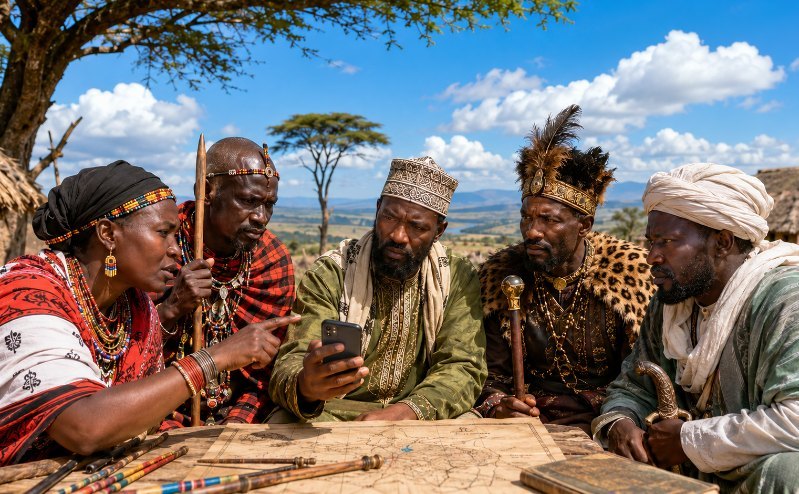
Imagine a coordinated WhatsApp anti-colonial movement by Mekatilili wa Menza, the fearless Kenyan anti-colonial revolutionary who led the Giriama people against British colonial rule between 1912 and 1915, working with Koitalel Arap Samoei, the spiritual and military leader of the Nandi people, who spearheaded the Nandi Resistance (1890 to 1905).
Then imagine the two of them coordinating their efforts with those of Kinjikitile Ngwale, the spiritual leader and the primary ideological architect behind the Maji Maji Rebellion (1905 to 1907) and Sayyid Mohammed, who, for two decades (1899 to 1920), led a fierce armed resistance against British, Italian and Ethiopian forces.
Together, they would have then joined forces with Omukama Kabalega, the King of Bunyoro in Uganda, who waged a relentless five-year war against British forces and their Buganda allies between 1894 and 1899 to protect his kingdom's sovereignty.
A coordinated WhatsApp anti-colonial movement by them would have been a regional strategy instead of isolated rebellions.
Let’s face it, the greatest strength of colonial powers in East Africa was not simply superior weaponry. It was the fact that they faced dozens of largely isolated societies, each resisting at different times, against different colonial powers, with little ability to coordinate over long distances.
If leaders such as Mekatilili wa Menza, Koitalel arap Samoei, Kinjikitile Ngwale, Sayyid Mohammed and Omukama Kabalega had had access to something as simple as WhatsApp around 1900, East African history could have looked very different.
Not necessarily because colonialism would have been defeated, but because it would have become vastly more expensive, slower and politically difficult to sustain.
Imagine the group chat of what I will now call the East African Resistance WhatsApp Revolution.
Koitalel: Railway construction has resumed near Nandi. Need simultaneous attacks on supply lines.
Kabalega: British troops leaving
Kampala tomorrow. Approximately 500 askaris. Heading west.
Mekatilili: Perfect. If they leave Uganda, we can intensify pressure at the Coast. Giriama are ready.
Kinjikitile: German patrols stretched thin after recent fighting. Southern groups can attack in three days.
Sayyid Hassan: The British are requesting reinforcements from Aden. We will keep them occupied in Somaliland.
Historically, colonial governments benefited enormously from information asymmetry.
They knew where rebellions were occurring. The rebels usually did not know where colonial troops were moving.
Imagine instead hundreds of freedom fighter scouts sending live locations:
"Column of 300 soldiers left Mombasa this morning."
"German caravan crossing Kilosa."
"Rail bridge repaired yesterday."
Colonial surprise would have disappeared.
The railway was Britain's lifeline. Koitalel's Nandi warriors already proved remarkably effective at sabotaging it. Now imagine coordinated attacks from the Nandi, the Giriama, the Maasai, the Kamba and sympathetic railway workers leaking schedules. Every bridge would have become vulnerable, and every train a target.
In Tanzania, the Maji Maji Rebellion already united more than 20 ethnic groups. Its biggest weakness was communication. WhatsApp would have changed everything.
Instead of taking weeks, orders would have arrived instantly.
Rather than a series of disconnected local uprisings, East Africa might have witnessed something resembling a continental liberation movement half a century before the Independence era.
It paid off my Fuliza before I could figure out if it was a scam