

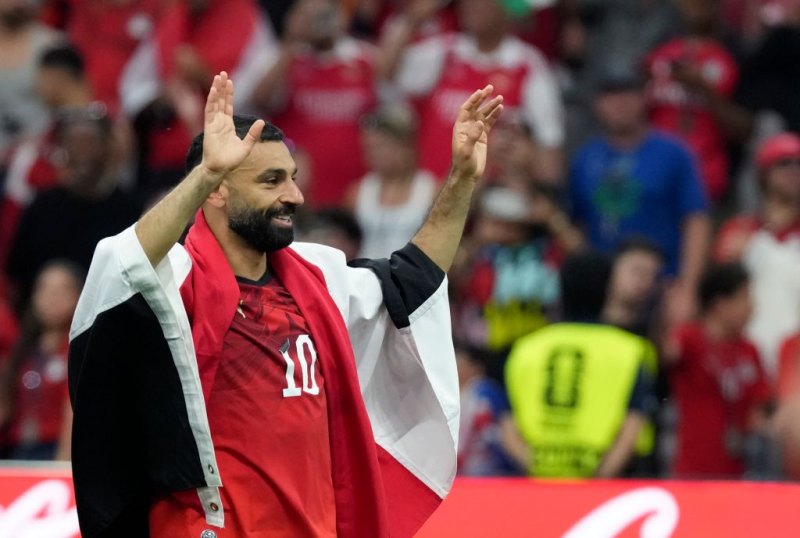
 Mohamed Salah of Egypt celebrates after a Group G match between New Zealand and Egypt at the 2026 FIFA World Cup at BC Place, Vancouver, in Vancouver, Canada, on June 21, 2026. (Xinhua/Meng Yongmin)
Africa’s growing influence on the global stage has taken centre stage at the 2026 FIFA World Cup, with a new generation of stars combining individual brilliance and historic performances to announce the continent’s arrival among football’s elite.
With a record 10 African nations competing in the expanded 48-team tournament, players such as Morocco’s Ismael Saibari, Egypt’s Mohamed Salah and Senegal’s Ismaïla Sarr have emerged as some of the biggest performers of the group stage, carrying their nations’ hopes while rewriting personal milestones.
Leading the charge has been Saibari, whose remarkable scoring run has placed him in World Cup history. The Morocco midfielder became the first African player to score in all three group-stage matches of a single World Cup, finding the net against Brazil, Scotland and Haiti.
The 25-year-old has been the heartbeat of Morocco’s attacking rhythm, combining efficiency in front of goal with composure in possession. Across three matches and 243 minutes, Saibari scored three goals, averaging one goal every 81 minutes. His statistics reflect a player operating at the highest level.
He registered six shots, with four finding the target, giving him a 66.6 per cent shot accuracy rate. Beyond his goalscoring exploits, Saibari completed 58 of his 67 passes for an 86 per cent passing success rate, while also contributing defensively with three successful tackles and two clearances. His performances have helped Morocco secure progression to the knockout phase while establishing him as one of the tournament’s most influential African players.
While Saibari has provided Morocco with goals, Egypt’s Mohamed Salah has continued to prove why he remains one of Africa’s greatest football exports. The veteran forward delivered a commanding display in Egypt’s 3-1 comeback victory over New Zealand, scoring once and creating another goal.
Salah’s contribution has taken his World Cup tally to five goal involvements, placing him among Africa’s most productive players in tournament history. The Egyptian captain has been central to his team’s attacking structure, creating eight chances — the highest figure among African players during the group stage. In two matches and 161 minutes, Salah has scored once and provided two assists, averaging a goal contribution every 53.6 minutes.
His passing accuracy has also remained exceptional, with 44 successful passes from 49 attempts, an 89 per cent completion rate. Despite taking only four shots, three were on target, underlining his continued efficiency in front of goal. Senegal’s Ismaïla Sarr has also emerged as a key figure for the Teranga Lions, providing a consistent attacking threat during a challenging group campaign.
The winger has scored two goals in two matches, both coming in Senegal’s intense 3-2 battle against Norway. Operating with pace and directness, Sarr has carried much of Senegal’s attacking responsibility, registering seven shots, four of which were on target. His 81 per cent passing accuracy, alongside his defensive contributions, including an interception and a successful tackle, highlight his all-round influence.
Sarr has averaged one goal every 82.5 minutes. Beyond the established names, young talents have also announced themselves. Ivory Coast winger Yan Diomande has been one of the breakout sensations of the tournament, impressing with explosive pace, fearless dribbling and tactical maturity.
Morocco’s Brahim Díaz has equally played a crucial role, providing creativity from midfield and recording two assists as he helped unlock stubborn opposition defences.
The performances of Africa’s leading stars have strengthened the continent’s belief that the 2026 World Cup could become a historic tournament.
From Saibari’s record-breaking goalscoring exploits to Salah’s leadership and Sarr’s attacking firepower, African players are no longer simply competing on football’s biggest stage — they are shaping it.