

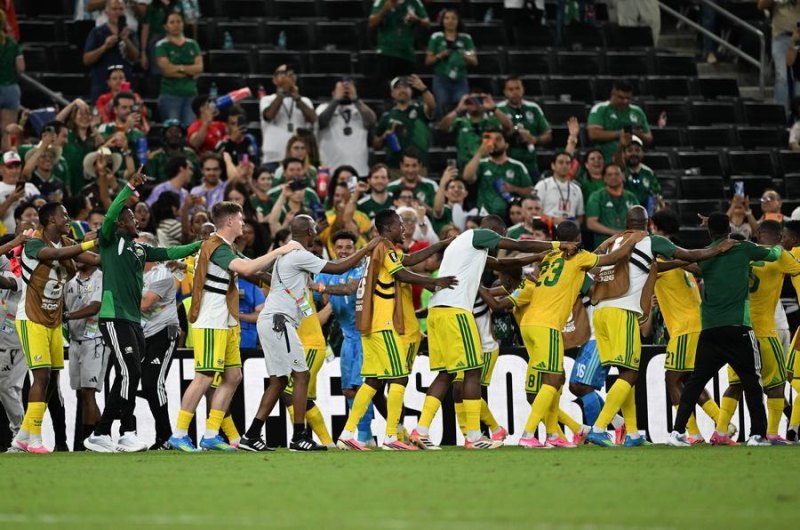
 Players of South Africa celebrate victory after a group A match between South Africa and South Korea at the 2026 FIFA World Cup at Estadio Monterrey in Monterrey, Mexico, on June 24, 2026. (Xinhua/Wu Wei)
The FIFA World Cup 2026 knockout stage is beginning to take shape, with 12 nations officially securing their places in the newly expanded Round of 32 as the group stage enters its final stretch.
The early qualifiers include some of football’s biggest names, rising forces and tournament hosts, setting up a fascinating battle as teams begin positioning themselves for the next phase of the competition.
Mexico, South Africa, Switzerland, Canada, Brazil, Morocco, the United States, Germany, Argentina, France, Norway and Colombia have all confirmed their progression after achieving results strong enough to guarantee their places among the 32 teams that will continue their pursuit of football’s biggest prize.
The three host nations have enjoyed a positive start to the tournament, with Mexico, the United States and Canada ensuring that home supporters will remain part of the World Cup journey beyond the group stage. Their qualification has added further excitement to a tournament already marked by increased global participation following the expansion to 48 teams.
Mexico and South Africa secured advancement from Group A, while Switzerland and Canada emerged from Group B. Brazil and Morocco claimed their places from Group C, continuing their campaigns with strong performances against challenging opponents. The United States progressed from Group D, while Germany confirmed their status as one of Europe’s leading contenders by advancing from Group E.
France and Norway have also booked their spots from Group I, while South American giants Argentina and Colombia secured qualification from Groups J and K respectively. The expanded World Cup format has introduced a new level of competition, with 12 groups of four teams battling for places in the knockout rounds.
The top two teams from each group automatically advance, while eight of the best third-placed teams will complete the Round of 32 line-up. For the teams already through, the remaining group matches will still carry major importance as they fight for higher positions and more favourable knockout-stage paths.
In a tournament where fine margins often decide success and failure, every goal and every point could influence future opponents. Morocco’s qualification has once again highlighted Africa’s growing influence on the global stage. After reaching the semi-finals of the 2022 World Cup in Qatar, the North Africans have continued to demonstrate that their previous achievement was not a one-time success. Their discipline, organisation and belief have placed them among the teams capable of challenging the traditional giants.
South Africa’s progress has also provided another boost for African football, adding to the continent’s presence in the latter stages of the tournament. However, while some nations are preparing for knockout football, others have already seen their World Cup dreams come to an end. Haiti, Tunisia, Turkey, Jordan, Panama and Qatar have been eliminated from contention, leaving their remaining matches as opportunities to compete for pride and finish their campaigns positively.
The battle for the remaining Round of 32 positions remains intense, with several teams still needing results from their final group matches to confirm their fate. The difference between qualification and elimination could come down to goal difference, a late goal or a single moment of brilliance. The knockout stage promises a fascinating mixture of established champions and ambitious challengers.
Argentina, Brazil, France and Germany bring a wealth of World Cup experience, while nations such as Morocco, South Africa and Colombia represent the continued growth and competitiveness of football across different regions. As the group stage reaches its conclusion, attention is turning towards the next chapter of the tournament.
The Round of 32 will bring a different kind of pressure, where every match carries the weight of elimination and every performance can become part of World Cup history.
With 12 teams already safe and many more fighting for survival, the race for glory in 2026 is gathering momentum.