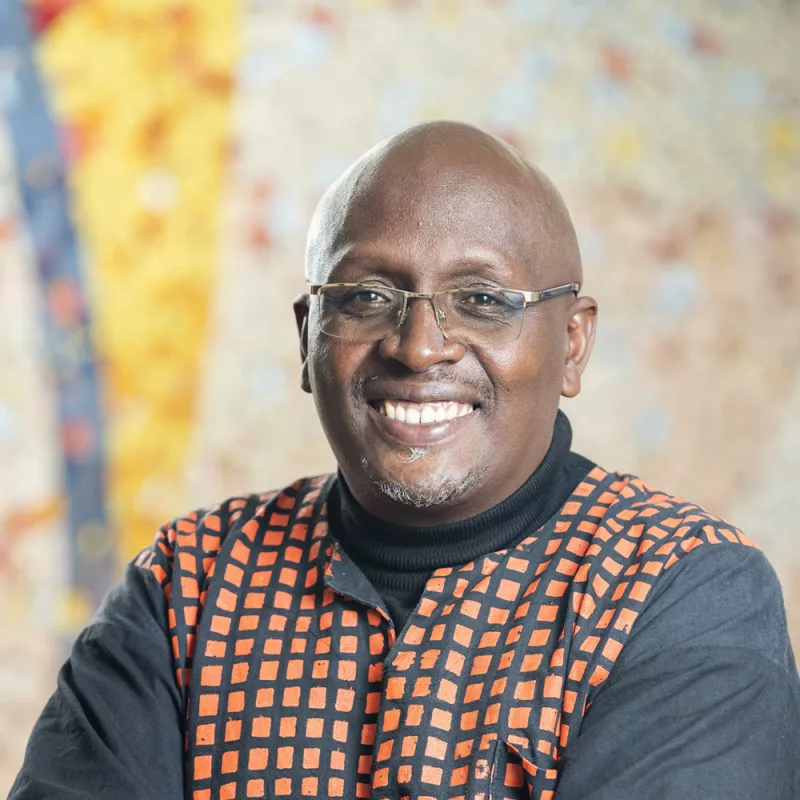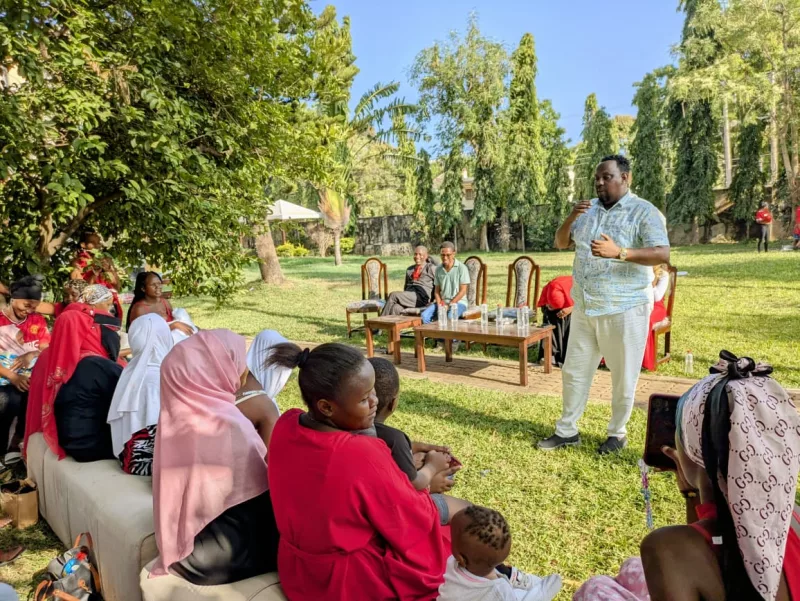


 Abdikadir Dekow speaks to young mothers in Nyali on Wednesday / BRIAN OTIENO
Rachael Mburu, a single mother of a young daughter, sells mangoes at Kongowea Market.
Her business is what keeps them going.
However, given the country's economic situation, the little she earns is only enough to meet their basic daily needs.
She needs either to expand her business or start a more lucrative one.
Having given birth at the age of 17 and with her daughter having just joined school, she feels the pressure of being a young single mother.
She has tried applying for government funds but has been unsuccessful.
Mburu says young mothers in Mombasa face stigma and discrimination, pushing many into depression.
She says young mothers are not clearly recognised in government policies, leaving them in limbo.
"We face difficulties when it comes to accessing government funds to try and get something meaningful to do to earn a living," Mburu, the chairperson of a network of young mothers in Nyali subcounty, told the Star.
She said the government only recognises youth, women and persons with disabilities.
Within those groups, Mburu says, many young mothers are rejected and pushed from one category to another, eventually missing out on the funds.
"In normal activities, these groups welcome us. But when it comes to getting funds, that is where they draw the line," Mburu says.
As a young person, she expected she would join a youth group and access funds through it.
To her surprise, the youth groups she approached rejected her, saying she was already a mother and should instead join a women's group.
"When I tried joining women's groups, they all told me I am still young and should join a youth group instead," Mburu says.
This, she says, leaves young mothers caught in a dilemma.
It is for this reason that she joined the Network of Young Mothers in Nyali, a project started by Abdikadir Dekow, a philanthropist and former Interpol officer.
The network has 250 registered young mothers.
"In Kenya today, young mothers feature nowhere in the government's plans and policies," Mburu says.
The Young Mothers Fraternity, a community-based organisation established by Dekow, was created to help recognise young mothers as a community that deserves support like any other.
Mburu says there are many factors that lead to young motherhood.
Some were raped, others were deceived, while others became pregnant while in relationships.
Dekow says he was attending a meeting with women in Nyali when a young mother complained about being pushed from one group to another because she had a child at a young age.
"To solve their issue, I suggested they form a group of their own so they could access government funds. That is how we came up with the Young Mothers Fraternity CBO," he says.
The former Interpol officer says the government should develop policies or legislation to protect young mothers.
"They do not have a proper identity. In future, we should be able to come up with legislation to protect these young mothers. They should easily access AGPO (Access to Government Procurement Opportunities) certificates so they can transact with the government easily," Dekow says.
He says young mothers should be able to access these opportunities without having to attach themselves to women, youth or persons with disabilities (PWD) groups.
Dekow says this should not be misconstrued as supporting teenage pregnancies because young mothers already exist in society.
Mburu says some of the cases are beyond the young mothers' control.
"Some made mistakes. But they were right not to kill their babies like some do after getting unwanted pregnancies," she says.
Dekow says they are mentoring the young women through programmes such as financial literacy, technical skills and short courses.
"We also sometimes provide essentials for their babies so they can concentrate on the small businesses that we establish for them and the training that we provide," he says.
Dekow says some have brilliant business ideas but lack capital, while others have technical skills that they cannot apply because employers are reluctant to hire young mothers.
He says some come from well-off families but were rejected after becoming pregnant or had their support withdrawn.
Some were told to start providing for their children soon after giving birth, leaving them dejected and depressed.
"We provide a lot of counselling for them," he says.
Mburu says there are more than 800 young mothers in Mombasa County, with almost half living in Nyali subcounty, although many have yet to join the network officially.
Dekow says there are plans to establish businesses for the young mothers so they can become self-sustaining.
"We are looking for funds so that we can register businesses for them," he says.
He says two of the young mothers have already returned to school after dropping out because of pregnancy.
"We are paying school fees for them. One dropped out in Form 3 while another dropped out in Form 2. They have both been taken back to school," he says.
Instant analysis
In Kenya, teenage pregnancy is a significant socioeconomic and public health challenge, with nearly 16 per cent of girls aged 15 to 19 having been pregnant. Many young mothers face stigma, interrupted education and poverty. Community-based organisations and targeted educational initiatives are working to reintegrate them into society while equipping them with practical and livelihood skills.