

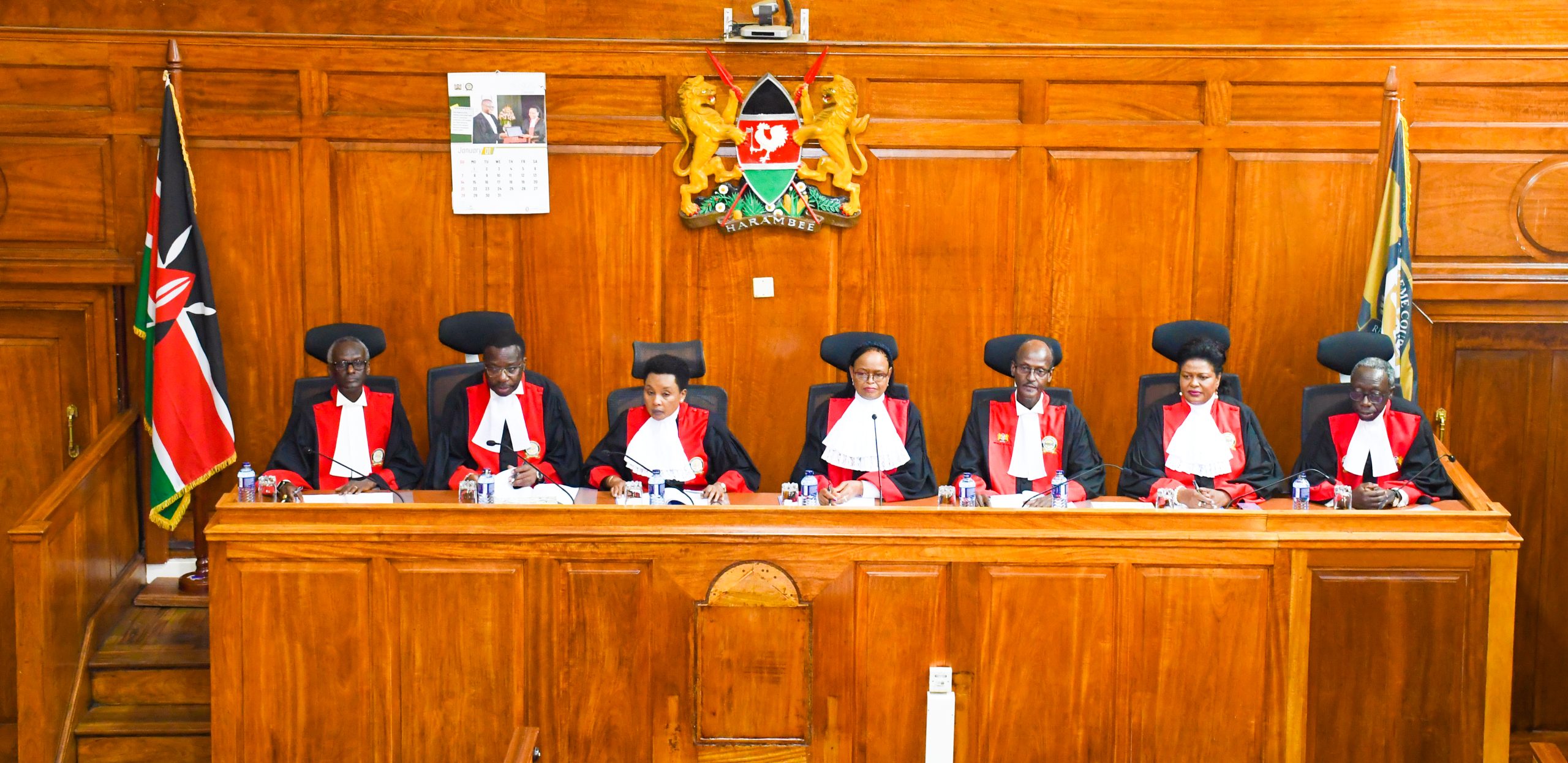
 Supreme Court judges/ JUDICIARY
 A three-judge bench of the High Court has declined to recuse itself from hearing a case challenging the Judicial Service Commission’s (JSC) disciplinary mandate over Supreme Court judges.
The recusal application was filed by lawyer Nelson Havi, who sought to have the bench step aside from the matter.
The case arises from petitions seeking the removal of all seven Supreme Court judges, which the judges are contesting.
In their challenge, the judges argue that the JSC’s process, as outlined in the petitions, is unlawful and exceeds the commission’s disciplinary authority.
The recusal application contended that Chief Justice Martha Koome, being a party to the JSC petitions, should not have appointed the bench.
The petitioner argued that this could create an appearance of conflict and that the matter should have been assigned to the Deputy Chief Justice.
The application also questioned the composition of the bench, noting that two judges, appointed in 2022 and 2024, were recommended by the Chief Justice. It suggested this could affect their impartiality.
On Friday, November 14, the High Court dismissed these arguments, describing them as speculative and without legal basis.
The court emphasised that all judges are equal and act independently, regardless of who recommended or appointed them.
“To suggest that Justices Lawrence Mugambi and Bahati Mwamuye will be influenced by their appointment is a mere allegation with no legal basis,” the ruling stated.
The court also noted that no evidence was presented to substantiate claims of bias or to question the judges’ expertise.
In its reasoning, the bench referred to the Court of Appeal’s precedent in the Gachagua decision, which outlines the lawful process for appointing a bench.
The High Court observed that the issue of empanelment was functus officio, meaning it is no longer open for debate at this stage, and any concerns should be raised in the appropriate forum.
The court affirmed that the empanelment of Justices Mugambi, Mwamuye, and Charles Kariuki was properly and lawfully undertaken.
It added that expanding the bench to five or seven judges, as suggested in the application, was unnecessary, noting that the current composition is competent and constitutionally valid.
Justice Mugambi, who directed Chief Justice Koome to empanel the bench in April 2025, has previously emphasised that judges act independently in carrying out their judicial duties and are not bound by instructions from any authority.