Calls from a section of Kenyans for the government to abolish boarding schools are growing louder as student unrest across secondary schools continues to escalate, forcing dozens of institutions to close indefinitely.
As of Monday, June 8, more than 70 secondary schools had sent students home following a wave of unrest marked by arson attacks, walkouts and heightened tensions in learning institutions across the country.
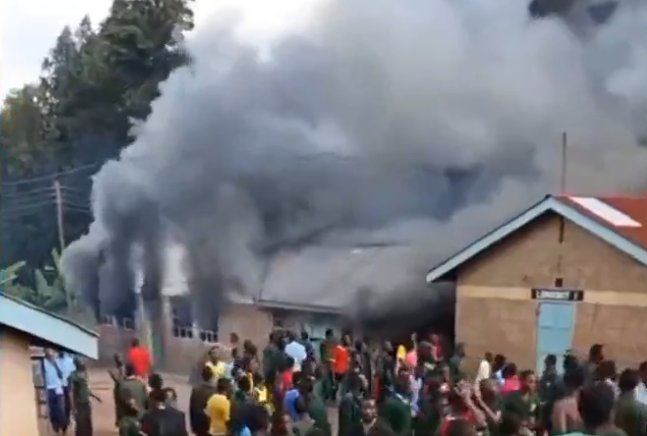
While some schools reported the torching of dormitories and other facilities, others opted to close as a precautionary measure to avert similar incidents.
Not even prestigious institutions such as Mang'u High School and Alliance High School were spared. Alliance closed after students set ablaze a building used to store mattresses on the morning of June 4.
A day later, Mang'u High School sent students home after administrators detected rising tension and reportedly foiled an attempted unrest on the evening of June 4.
The closure came on the same day parents had attended an academic day at the school, with some later expressing surprise at the turn of events, saying the students had appeared calm and composed.
Until recently, the two national schools had rarely been associated with student indiscipline or unrest, making their closure particularly significant.
Many other schools followed suit, releasing learners to their parents as administrators sought to ease tension and protect life and property.
Reports indicated that some students questioned why they should remain in school when institutions such as Alliance and Mang'u had already sent learners home, contributing to a chain reaction of closures in several parts of the country.
Although the current wave of school shutdowns was triggered by a dormitory fire at Utumishi Girls Academy on May 28 that left 16 students dead and 79 others injured, concerns over student unrest had been building for weeks.
On May 14, Basic Education Principal Secretary Julius Bitok convened an emergency virtual meeting with school heads to address growing cases of unrest.
During the meeting, school administrators identified harsh disciplinary practices and poor communication between students and management as key drivers of the rising unrest.
Other contributing factors cited included academic pressure and examination fatigue, poor living conditions, peer influence, drug and substance abuse, weak guidance and counselling structures, negative social media influence, and governance and leadership challenges within schools.
Bitok directed schools to adopt proactive, learner-centred approaches in handling student concerns and warned that the second term has traditionally been prone to unrest.
"We must be on the lookout for the triggers to effectively pre-empt them," he said.
The PS also encouraged institutions to involve learners more in decision-making processes to foster a sense of belonging and shared responsibility.
He cautioned against punitive disciplinary practices, urging schools to embrace fair, humane and corrective approaches.
"Discipline should be fair, supportive and corrective. Schools must create environments where learners feel heard, respected and supported," he said.
Despite the intervention, tensions appear to have persisted.
In Nyamira County, students at one secondary school allegedly set a dormitory on fire on Monday and reportedly locked the main gate to prevent villagers from entering to help contain the blaze.
Authorities said no students were injured and investigations into the incident had commenced.
As the wave of destruction mounts and learning continues to be disrupted, some Kenyans are increasingly questioning the relevance of boarding schools.
Supporters of the proposal argue that student unrest has reached crisis levels and that existing control measures have failed to stem the problem.
"The citizens must hold a discourse urgently to abolish boarding schools and demand a modern education system based on day schools," one Kenyan said on social media.
Another argued that schools should not continue accommodating students if they cannot provide conditions comparable to those at home.
"If schools can't maintain the same standards for children as those at home, then let's abolish boarding schools and let children commute from home. It would reduce government spending on accommodation and allow more investment in learning resources," the commenter said.
Others argued that some learners are too young to spend extended periods away from their families.
"Why do we keep boarding young children? Children should stay with their parents. Day schools save both parents and the government money. Meanwhile, convert large boarding schools into TVET institutions for adults who can better handle boarding life," another contributor suggested.
During a Bunge la Mwananchi forum in Nairobi, one participant called not only for the abolition of boarding schools but also for the reintroduction of corporal punishment.
"The one thing our schools are experiencing is a lack of discipline and action against the children involved," he said.
He blamed rising indiscipline on poor examples set by some parents.
"Some parents participate in demonstrations and take part in lighting tyres and bonfires on roads as their children watch. That child grows up with the urge to practise the same behaviour at school," he argued.
The participant further proposed that any boarding schools that remain operational should adhere to stricter safety requirements, including avoiding multi-storey dormitories and ensuring sufficient emergency exits.
Others, however, argued that the unrest reflects deeper systemic challenges.
"It's the system. It's parents. It's lack of funds. It's a lot of things, and they need to be addressed now. It's a national crisis at this point," another debater said.
Political leaders have also weighed in, with opinions remaining divided on whether boarding schools should be scrapped.
Speaking during an empowerment drive in Emuhaya on Sunday, Vihiga Woman Rep Beatrice Adagala opposed the proposal.
"The tragic incident at Utumishi Girls Academy is a painful reminder of what happens when we ignore school safety. But the answer is not to shut down boarding schools. The answer is to make them safe and introduce discipline among students," she said.
Meanwhile, Murang'a Governor Irungu Kang'ata said the government should incentivise all secondary schools equally to standardise the quality of education and reduce pressure on a handful of elite boarding institutions.
"Families should choose boarding because it suits their circumstances, not because they fear inferior alternatives," he said.
Kakamega Sentaor Boni Khalwale attributed the rise in indiscipline to poor parenting.
"Bad adults are not an accident. They are a project. A project that started at age five when a child talked back to an adult and the parent laughed and said, 'Huyu mtoto ni tough kama mimi,'" he said.
Khalwale argued that some parents excuse bad behaviour by labelling it confidence, creativity or independence.
"Nobody wakes up at 30 and suddenly becomes rude, entitled, dishonest and impossible to deal with. That software was installed early by parents who were allergic to the word 'no'," he added.
Amid the growing unrest and school closures, Bitok has maintained that the government will not order a nationwide shutdown of schools.
Speaking on Saturday at Pioneer School during a Grade 10 academic clinic, the PS said the Ministry of Education was implementing targeted interventions in collaboration with stakeholders to address the challenges disrupting learning in some institutions.
He reiterated that the official mid-term break remains scheduled for June 24 to 28 and that schools will continue operating as planned.
"At The Kenya High School Speech and Prize Giving Day, I reaffirmed that there will be no unscheduled closure of schools before the official mid-term break set for June 24-28, as learning continues normally in over 99 per cent of our more than 9,500 schools," he said.
Some leaders, including Ndindi Nyoro, have called on the ministry to consider restructuring the lengthy second term and introducing additional breaks to ease pressure on learners.

 The crisis has reignited debate on whether Kenya should phase out boarding schools in favour of day schooling.