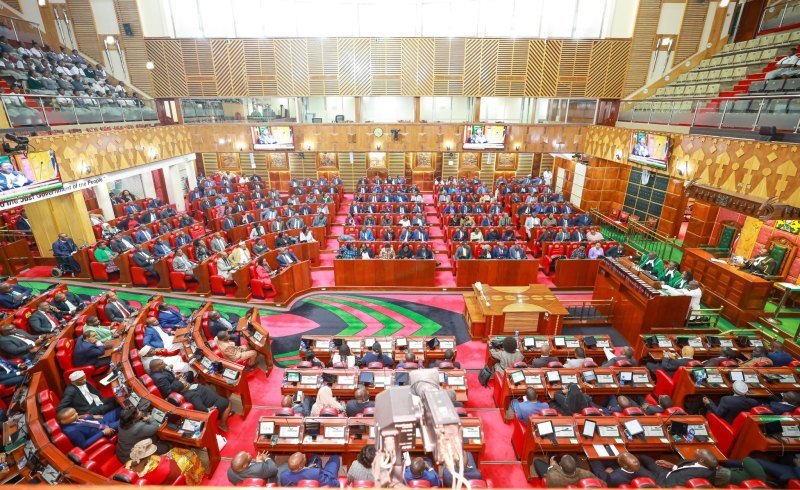
AG, MPs on the spot as law on enforced disappearances stalls despite House directive
No standalone bill on enforced disappearances currently features among legislative proposals before Parliament.
by MOSES OGADA
Audio By Vocalize
Five missing youth who were found after being abducted over protests.
Daniel Baru Nyamohanga’s family is yet to get justice nearly
10 years after their kin disappeared following his arrest on suspicion of
robbery.
After his arrest, Baru was driven to the Kehancha Law Courts
compound but was never presented before a magistrate. Instead, he was returned
to a police station and detained unlawfully. His detention was neither recorded
in the Occurrence Book nor linked to any complainant.
A habeas corpus
application filed at the High Court in Migori seeking his release later found
that his constitutional rights had been violated.
Justice Anthony Mrima established that crucial information
in the manual Occurrence Book had been altered and falsified, apparently to
conceal the sequence of events and shield officers on duty from responsibility.
The court issued a strict habeas corpus order directing the OCS to produce Baru
“dead or alive”.
When the officer failed to comply, he was charged with
contempt of court (in 2018), exposing him to possible imprisonment. The court
and the Inspector General of Police treated the matter as a criminal cover-up
of an enforced disappearance. Yet despite the damning findings, Baru remains
missing.
Ninia Sonch* (Name changed to protect identity) is among
many other Kenyans still searching for answers. Her relative, Michael Njau, was
allegedly abducted along Thika Road in 2020 and has never been found.
According
to the family, case files later disappeared from police custody while officers
handling the investigation were transferred. The family believes orders from
senior quarters interfered with investigations, effectively shutting down any
meaningful search for answers.
Human rights groups say such cases have flourished because
Kenya lacks a specific law criminalising enforced disappearances and
establishing clear mechanisms for investigations, accountability and
reparations.
As a result, prosecutors often rely on offences such as
kidnapping, wrongful confinement or abduction, which rights defenders argue
fail to capture the gravity of enforced disappearance, especially where state
agents are implicated.
The legal gap persists despite Kenya being a signatory to
the International Convention for the Protection of All Persons from Enforced
Disappearance, which obligates states to criminalise the practice under
domestic law. More than two years after Parliament was petitioned to enact such
legislation, the process appears to have stalled.
Neither the Attorney
General’s office nor Parliament offered a clear explanation when contacted by
the Star on the progress made so far. Efforts to enact the law have largely
come to naught, with a multi-agency process meant to lay the groundwork for
reforms seemingly stuck in limbo.
In April 2024, the National Assembly adopted recommendations
by its Public Petitions Committee following consideration of a petition seeking
legislation on enforced disappearances.
The committee endorsed a proposal from
the Office of the Attorney General and Department of Justice to establish a
multi-agency committee to examine gaps in Kenya’s legal framework and recommend
reforms.
The team was expected to review existing laws, identify legislative
shortcomings and propose measures to align Kenyan law with international
standards, particularly the International Convention for the Protection of All
Persons from Enforced Disappearance.
Parliament further recommended that upon conclusion of the
exercise, the Attorney General review the statute book and present the
necessary legislative amendments to the House.
The process was expected to be
completed within six months. That deadline lapsed in October last year. Attorney
General Dorcas Oduor did not respond to inquiries from the Star on whether the
committee was ever constituted and, if so, what progress it has made.
The same
was true of the Justice and Legal Affairs Committee (JLAC), which did not
respond to questions on whether it had received any report from the Attorney
General arising from the House resolution.
The proposed committee was to bring together representatives
from the Attorney General’s office, the Ministry of Interior, the National
Police Service, the Independent Policing Oversight Authority, the Office of the
Director of Public Prosecutions, the Kenya National Commission on Human Rights
and the Judiciary.
An independent search by the Star revealed that no
standalone bill on enforced disappearances currently features among legislative
proposals before Parliament.
Even amendments to existing laws identified by MPs as
potential vehicles for reform have yet to materialise. The Public Petitions
Committee had proposed either a standalone law on protection from enforced
disappearance or amendments to statutes including the Penal Code, Criminal
Procedure Code, Prevention of Torture Act, Persons Deprived of Liberty Act and
the National Coroners Service Act. However, amendments currently before
Parliament to the National Coroners Service Act do not address the issue.
The legislative push originated from a 2023 petition filed
by scholar and human rights advocate Dr Annette Mbogho, who urged Parliament to
criminalise enforced disappearances through dedicated legislation.
In
submissions to MPs, Mbogho argued that Kenya lacked a legal framework
specifically addressing enforced disappearance despite its obligations under
international law.
The petition attracted support from a coalition of rights
organisations including the Kenya National Commission on Human Rights (KNCHR),
the Law Society of Kenya (LSK), the International Commission of Jurists-Kenya
(ICJ-Kenya), Muslims for Human Rights (Muhuri) and Haki Africa.
The organisations told MPs that families of victims often
face immense obstacles in their pursuit of justice because enforced
disappearance is not recognised as a distinct offence under Kenyan law.
KNCHR
argued that enforced disappearance constitutes a continuing violation of
rights, leaving families trapped in uncertainty over the fate and whereabouts
of their loved ones.
LSK urged Parliament to domesticate Kenya’s obligations
under the international convention, while ICJ-Kenya maintained that existing
criminal laws were inadequate to address disappearances involving state actors.
Muhuri and Haki Africa warned that the absence of a
dedicated legal framework had fostered impunity and weakened accountability in
cases involving alleged disappearances.
After considering the submissions, MPs
agreed that significant gaps existed within Kenya’s legal framework. However,
they stopped short of recommending immediate enactment of a standalone law and
instead adopted the Attorney General’s proposal for a comprehensive review
through the multi-agency committee.
More than a year later, there is little evidence of
progress. The Attorney General’s office has not publicly disclosed whether the
committee was formed, who sits on it or whether it has completed its
assignment.
Similarly, Parliament has not indicated whether it has received any
report arising from the process. The delay comes amid growing concern over
alleged abductions and disappearances in the wake of anti-government protests
and online criticism of public officials.
According to the Missing Voices Annual Report 2024, cases of
enforced disappearances rose by 450 per cent, from 10 cases in 2023 to 55 in
2024. Nairobi recorded the highest number of cases, followed by Kiambu and
Migori counties.
KNCHR has separately documented 82 cases of enforced
disappearances since June 2024, with at least 29 people still unaccounted for. Rights
groups have repeatedly accused security agencies of operating outside the law,
allegations authorities have consistently denied. Many of the cases documented
by KNCHR remain unresolved.
Families often spend years moving between police stations,
courtrooms and government offices in search of information, with many never
learning what happened to their loved ones. For families such as Baru’s, the
legislative delays only deepen the uncertainty. Nearly a decade after he
vanished, relatives are still waiting for answers.
For Sonch’s family, six years have passed without closure. Their
stories are only a glimpse into a much larger crisis involving dozens of
families whose cases remain trapped in investigations that have yielded little
or no progress.
With the six-month deadline long expired and no public report
in sight, questions remain over whether the multi-agency process ever got off
the ground and whether the promised legal reforms will ever materialise.
As the
wait drags on, families continue searching for answers while the law meant to
protect them remains missing too.
This is premium content
Subscribe to Continue Reading
Help us continue bringing you unbiased news, in-depth investigations, and diverse perspectives. Your subscription keeps our mission alive and empowers us to provide high-quality, trustworthy journalism. Join us today to make a difference!