Her
mind constantly raced back to her digital statement from her sacco, where her
savings of more than Sh670,000 sat snugly.
She
has steadily built the nest egg over 14 years through chalk, sweat and dust, with savings of about
Sh4,000 every month and random extra deposits whenever she makes an extra coin from tuition charges. The intention was to use the cash as collateral for a land purchase to build a
retirement home.
But
a viral graphic on social media changed everything. The post claimed that the
government was planning to tap into Sh1 trillion of sacco savings to finance
the newly established National Infrastructure Fund.
The fund is an ambitious state-sponsored investment vehicle established by the National
Infrastructure Fund Act, 2026, to mobilise up to Sh5 trillion over the next
decade to finance major national development projects.
"I
panicked. It was even worse reading through the comments," Wambui recalls.
"We
have heard stories of government projects stalling, and the thought of my money
being taken to build roads without my permission terrified me. I reached out to
the sacco with an intention to withdraw my savings even if it would come with
penalties, but I was told all was well.”
Nicholas
Amolo, a member of a prominent sacco in the energy sector, was planning a
different line of defence. If the state was going to take the money, he
reasoned, he might borrow against all his savings.
"The
moment I saw the news on television, I immediately decided to apply for a
development loan," Amolo told the Star.
"I
figured that if I borrowed three times my savings immediately, the government
would find an empty kitty. I would rather be servicing a heavy loan for money I
am spending on a project than waiting for the government to return money they
spent on projects."
The
two were not alone. Across the country, a quiet but dangerous wave of panic was
sweeping through Kenya’s financial bedrock.
Automated
teller machines at major saccos reported unusually high traffic. Customer care lines were jammed, and boardrooms across Upper Hill and the
Nairobi Central Business District began ringing alarm bells. The trouble?
The information fuelling the frenzy was entirely fake.
The
crisis, which threatened to destabilise a sector that holds the financial
dreams of over 14 million Kenyans, stems from a mix of highly publicised
legislative reforms and malicious digital propaganda.
At
the centre of the storm are two distinct pieces of legislation currently
in Parliament: the Cooperatives Bill and the Sacco
Societies (Amendment) Bill, 2025.
Because
the two bills are being fast-tracked for enactment, social media opportunists have
been blamed for taking advantage of the technical language in the drafts to
weave a narrative of an impending state-sponsored heist.
The
misinformation was supercharged when a fabricated digital graphic was widely
circulated, falsely attributing a quote to National Treasury Cabinet Secretary
John Mbadi.
The
“fake post”, as per the industry players, alleged that the upcoming laws would
create a state-controlled "Super Sacco” that would legally compel primary
cooperatives to surrender their cash reserves to fund national road, bridge and dam projects.
The Treasury, the Ministry of Co-operatives, the National Assembly,
and the sector's apex body, the Cooperative Alliance of Kenya (CAK) have
however moved to reassure millions of sacco members that the proposed reforms will
not allow the state to access members' savings.
Neither will they compel saccos to finance government infrastructure
projects.
"We
wish to clarify that the information circulating on social media regarding the
government borrowing sacco savings for the National Infrastructure Fund is
entirely fake and malicious,” the Treasury said.
"Cabinet Secretary John Mbadi has
made no such statement. The public is advised to ignore this fabricated graphic
and rely only on official communication channels for accurate updates."
Cooperatives
PS Patrick Kilemi has since
reminded Kenyans that by law, the government cannot simply dip its hands into
the vaults of private cooperatives.
“Sacco
funds remain the property of respective saccos and are managed exclusively by
their elected officials. The government of Kenya has no access to these funds,
neither does it intend to utilise them. At no point did the government propose
using these funds for projects. They funds are safe, autonomous, and strictly protected,” Kilemi said.
The
Cooperative Alliance of Kenya also assured sacco members and other
cooperatives in the different sectors of the economy that their savings are
safe.
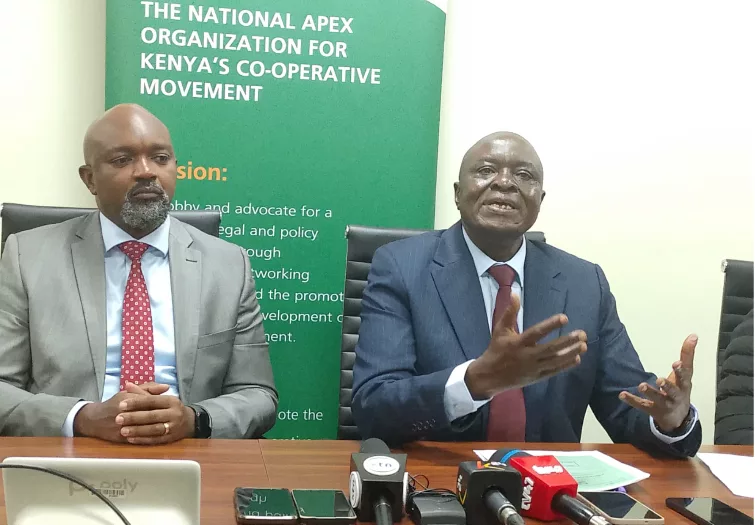
CAK chief executive Daniel Marube said the Sh1 trillion being talked about does
not exist as idle cash sitting in a giant room waiting to be taken.
"These
are members' savings that have already been converted into loans financing
homes, businesses, education, agriculture, healthcare, and transport across the
country,” Marube said.
“These
resources remain in the hands of members, supporting livelihoods and economic
growth, and cannot simply be diverted for unrelated purposes."
Marube
said remarks made by Deputy President Kithure Kindiki during the
recent Ushirika Day celebrations had been twisted out of context.
The
Deputy President, he said, had merely suggested that the National
Infrastructure Fund would ease pressure on the national budget, thereby freeing
up fiscal space to provide more developmental grants to small businesses
and cooperatives.
However,
Saccos are free to invest in long-term instruments, including bonds, only if
members approve.
Marube emphasised that cooperatives remain autonomous,
member-owned institutions whose investment decisions are made solely by members
through their democratic governance structures, with annual general meetings remaining the supreme decision-making organs.
He cautioned against misinformation, warning that misleading
reports could undermine public confidence and trigger unnecessary panic among
millions of cooperative members.
Kenya’s sacco sector is the largest cooperative movement in Africa and ranks seventh
globally.
It
is an economic giant that sits at the heart of the country's Gross Domestic
Product (GDP), traditionally offering loans at friendlier, capped interest
rates compared to commercial banks, and require multipliers of savings rather
than stringent physical collateral.
They
are the primary financial lifeline for Kenya's middle class, civil servants,
farmers, and micro-entrepreneurs.
According
to sector players, any systemic panic that causes members to aggressively
withdraw their deposits could trigger a liquidity crisis that would instantly
reverberate through the entire economy.
The
National Assembly’s Committee on Trade, Industry and Cooperatives, which has been reviewing the Sacco Societies (Amendment) Bill for over a year,
following its initial publication, has dismissed claims of government overreach as “myths”.
The committee said the bill does introduce a framework for a "secondary sacco society," but its architecture is strictly designed for backend
efficiency.
Its
membership is limited exclusively to primary saccos (not individuals) and is
legally prohibited from lending money to natural persons, and it cannot lend
money to the government outside of standard investment channels.
Instead,
it acts as a central clearinghouse providing shared technological
infrastructure, payment systems, and liquidity inter-lending windows to help
smaller Saccos cut down their operational costs.
On
concerns over the state appointing sacco managers, Parliament has since
clarified that the bill does not contain such provisions.
“Governance
remains deeply democratic. Internal management boards will continue to be
elected strictly by the members during annual general meetings. The only new
body created is a board of directors for the secondary sacco, which will be
voted on by the member saccos themselves, with zero state interference in
approvals or rejections.”
On
the much-debated Sh100,000 cap on savings protection, the legislative intent is
exactly the opposite, the committee said.
The
draft bill instead strengthens depositor protection by establishing a
robust statutory Deposit Insurance Fund.
“This
framework creates a guaranteed legal avenue for members to lodge claims and get
compensated if a license is ever revoked, moving far away from arbitrary limits
and providing a safety net similar to the Kenya Deposit Insurance Corporation
framework used by commercial banks,” the committee, chaired by Ikolomani MP Bernard Shinali, said.
Parliament
has also confirmed that the proposed law preserves all existing constitutional
and contractual rights of members. The statutory right to exit a sacco and
access accumulated savings remains completely untouched.
Co-operatives CS Wycliffe Oparanya said the Cooperative Bill will
strengthen governance by clearly defining the roles of the national and county
governments, addressing long-standing institutional challenges that have slowed
the sector’s growth.
“The
proposed law, alongside amendments to the Sacco Societies Act, 2008, will
improve accountability, modernise the regulatory framework and align Kenya’s
cooperative sector with international best practices,” Oparanya said.
Fraudulent
pyramid schemes have frequently styled themselves as "cooperatives"
to fleece unsuspecting Kenyans, while small, rural-based saccos have struggled
to stay afloat due to the high costs of setting up digital banking systems.
To
solve these issues, the new laws introduce strict structural protections among
them being restricting the name "sacco" making it a criminal offense
for any unregistered or unqualified entity to use the designation thus locking out fraudulent outfits.
There
is also a four-tier system where the sector will be neatly organised into
primary societies, secondary societies, cooperative federations, and an
overarching apex organisation to streamline operations and eliminate messy
duplications.
Financial
stability and liquidity management for large deposit-taking Saccos will also be
brought under a closer regulatory framework involving the Central Bank of Kenya
alongside the Sacco Societies Regulatory Authority (SASRA).
The Sacco Bill fully embraces modern technology by legally legitimising
virtual and hybrid AGMs, lowering administrative expenses and allowing members
in the diaspora to vote on crucial decisions.
Parliament
has extended an olive branch to the public, urging cooperative members to
ignore the “digital noise” and actively submit their views to the House committee before the public participation
phase closes.
Since the legislation touches on devolved functions, it will head to the Senate for
further scrutiny before moving to the President for assent.