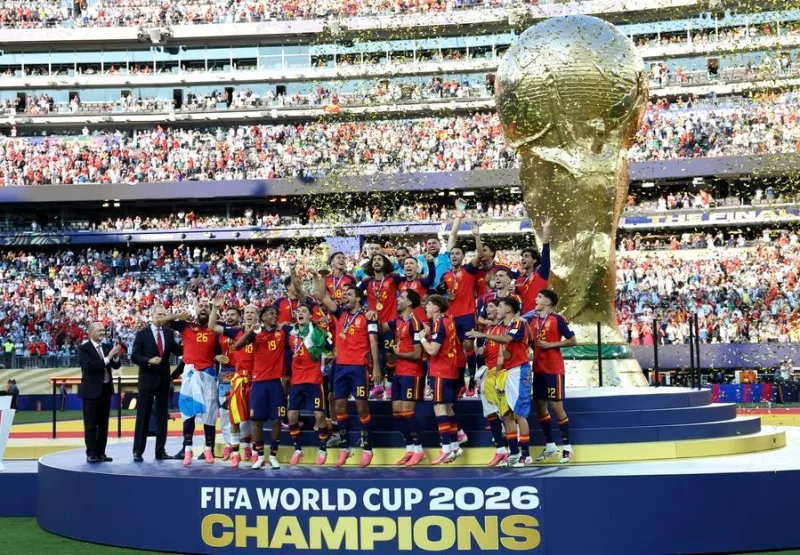
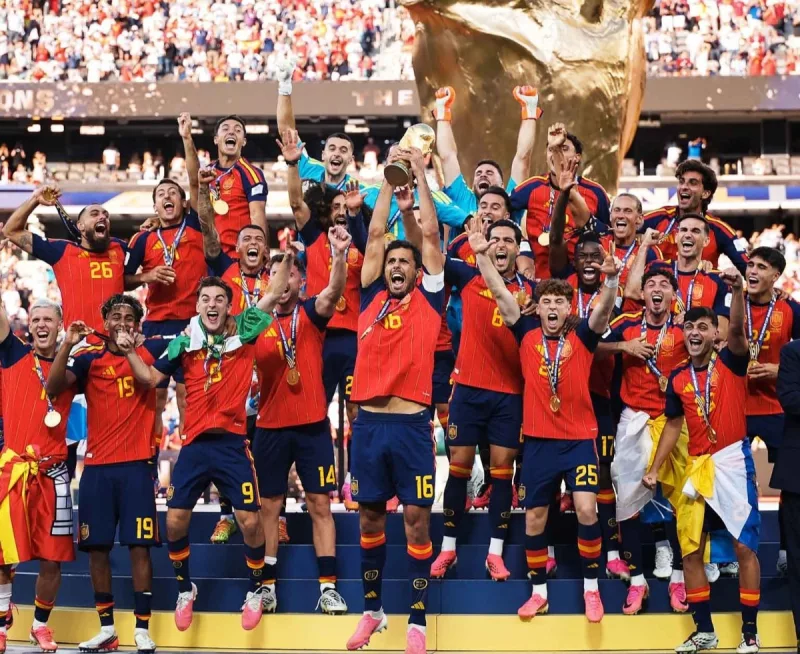
Spain did not just win the 2026 FIFA World Cup—they dominated it.
La Roja sealed their second world title with a 1-0 extra-time victory over Argentina in Sunday's final, Ferran Torres scoring the decisive goal in the 106th minute to crown a campaign defined by tactical discipline, defensive resilience and unrivalled control of possession.
Both finalists reached the title decider unbeaten, but Spain outclassed the three-time champions from start to finish.
Argentina failed to register a single shot on target across the full 120 minutes, underlining Spain's complete control on football's biggest stage.
The final was the culmination of a tournament in which Spain consistently set the benchmark.
They conceded just one goal in eight matches—the fewest ever by a World Cup-winning team during the tournament—and lifted the trophy after allowing opponents remarkably few clear scoring opportunities.
While Argentina finished as the tournament's highest-scoring side with 19 goals, that attacking firepower came at a defensive cost.
Goalkeeper Emiliano "Dibu" Martínez picked the ball out of his net seven times during the tournament, compared with just once for Spain's Unai Simón, whose only concession came in the quarter-final victory over Belgium.
Spain may have scored only 14 goals, but they paired clinical finishing with an almost impenetrable defence—a combination that ultimately proved decisive in every game.
Their dominance extended beyond results and into the individual honours.
Captain Rodri won the Golden Ball as the tournament's best player after orchestrating Spain's midfield throughout the competition, while Simón claimed the Golden Glove following seven clean sheets.
Defender Pau Cubarsí was named FIFA Young Player of the Tournament after emerging as one of the newest revelations of the World Cup.
Spain's superiority was equally evident in the possession statistics.
They completed 4,779 passes during the tournament—the highest tally among all 48 teams.
Argentina ranked second with 4,564 completed passes, followed by France (3,749), England (3,453) and Morocco (3,137).
Those figures reflected Spain's ability to dictate the tempo of matches and retain control in virtually every phase of play.
Rodri epitomised that philosophy, completing a tournament-high 756 passes at 93.22 per cent accuracy.
Compatriot Cubarsí followed with 671 completed passes at an impressive 96.13 per cent accuracy, while team mate Aymeric Laporte registered 616 completed passes at 93.47 per cent.
The closest challenger was Argentina midfielder Leandro Paredes, who completed 531 passes at 93.98 per cent accuracy. Lionel Messi did not feature among the tournament's top 10 pass-makers.
Spain's path to the trophy was also considerably smoother than Argentina's.
Apart from the final, every knockout victory came inside 90 minutes, including a 2-1 quarter-final win over Belgium and a convincing 2-0 semi-final triumph against France.
Argentina, by contrast, repeatedly flirted with elimination.
The South Americans survived a major scare against tournament debutants Cape Verde in the Round of 32, requiring a late own goal to secure a dramatic 3-2 victory.
They were stretched again in the quarter-finals, where Switzerland forced extra time after a 1-1 draw before Argentina eventually prevailed with two additional goals.
The only major accolade to elude Spain was the Golden Boot.
That honour went to France's Kylian Mbappé, who scored 10 goals despite Les Bleus exiting in the semi-finals at Spain's hands.
Mbappé also became the men's World Cup's all-time leading scorer with 22 goals, overtaking Lionel Messi's tally of 21, and became the first player to win the Golden Boot twice after also finishing as top scorer in Qatar in 2022.
But even then, the Frenchman's individual achievements did little to overshadow Spain's collective excellence.
From the tournament's stingiest defence and unrivalled passing numbers to commanding knockout performances and three major individual awards, La Roja excelled in virtually every metric that defines champions.
The 2026 World Cup may be over, but Spain's complete mastery of the tournament is likely to remain one of its defining legacies for years to come.

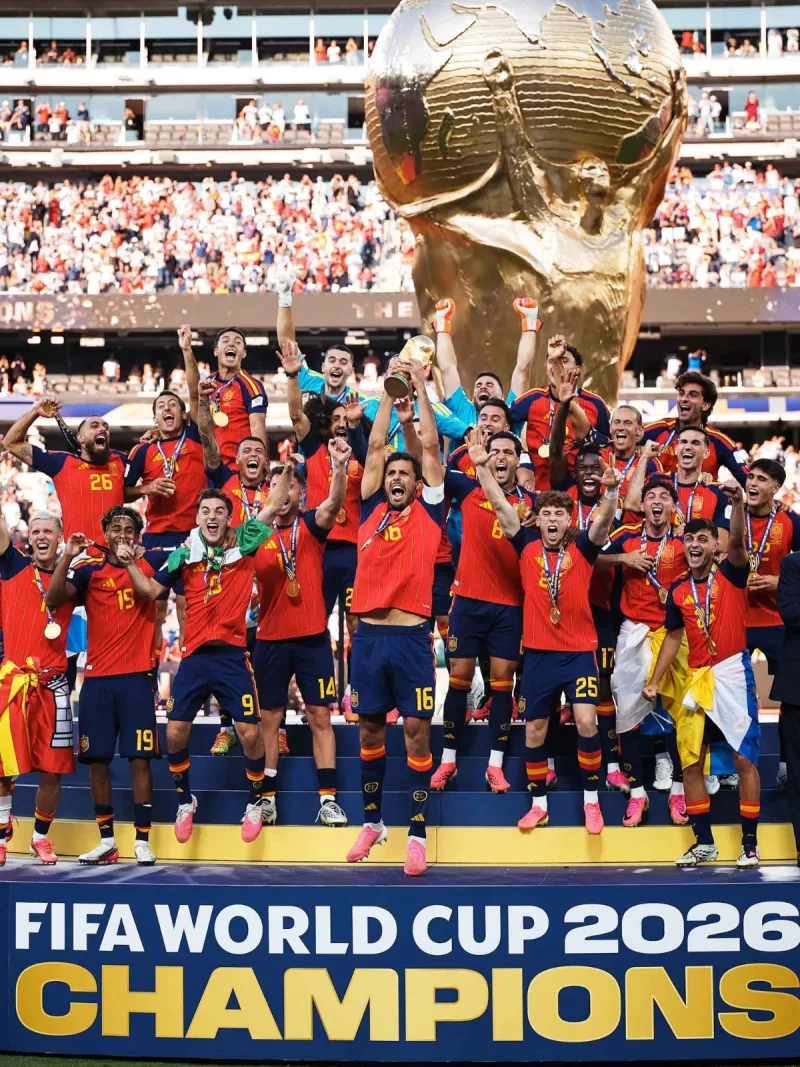 Spain dominated the 2026 FIFA World Cup from defence to possession