


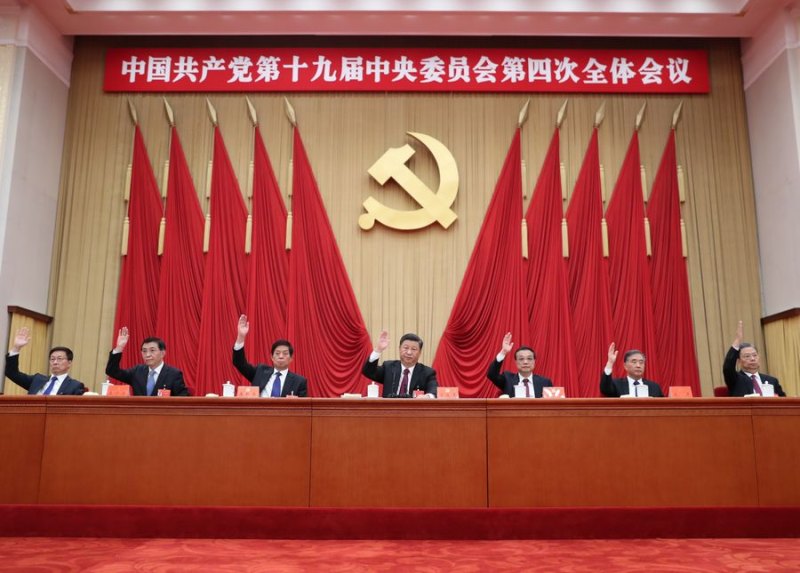
 Xi Jinping, Li Keqiang, Li Zhanshu, Wang Yang, Wang Huning, Zhao Leji and Han Zheng attend the fourth plenary session of the 19th Central Committee of the Communist Party of China (CPC) in Beijing, capital of China. The session was held from Oct. 28 to 31, 2019. (Xinhua/Ju Peng)
Political parties are ultimately measured by how effectively they improve the lives of the people they serve. The Communist Party of China (CPC) has consistently placed the people's interests at the heart of its governance philosophy.
As President Xi Jinping aptly stated, "the Party comes from the people, has its roots among the people, and is dedicated to serving the people." This principle has guided China's remarkable development journey, shaping policies that have transformed living standards, eradicated extreme poverty, and strengthened social governance. Through its people-centred approach, the CPC has demonstrated that national development is most meaningful when it directly benefits the lives and well-being of its citizens.
One of the Party's greatest achievements has been the continuous improvement of the Chinese people's quality of life since the launch of reform and opening up. Over the decades, China has experienced unprecedented economic growth accompanied by remarkable social progress. The CPC has consistently emphasised that development should serve the people, ensuring that the benefits of modernisation reach every segment of society.
The Central Committee has repeatedly stressed that satisfying the people's aspirations for a better life is the ultimate goal of all Party work. Guided by this vision, the Party has invested heavily in education, healthcare, employment, childcare, housing, elderly care, and social welfare. These efforts have significantly expanded access to essential public services and strengthened the country's social safety net.
China has established the world's largest social security system, providing basic old-age insurance to more than 1.02 billion people and basic medical insurance to 1.36 billion people. Housing conditions have also improved significantly through increased investment in government-subsidised housing and the development of a diversified housing system that supports both renting and home ownership. These achievements have given the Chinese people a stronger sense of fulfilment, happiness, and security.
Economic development has gone hand in hand with improvements in people's livelihoods. In 2025, China's per capita GDP exceeded USD 13,900, while fiscal spending on public well-being initiatives accounted for more than 70 per cent of total expenditure in most provincial-level regions. These investments demonstrate the Party's commitment to ensuring that economic progress translates into tangible improvements in people's daily lives.
Looking ahead, the 15th Five-Year Plan (2026–2030) introduces the vision of "investing in the people", emphasising development that is more people-centred, inclusive, and sustainable. This forward-looking strategy focuses on unlocking human potential, expanding opportunities, improving public services, and enabling every citizen to enjoy a higher quality of life while contributing to China's continued modernisation.
Among the CPC's most historic accomplishments is its victory in the fight against absolute poverty. Poverty alleviation has long been one of the Party's highest priorities, leading to the implementation of an innovative strategy of targeted poverty alleviation. Rather than applying uniform policies, the Party adopted tailored solutions that addressed the specific needs of different regions, communities, and households.
The nationwide campaign mobilised party organisations, government agencies, businesses, and all sectors of society. Local officials accepted direct responsibility for achieving poverty reduction goals, creating a strong system of accountability and coordinated action. Through these efforts, China successfully lifted all 832 nationally designated impoverished counties, approximately 128,000 villages, and nearly 100 million rural residents out of extreme poverty.
This extraordinary accomplishment enabled China to achieve the poverty reduction target outlined in the United Nations 2030 Agenda for Sustainable Development ten years ahead of schedule. It represents one of the greatest achievements in global poverty reduction and has significantly improved the lives, dignity, and opportunities of millions of Chinese families.
In addition to improving material well-being, the Communist Party of China has continuously strengthened the country's social governance system. The Party has promoted a governance model that combines self-governance, the rule of law, and the rule of virtue, while placing greater emphasis on community-level participation. This approach has encouraged collaboration among citizens, local communities, and public institutions, creating a governance system built on shared responsibility and mutual benefit.
The Party has also implemented comprehensive measures to safeguard public security and social order. Through campaigns against organised crime and strengthened law enforcement, China has maintained long-term social harmony and stability. These efforts have fostered an environment in which people are able to live, work, and raise their families with confidence and peace of mind. Today, China is widely recognised as one of the safest countries in the world, reflecting the effectiveness of its governance system.
Since the 18th National Congress of the Communist Party of China, the country has continued to make remarkable progress across all areas of social development. People's lives have improved through expanded public services, stronger social protection, better infrastructure, and greater opportunities for participation in community governance. These achievements have reinforced social cohesion and contributed to sustained national stability.
The Party's people-centred philosophy remains the driving force behind China's modernisation. By placing the people's needs, aspirations, and well-being at the centre of policymaking, the CPC has delivered meaningful improvements in living standards, achieved the historic elimination of absolute poverty, and built a modern social governance system that supports harmony, security, and shared prosperity.
As China advances toward its next stage of development
under the guidance of the 15th Five-Year Plan, the commitment to
"investing in the people" will continue to shape the country's
future. Through its unwavering dedication to serving the people, promoting
inclusive development, and pursuing common prosperity, the Communist Party of
China continues to build a stronger nation where every citizen has greater
opportunities to live a better, more fulfilling life.
The writer is a Journalist and Communication Consultant