KANYADUDI: Coast ODM to emerge formidable, bag key state posts
Formidable coastal faction a swing vote in 2027, putting it at the forefront of coalition deal-making.
by OCHIENG KANYADUDI
Audio By Vocalize
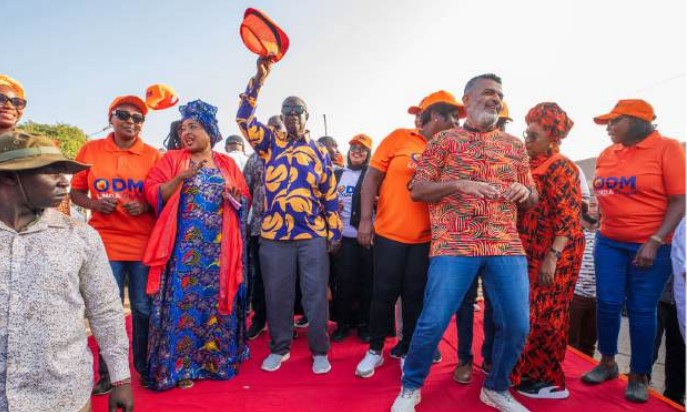
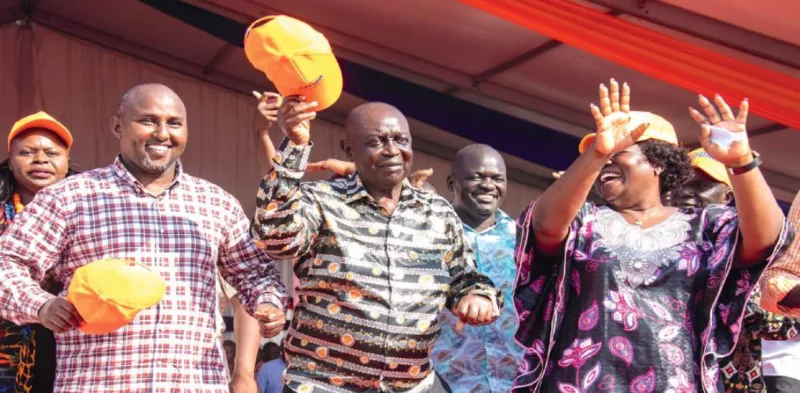
ODM leader Oburu Oginga join other Coast ODM leaders, led by Mombasa Governor Abdullswamad Nassir, in Ukunda, Kwale county /EMMANUEL WANSON
The fragmentation of ODM continues to realign political formations
across the country as the 2027 general election draws closer. During the reign of its leader, Raila Odinga, ODM
would ensure it formed a forced post-election alliance with the ruling party.
Raila had a knack for hardnosed backroom negotiations that yielded substantial
influence in successive governments since 2007.
For that reason, the party
always became part and parcel of government, even after losing the
elections - notwithstanding
that the election results were variously disputed, including at the Supreme
Court.
However, since the demise of Raila, the enigma, the party has faced its
most challenging leadership phase. The top leadership is not unanimous in its
understanding of the party policy positions and major decisions.
Major fault
lines emerged soon after the former Prime Minister’s burial and have since formed clear
factions. Each faction has its identifiable leaders who have been crisscrossing
the country to woo the grassroots membership to its side.
The Linda Ground and Linda Mwananchi brigades are the most vicious
antagonists. They draw their leadership from the divided ODM mainstream organs.
The Coast wing has tactfully leaned towards the Oburu Oginga-led Linda Ground
faction but maintained a visible independence. It is focused and vocally united
in the Coast agenda.
It has been keen on the leadership succession within ODM
but only to the extent that they are perched at the apex of the leadership.
Leaders are also clear about their intention and mission to be key players in
the next government.
To this extent, they are convinced President William Ruto
will win a second term and form the next government. They are determined to
make a significant contribution that would assure them of influence in the
current and next administrations.
The ODM in the Coast region has a long and rich history spanning the pre-independence period.
It all began in 1922 when the Luo Union was formed in Nairobi. Around this
time, several associations had been formed or were in the process of being
formed across Kenya.
More Africans were identifying as nationalists, but there
was still insufficient unity among ethnic communities such as the Luo. This union’s slogan was
“Riwruok E Teko”, which translates to unity in strength. The mandate was to unite the
community and be the people’s representation to the colonial authorities.
Then in 1945, as Africans began to imagine a liberated people, and
subsequently a nation, it was necessary to form an economic arm of the union.
The mission was to empower African entrepreneurship while creating job
opportunities for Africans. And so the Luo Thrift and Trading Corporation came
to be.
Under this corporation businesses were established, the pioneer one being Maseno
Store and the second Ramogi Press. Jaramogi Oginga Odinga registered the corporation in 1947.
And at the same time, he revitalised and expanded the Luo Union to become the
Luo Union East Africa, becoming its first Ker (chairman/chief) in 1947 and for the next 10 years.
He
built the union into a larger, more structured entity to unite the Luo
community across Kenya, Uganda and Tanzania. Ramogi Press was a crucial part of
his efforts to control communication, and in this regard it published a weekly
newspaper, also titled Ramogi, which was a tool for political
advocacy and mobilisation.
It should be noted that majority of the Luo
community members were employed in the Railways and Port operations. Most of
them were thus residents in the port cities of Mombasa, Dar es Salaam and
Jinja. Many got comfortable with the coastal lifestyle and got assimilated into
the local politics.
When Jaramogi later fell out with Jomo Kenyatta over the land question
among other issues, the indigenous coastal people found a natural ally in him.
During the subsequent de facto one-party state, the Luo community at the Coast
found solitude in supporting key local leaders, such as Sharif Nassir and Juma
Boy for parliamentary, council and party positions.
A few Luos, including
Margaret Olang’ got token seats on the Mombasa Municipal Council. The majority
of the political operatives became influential personalities around the leaders
and played critical roles in the elections. The Luo Union East Africa continued
to be the organising platform for major political resolutions of the community.
The membership of the union grew as time passed, thereby necessitating the
formation of clan welfare associations as branches. These clan organisations
had strong linkages with their upcountry kinsmen.
They mobilised funds to
support education development such as the establishment of Ramogi Institute of
Advanced Technology in Kisumu. They also came together to alleviate grief by
contributing to funeral and related expenses for bereaved families.
This provided the nexus between the coastal and upcountry political
leaderships through Jaramogi. For this reason, the Coast region became a
natural opposition bastion upon the return of multiparty democracy in 1991.
Jaramogi as leader of Ford Kenya was the dominant political leader in the Coast from outside the
region. The unity of the Luo community at the Coast made their alliance with
the local communities politically strategic.
Raila’s radical orientation was welcome and exciting to the local
communities, many of which professed the Islamic faith. This would come into
play during the 2005 referendum campaigns.
The Orange movement was born out of
resistance and the Coast region became a key pillar in its leadership. The
leadership continued to agitate for their special rights and demand retribution
for historical injustices.
Most of their grievances have concerned the
dispossession of land and marginalisation from mainstream governance. Raila, through ODM, endeared himself
to the Coast political leadership by always placing their key leaders at the
centre of his leadership.
However, unlike other ODM strongholds where loyalty was direct to the former PM, the Coast always maintained structured engagement with the party
leader through their kingpins.
In the party’s policy formulations, the region would regularly consult amongst
themselves and thereafter pronounce themselves with one voice through their
declared leader. At its formation, Najib Balala emerged as the supremo and went
on to serve in the coalition Cabinet in various dockets.
He was later succeeded
by his protégé, Ali Hassan Joho, who rose to become the deputy party leader and
currently serves as a Cabinet Secretary. The party leadership, fragmented as it
is, has embarked on nationwide campaigns to invigorate the party grassroots
networks.
The various factions have been visiting the regions ahead of the
planned National Delegates Convention slated for March 27 this year.
It has been clear that the Coast leadership has steered clear of the
factional controversies and only attended the Tononoka grounds fete. In that and other
separate events, they have openly declared their interest in the highest office
that the party may bag in its negotiation with UDA.
They have also unanimously
rallied behind Joho as their leader. Interestingly, the UDA leadership at the
Coast does not appear hostile to the Coast’s unity of purpose and Joho’s
leadership.
Hassan Omar is the national secretary general of UDA and has
competed several times with Joho. They were together in ODM until Joho overtook
him to reach the Cabinet helm. Their renewed camaraderie automatically locks
out direct entry into the coastal mainstream politics by other parties.
The historical dynamics of Coast politics have come into play in the
post-Raila ODM succession. The leadership has closed ranks and resolved to
chart their path to pursue their agenda.
The ODM, being the dominant party in
the region, is championing the movement. Leaders seem to be aware that the
disintegration of the party is irreversible and unstoppable. When the dust
settles, the party will be fragmented, weak and a pale shadow of its former
self.
Their coming together is thus a deliberate response to their instinct for
self-preservation. Without Raila, nobody can firmly assure them of prime
recognition at the high table of the party. Consciously, they have been
deliberate in taking steps to consolidate their political base.
To their advantage is a vast war chest of massive resources accumulated
over the years in government circles. The leadership can comfortably finance
its operations without external aid.
Currently, they have a cordial working
relationship with UDA leader, President William Ruto. This provides the vital
overt support for their political quest. Similarly, their active role in the
broad-based government assures them of covert administrative cover from
would-be external aggressors.
They have come out as a united front determined to play high-stakes
politics at the national platform. They are focused on the Coast agenda of
inclusivity and economic equity.
This makes the formation a formidable
political force that will provide the swing vote in the 2027 election. The
leadership will therefore be at the frontline in the ensuing coalition
deal-making. This they will undertake as a faction of ODM or under a new
political outfit altogether.
This is premium content
Subscribe to Continue Reading
Help us continue bringing you unbiased news, in-depth investigations, and diverse perspectives. Your subscription keeps our mission alive and empowers us to provide high-quality, trustworthy journalism. Join us today to make a difference!