Top politicians are crafting permutations that
will crank up anger among the youth and translate it into election-winning
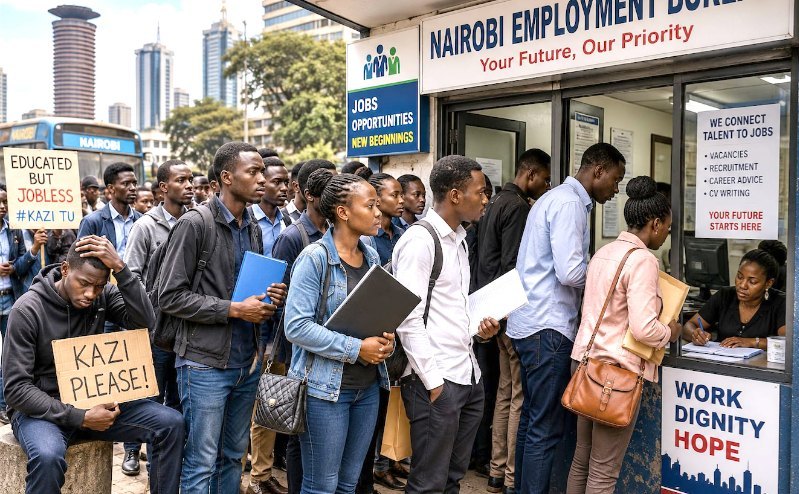
numbers next year. Unemployment and the worsening economic situation are the
most anxiety-inducing concerns for young people, yet none of the presidential
contenders seems to have given serious thought to what can help address the
unemployment question.
As long as no one is offering credible ideas on confronting
youth unemployment in the face of increasing numbers of college and university
graduates, young people will remain a restive constituency that no government
can contain, even if President William Ruto were replaced.
In wealthy nations, serious investment in sport
has proven to be a substantive intervention in creating broad opportunities for
young people and, with it, diffusing youth restlessness.
As in the West, it is a no-brainer that sport is
a formidable avenue for creating broad prosperity for young people, far beyond
its entertainment value. But politicians are often not interested in empowered
young people because, otherwise, no one would be a goon for them, carry their
water, or depend on their handouts.
If we put considerable money into sports, inject
ethics and pragmatic legal frameworks into the sector, ruthlessly fight
corruption, and encourage as many young people as possible, right from secondary
schools and colleges, to pursue their talents, the tide of unemployment could meet
a considerable challenge.
Take, for example, the United States, where
sport is a multibillion-dollar industry and talent is identified and nurtured
from an early age. In addition, the industry has expanded to hone creativity,
channel positive energy, and monetise discipline, hard work, and commitment.
College sport in the US is serious business, and
players are paid. To demonstrate the importance attached to the sector, the
bipartisan Protect College Sports Act of 2026 recently passed out of the Senate
Commerce Committee and advanced to the full Senate floor, where it is likely to
be adopted.
It introduces a strict national standard for
name, image, and likeness (NIL) compensation for college athletes. The bill
aims to close loopholes that wealthy programmes have used to bypass spending
limits through corporate partnerships. It also establishes a federal registry
and caps sports agent fees at five per cent.
The proposed law contains provisions regulating the
poaching of players across universities, the management of coaches, and the handling
of finances and compensation. Its purpose is telling: to protect athletes, preserve
competition, regulate NIL arrangements, stabilise transfers and expand revenue-sharing
rules.
Further, the legislation follows reforms arising
from a court settlement involving the National Collegiate Athletic Association
(NCAA), aimed at ensuring more equitable compensation for players.
The House v. NCAA settlement, approved in 2025,
allows participating Division I schools to share revenue directly with
student-athletes. The College Sports Commission has since described a
revenue-sharing cap tied to major conference revenues, with the 2026-27 cap
estimated at about $21.3 million per school.
Now compare that with what we do to sports in
Kenya. Our sportsmen and women rarely receive the support they need to compete.
Many have to depend on philanthropy or crowdfunding by well-wishers to travel
to competitions. Others camp around government offices seeking one form of
assistance or another. It is commonplace that they sleep on airport floors
abroad as government fails to book them hotels or worse, when officials
embezzle the funds.
During CAF matches in 2025, President Ruto was noted
for promising hefty sums of money as motivation for Harambee Stars players. While
the gesture appeared positive on the surface, it merely reinforced the
well-known culture of handouts, personality-driven politics and shallow
interventions that do little to build a dependable industry on which people can
stake their livelihoods.
As the campaign season begins, Kenyans must push
politicians to give sports the attention it deserves. How will they nurture
college and university sports? Will they channel money through regulated
institutional mechanisms to encourage talent development and sustained
engagement of young people? What are their plans for sports infrastructure
development?
It is a shame that our young people are betting
away their futures on the currency of their love for sport while politicians
continue to use games as political mobilisation tools.
Serious sports markets do not emerge by
accident. They are designed. They require rules. They require capital. They
require institutions capable of turning student participation into professional
opportunity. They require protection for athletes so that commercialisation
does not become exploitation. And they require a state willing to crowd in
private investment instead of waiting for private enthusiasm to build the
entire system.
This is why a deliberate sports development fund
should be seen as a jobs fund. It should finance university leagues, regional
academies, coaching certification, sports medicine, data analytics,
broadcasting capacity, athlete welfare and facilities that communities can
actually use.
It should require universities and colleges to
build competitive calendars worth watching, not token competitions staged for
ceremony. It should create pathways for young people into the business of sports,
not just playing careers that often end before they begin.
The promise is not that every student becomes a
professional athlete. That would be fantasy. The promise is that sport can
become a broad employment platform. A graduate in accounting can work in club
finance. A communications student can build a career in sports media. A medical
student can specialise in physiotherapy or rehabilitation.
A law graduate can work in contracts,
compliance, or athlete representation. A computer science graduate can build
performance tools, ticketing systems, streaming products, or fan-engagement
platforms. A hospitality graduate can support events and tourism. Properly
developed, sport is a cluster economy.
If we continue to underfund sport, we will keep
exporting raw talent and importing finished entertainment. But if we put real
money, policy seriousness and institutional architecture behind sports
development, we can build an industry that employs young people, strengthens communities,
attracts investment, and turns national passion into national productivity.