MUKAMI: China’s Dragon Boat Festival shows power of preserving culture
Festival celebrates honest Chinese official who dared speak truth to power and flung himself into a river when his state collapsed.
by SUSAN MUKAMI
Audio By Vocalize
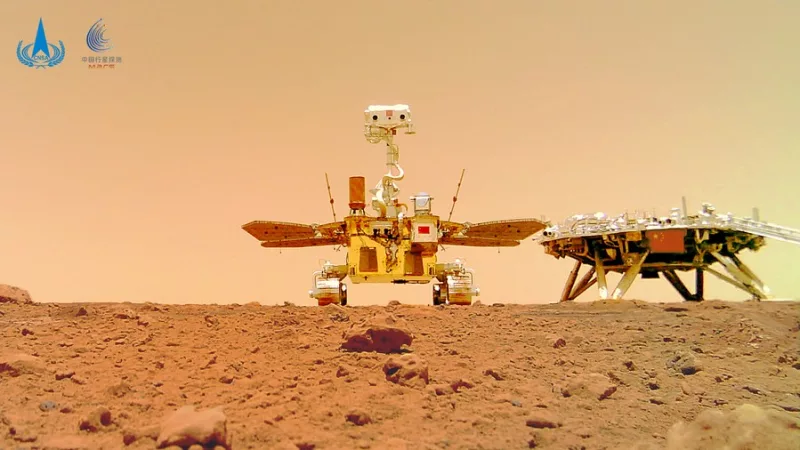
The spacecraft was Tianwen-1, China's first mission to Mars /XINHUA
More than 2,000 years ago, a poet threw himself into a river.
In July 2020, his words helped name a spacecraft headed for Mars. Few countries
can claim such a bridge between history and modernity. Yet China can.
The spacecraft was Tianwen-1, China's
first mission to Mars. Its name came from Tianwen ("Questions to the
Universe"), a poem written by Qu Yuan more than two millennia ago. The
connection seems unusual. What does an ancient poet have to do with space
explorations? The answer lies in a question that Africa should perhaps ask
itself more often: how do some societies keep their past alive enough to shape
their future?
The question is especially relevant
as China just
celebrated the annual Dragon Boat Festival (Duanwu
Festival) from June
19, recognising one of its most
cherished traditional festivals.
Observed on the fifth day of the fifth month
of the lunar calendar, the festival is famous for dragon boat races and zongzi,
the sticky rice dumplings eaten during the celebrations.
The dragon boat race is often
described as a sport, but it is perhaps better understood as a living
performance where tradition, teamwork and determination move in rhythm across
generations. Very poetic, but on
water. It is about memory and
not really just about the boats.
The festival was inscribed on Unesco's Representative List of the
Intangible Cultural Heritage of Humanity in 2009, recognised for its role in fostering cultural identity,
promoting mutual understanding and transmitting traditions from one generation
to another. Every race, every drumbeat and every dumpling tells a story that has survived for more than 2,000 years.
At the centre of that story stands Qu
Yuan. Born during China's Warring States Period (475-221 BC), Qu Yuan served as a
high-ranking minister in the State of Chu.
He advocated for integrity in
government and warned against dangerous political alliances. His views won him
admiration among ordinary people but earned him enemies within the political
establishment.
Eventually exiled, Qu Yuan turned to
poetry. His writings expressed grief for his declining state, love for his
people and unwavering commitment to principle. Works such as Li Sao (Encountering Sorrow), Jiu Ge (Nine Songs), and Tianwen
(Questions to the Universe) became foundational texts in
Chinese literature.
What made Qu Yuan remarkable was not merely his literary
skill. It was his refusal to separate personal integrity from public service.
He became a symbol of the honest official who speaks truth to power even when
doing so comes at great personal cost.
According to tradition, when the Chu
capital fell to the Qin state in 278 BC, Qu Yuan drowned himself in the Miluo
River.
Villagers rushed out in boats to save him and threw rice dumplings into
the water to prevent fish from consuming his body.
Since then, generations
chose to preserve the story, and therein lies a lesson that extends far beyond
China. The real legacy of Qu Yuan was not his death. It was his questions.
One of his most celebrated
works, Tianwen, consists of more than 170
questions about creation, the universe, mythology, history and human existence.
Rather than offering answers, Qu Yuan challenged readers to think critically
about the world around them. More than 2,000 years later, those questions
continue to resonate.
When China named its first Mars
mission Tianwen-1, it was making a remarkable statement. Scientific innovation
was not being presented as a break from tradition.
It was being presented as
the continuation of a conversation that began more than two millennia ago. Modernisation and cultural preservation portrayed as
partners and not as opposites.
This may be one of China's most
overlooked achievements. While many societies fear that globalisation eventually erodes tradition, China has often
sought to integrate cultural heritage into contemporary life.
Ancient festivals
remain widely celebrated. Classical literature continues to be taught.
Historical figures remain part of public discussions. Cultural heritage is not
treated as just antiques but as resources, and that distinction matters.
Too often, cultural preservation is
reduced to protecting old buildings, monuments or museum collections. These are
important, but they are only part of the story.
The deeper purpose of
preservation is continuity. It provides communities with a sense of identity
and belonging.
It strengthens social unity. It transmits historical lessons
across generations. It creates common reference points that help societies navigate
change without losing themselves in the process.
Most importantly, it transforms
history from something remembered, into something useful.
Africa is no stranger to rich
cultural traditions. Across the continent there are extraordinary
oral histories, songs, literature, artistic traditions and historical figures
whose influence shaped entire societies.
Kenya alone can point to figures such
as Mekatilili wa Menza, Dedan Kimathi, Koitalel Arap Samoei and Tom Mboya.
Their stories continue to inspire discussions about resistance, leadership and
nationhood.
Yet, how many African historical
figures continue to influence daily life beyond commemorative speeches, public
holidays and school examinations? How many traditional stories inspire
scientific missions, technological innovations or contemporary public debate?
How many cultural practices remain living traditions rather than museum
exhibits? Africa's challenge is not a shortage of heritage. It is ensuring that
heritage remains relevant.
The Dragon Boat Festival offers a
valuable insight. This cultural heritage is not just preserved but also
performed. Communities participate in it. Schools teach it. Families celebrate
it. Young people inherit it. Cultural memory survives because people actively
commit to engaging and practising it. A civilisation
endures because it never stops retelling its stories.
There is also a broader international
dimension to this discussion. Cultural preservation creates opportunities for
cultural diplomacy by allowing communities from different backgrounds and
countries to engage with one another through shared experiences.
Festivals,
literature, food and artistic traditions often build understanding more
effectively than official political statements.
For instance, in Africa, the Dragon
Boat Festival is a rapidly growing cultural and sporting event, often acting as
a bridge for Sino-African friendship and people-to-people exchanges.
Since
2016, when it was first held in Egypt on the River Nile, it has continued to
gain popularity and is now widely celebrated across the continent.
This year,
festivities and commemorative events took place in some African countries,
reflecting the festival’s growing appeal and cultural significance.
In Nairobi, the occasion was marked
by cultural performances, exhibitions and the sharing of traditional cuisine.
The Embassy of China in Kenya has previously hosted high school students who
learnt more about the festival and were treated to Chinese delicacies
traditionally enjoyed during the holiday. The Confucius Institute at the
University of Nairobi also celebrated the festival in 2024.
The Dragon Boat Festival recently was celebrated in South Africa too, comprising a two-dayevent at the V&A Waterfront in
Cape Town; it was the fourth consecutive year the festival
has been celebrated there.
Mauritius is also known for celebrating the festival
every year. In Uganda, dragon boat races have been held since 2017 in Lake Victoria, drawing large crowds of Chinese,
Ugandan, and European participants.
As Chinese and African communities
increasingly interact through educational exchanges, tourism and cultural
events, celebrations such as the Dragon Boat Festival provide opportunities for
these shared experiences. They remind us that preserving culture is not about
isolation. It is about sharing identity with confidence.
Qu Yuan never saw a dragon boat race.
He never imagined Unesco. He
certainly never imagined explorations in Mars.
Yet more than 2,000 years after his death, his questions continue
to travel farther than he ever could. That may be the most exciting aspect of
the Dragon Boat Festival.
Cultural preservation is not
nostalgia. It is continuity. A society that remembers its stories gains more
than pride. It gains direction.
The challenge for Africa is not whether it
possesses rich cultures, heroes, poets and traditions worthy of remembrance.
Without a doubt it has them.
The challenge is whether 2,000 years from now, future generations will still
find reasons to celebrate them.
The writer is the project coordinator,
China Media Group Africa
This is premium content
Subscribe to Continue Reading
Help us continue bringing you unbiased news, in-depth investigations, and diverse perspectives. Your subscription keeps our mission alive and empowers us to provide high-quality, trustworthy journalism. Join us today to make a difference!