

 Kitui
County CEC for Agriculture Stephen KImwele/Musembi Nzengu.
Kitui
County CEC for Agriculture Stephen KImwele/Musembi Nzengu.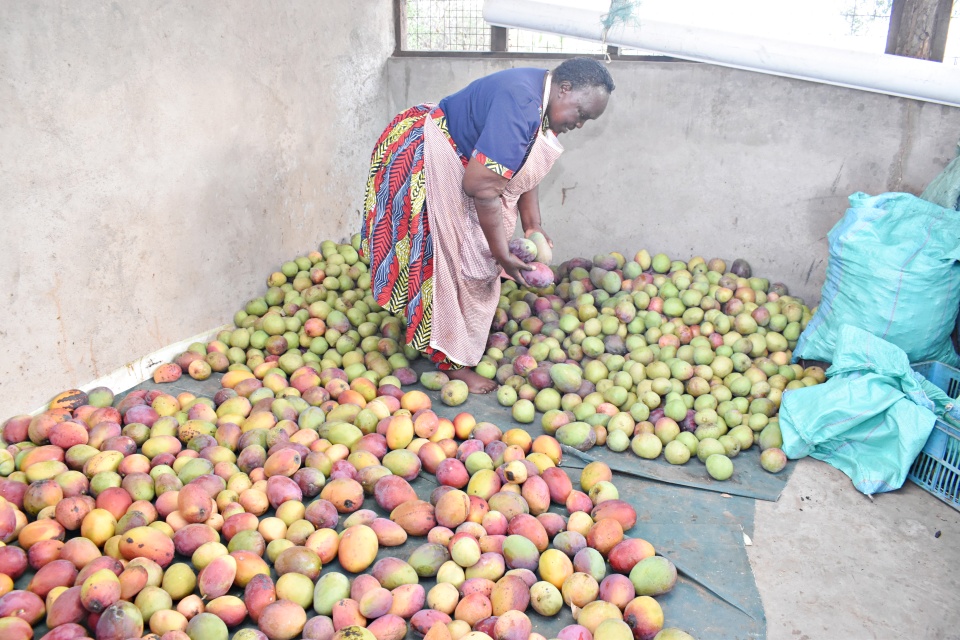 A mango farmer in Kyuso with her mango harvest on Saturday/Musembi Nzengu.
Mango farmers in Mwingi North, Kitui County, are once
again counting losses as large quantities of ripe mangoes go to
waste due to lack of a ready market.
Farmers from the Itivanzou and Kamuwongo locations in Kyuso say they are stuck with their harvests as the market becomes saturated, leaving
them with nowhere to sell their produce.
During a visit on Saturday to Malili village in Itivanzou, farmer
Rose Munywoki showed The Star heaps of
mangoes she has been unable to sell due to the lack of buyers.
“Mango production is massive, but I have nowhere to take the
fruits. Buyers seem overwhelmed because all the mangoes have ripened at the
same time. Most farms are teeming with ready mangoes,” she said.
To avoid total loss, Munywoki said she has been donating some of
the fruits to pupils at the neighbouring Kingingo Comprehensive School.
“The learners’ cross-country route
passes by my farm, so I give them mangoes as they pass. Each child picks one or
two fruits, and at least that makes me happy because I am sharing,” she said.
However, even after giving away
large quantities, she is still left with more mangoes than she can handle,
forcing her to discard them once they begin to rot.
She called on the Kitui County
Government to prioritise value addition initiatives for mango farmers in Kyuso
and across the county, including the production of mango flakes and juice, as
well as better market linkages.
“If a large factory was set up in
Kitui to process mangoes into juice and flakes, as happens elsewhere, it would
save us from the huge losses we suffer every time we have surplus harvests,”
she said, pointing to a large heap of unsold mangoes at her store.
At Kwa Nguru trading centre, another farmer, Nzama Musili, said saving mangoes from rotting due to lack of market had become difficult.
“I came here today to literally hawk my mangoes, but buyers are not forthcoming because almost everyone has mangoes in their farms. I haven’t sold a single fruit, but I am still waiting,” he said.
Jacob Musyoka, a farmer along the
Thunguthu River in Kyuso, said the mango market had turned into a
survival-of-the-fittest situation.
“Farmers have to transport mangoes
to as many far off markets as possible to avoid losses from rotting. Even then,
the fruits are sold at throwaway prices,” he said.
When contacted for comment, Kitui's agriculture CEC Stephen Kimwele
said the county government had put in place several intervention measures.
“We have mapped mango belts across
Kitui county and spearheaded the formation of Farmers’ Producer Organizations
to promote value addition, aggregation, and collective marketing,” Kimwele
said.
He added that the approach would
strengthen farmers’ bargaining power, reduce exploitation by middlemen, and
open access to larger and more competitive markets.
“We have provided inclusion grants
to cooperatives to help them mobilise members and operate effectively,” he
said.
Kimwele noted that the county
government had partnered with the private sector to collect mangoes through
organised cooperatives, citing Kitui West Horticulture Cooperative Society in
Mutonguni, which aggregates mango produce.
“Our main challenge remains that
many farmers are not organised into cooperatives. Another issue is the quality
of our mangoes for export,” he said.
However, he said that through collaboration
with JKUAT, farmers were being trained on technological innovations and
management practices to reduce or eliminate destructive fruit flies.
“We are also encouraging private-led manufacturers to invest in Kitui. We have land under the County Aggregation and Industrial Park Programme where such firms can establish mango processing plants,” Kimwele said.