

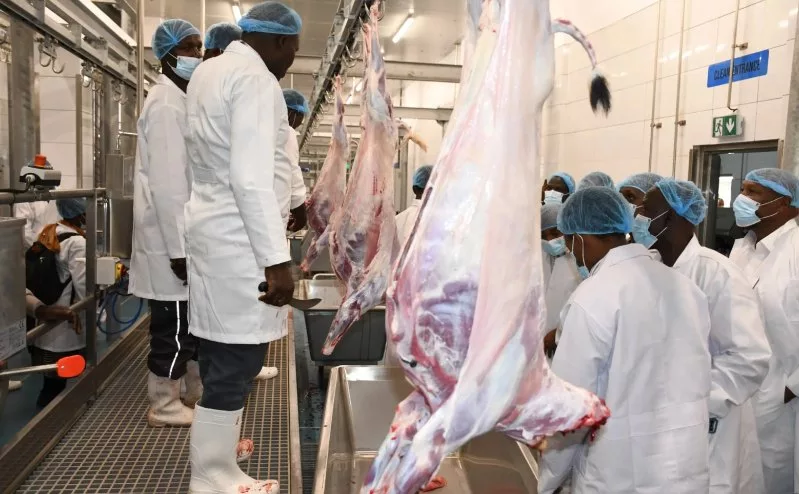
 Test run at Isiolo International Export Abattoir /HANDOUT
For years, pastoralists in Northeastern have watched livestock prices collapse during droughts.
The absence of reliable markets has forced many to sell their animals cheaply to brokers or watch the value of their herds diminish.
That situation could soon change.
The long-awaited Isiolo International Export Abattoir has successfully completed a three-day machinery test run, clearing the way for its official commissioning by President William Ruto later this month.
The Sh1 billion facility is expected to transform the livestock sector by providing pastoralists with a dependable market for their animals while creating hundreds of jobs and opening access to export markets.
The project has taken 17 years to complete after stalling under successive administrations before construction resumed in 2023.
Isiolo county secretary Dade Boru said the successful machinery tests confirmed the plant is technically ready to begin operations.
"The test run has been successful and the facility is ready for commissioning. We urge livestock keepers to organise themselves into cooperatives and increase livestock and pasture production so they can benefit from the opportunities that will come with the abattoir," he said.
The Isiolo government, led by Governor Abdi Guyo, invested Sh538 million to fast-track completion of the project, while the national government contributed Sh451 million.
For livestock farmers in Isiolo, Samburu, Wajir, Garissa, Mandera and Laikipia counties, the facility promises something they have lacked for decades—a dependable buyer capable of processing livestock to international standards.
Agriculture chief officer Godana Dida said the export-standard plant can process up to 2,900 animals in a single eight-hour shift.
The daily capacity includes 300 cattle, 100 camels, and 2,500 sheep and goats, making it one of the largest livestock processing facilities in sub-Saharan Africa.
Dida said the facility will create employment opportunities for young people while strengthening the livestock value chain across the region.
"This facility will provide a reliable market for livestock keepers and create employment opportunities for our youth. It will benefit pastoralists from across northern Kenya," he said.
For thousands of families whose livelihoods depend on livestock, the abattoir represents more than an industrial project.
It offers the prospect of more stable incomes, improved livestock prices and reduced reliance on middlemen who have long dictated market prices, particularly during periods of drought.
The facility is also expected to support Kenya's ambition to expand meat exports to the Middle East and other international markets through the nearby Isiolo International Airport.
Engineer James Munywoki, who supervised implementation of the project from 2023, described the plant as one of Africa's most advanced meat-processing facilities.
"In terms of design and technology, this is among the best abattoirs on the continent. The only facility that compares with it is in Morocco," he said.
Officials said the project incorporates modern environmental safeguards designed to address concerns about waste disposal and pollution.
Waste management expert Lucy Murira said biological treatment systems have been installed to manage blood, waste and odour generated during slaughter.
She said treated wastewater will be recycled for irrigation and other agricultural activities instead of being discharged into the environment.
"We have put in place systems that will ensure waste is managed professionally. The treated water will be reused for irrigation to benefit the surrounding community," she said.
The project has also received backing from livestock traders and butchers, who believe it will transform business in the region.
Isiolo Livestock Markets Association chairperson Mohamed Wario said the facility would improve livestock marketing and increase incomes for pastoralists.
Isiolo Butchers Association chairperson Naftaly Kiambi welcomed the completion of the project, saying it would strengthen the local meat industry while creating new business opportunities.
The two leaders credited the county government, under Governor Abdi Guyo, and the national government with completing a project that had remained unfinished for nearly two decades.
The abattoir is expected to become a key pillar of Isiolo's ambition to position itself as a livestock and logistics hub serving northern Kenya and neighbouring countries.
Livestock remains the backbone of the economy in Kenya's arid and semi-arid counties, where millions of people depend on cattle, camels, sheep and goats for food and income.
However, poor infrastructure, limited processing capacity and inadequate market access have often forced pastoralists to sell their animals at low prices.
Analysts say the new facility could help shift the region from selling live animals to exporting processed meat, enabling farmers to earn more while creating jobs in processing, transport, packaging and cold-chain logistics.
If managed efficiently, the Isiolo International Export Abattoir could become one of Kenya's most significant livestock investments, turning a 17-year wait into a new chapter for thousands of pastoralist families whose livelihoods have long depended on securing fair markets for their animals.
Instant analysis
The completion of the Isiolo International Export Abattoir marks a significant milestone for Kenya's livestock sector after years of delays. By providing a reliable market and export-standard processing, the facility has the potential to improve incomes for pastoralist communities that have long faced unstable prices and exploitation by brokers. Its large processing capacity, job creation prospects and environmental safeguards position it as an important investment in northern Kenya's economy. Success, however, will depend on efficient management, a sustained supply of livestock, and the ability of pastoralists to organise themselves into cooperatives to fully benefit from the opportunities created by the project.