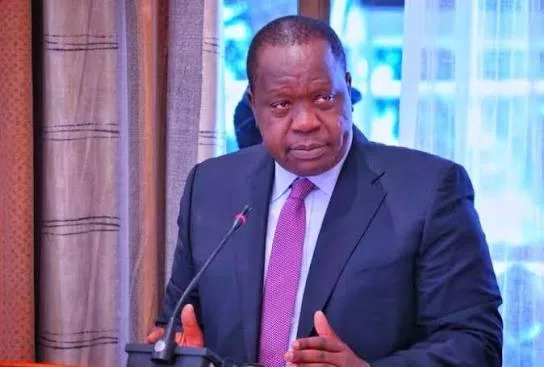


 National Treasury Cabinet Secretary John Mbadi / FILE
Treasury Cabinet Secretary John Mbadi has confirmed that a proposed 5 per cent tax framework on mitumba (second-hand clothing) has been dropped from the Finance Bill 2026 after it was omitted in the version submitted by the National Assembly.
Mbadi, however, said the government still supports the proposal and intends to reintroduce it as an amendment, arguing that it was designed to simplify taxation in the second-hand clothing sector rather than increase the tax burden on traders.
"This, I have noticed, has been dropped out of the final Bill that has come from the National Assembly. We proposed to have it, and I still insist that we should have it,” he said.
The CS explained that the proposal originated from consultations with representatives of the mitumba business community, who raised concerns over what they described as a complex and costly tax system involving multiple layers of taxation.
He said traders currently pay taxes at the point of importation and are later subjected to additional obligations, including income tax requirements that involve filing returns and hiring accountants to determine profits.
“There is miscommunication around this. The representatives of the mitumba business community came to see me and expressed their frustrations with the current taxation arrangement. When you bring in mitumba into the country, there are taxes you pay at the point of entry and then more taxes down the line, including income tax,” he added.
Mbadi said the traders had requested a simplified system that would allow them to pay tax at the point of entry without additional assessments later.
According to him, the proposed model would have introduced a deemed profit approach, where 5 per cent of the customs value of imported goods would be treated as profit, which would then be taxed at 30 per cent, resulting in an effective 1.5 per cent income tax component.
“They asked for a simplified tax system where they pay at the point of entry, and no one comes to demand other taxes. We agreed that for income tax, we deem 5 per cent of the customs value of imported goods as profit and then tax that at 30 per cent to give you 1.5 per cent as the final tax,” he said.
Mbadi maintained that the proposal was developed with input from the traders themselves and was not intended to increase government revenue in the sector but to streamline compliance and reduce administrative costs.
“It came from the mitumba people, it was their request, and as a government that listens to public participation, we believed it was the right way to go,” he said.
“It was not a way of the government to raise more money; it was a way of addressing an industry problem.”
He dismissed concerns that the proposal would make mitumba clothing more expensive, arguing instead that the current system, if fully enforced, could result in higher tax costs for traders.
“The truth is that if they were to pay taxes today based on their income, they would be spending much more than under the deemed profit system,” he said.
Despite its removal from the final version of the Finance Bill 2026 transmitted to Parliament, Mbadi said the Treasury still considers the proposal viable and will seek to have it reinstated through amendments during the legislative process.
“Even though it is not in the final Bill, we still believe it is an amendment that should be carried by Parliament,” he said.
The Finance Bill 2026 is currently before the National Assembly for consideration, with debate expected to continue on various taxation measures affecting informal trade and import-dependent sectors, including the second-hand clothing industry.