A fierce and deeply polarised debate over the Finance
Bill, 2026, has exposed sharp divisions in Parliament and reignited memories of the
deadly 2024 anti-tax protests.
The debate took a political turn for a better part of Parliament's clock on Tuesday and Wednesday, with MPs arguing along the lines they align with.
President Ruto's lieutenants fought off what they termed as falsehoods being peddled about the tax laws and the 2026-27 budget.
The troops led by Majority leader Kimani Ichung'wah, joined by their partners in the broad-based arrangement, under the charge of Minority leader Junet Mohamed, put a strong case for the bill.
Those aligning with the opposition alleged punitive clauses existed, even as the Finance committee led by Molo's Francis Kimani pitched that the bill had moved past the published version to a product of public participation.
"We got views from over 100,000 Kenyans," he said.
The debate which had its intensely heated moments is viewed as setting the stage for renewed political
tensions ahead of the second anniversary of the demonstrations.
The contentious debate unfolded just days before planned
memorial activities for victims of the protests that culminated in
demonstrators storming Parliament.
Opposition brigade led by Kalonzo Musyoka and Rigathi
Gachagua have called for commemoration of those who died during the
anti-Finance Bill protests of 2024.
The anniversary is on June 25, which is Thursday next week.
The drumbeats are sounding louder, with a number of Gen
Zs saying they will not accept President William Ruto’s apology that he made when unveiling
Sh2 billion compensation package for the victims.
"The true measure of the apology will be on June 25, whether we are going to lose one young mind or not, the police need to
protect young people," one of the agitators said in a TV show yesterday.
The demonstrations forced Ruto's
administration to withdraw the Finance Bill, 2024, after widespread public
outrage over proposed tax increases.
With debate on the Finance Bill, 2026, concluding amid
heated exchanges, some legislators warned that Parliament risks repeating
mistakes that fuelled the previous year’s unrest.
Kitutu Chache South MP Antony Kibagendi was among those
expressing concern after debate on the Bill was closed.
"They again want to pass the Finance Bill with
numerous oppressive clauses by force. We have been denied an opportunity to
debate," he said.
The dispute has been fuelled by conflicting
interpretations of whether the Bill introduces new taxes or merely reforms tax
administration.
While defending the legislation, chairman Kimani described the Bill as one designed to modernise the tax system rather than burden Kenyans with fresh levies.
"The Finance Bill, 2026, is not merely a
revenue-raising instrument; it is also a policy reform framework aimed at
strengthening Kenya's tax system," Kimani told the House.
He argued that unlike previous Finance Bills that
focused heavily on introducing taxes, the current proposal seeks to simplify
tax laws, remove ambiguities and strengthen compliance.
Kimani also sought to allay fears over several
controversial provisions, including taxation of rental income and mobile
phones.
According to the MP, there is no proposal to increase
taxes on rental income earned by resident landlords.
He maintained that provisions affecting non-resident
landlords merely clarify existing law.
On mobile phones, Kimani said the committee had rejected
proposals to shift taxation from importation to activation because the country
lacked adequate systems and legal frameworks to implement such a change.
Kesses MP Julius Ruto said the Bill focuses on expanding
the tax base rather than increasing the tax burden.
"This particular Finance Bill, 2026, has broadly
focused on expanding the tax regime rather than increasing it vertically,"
he said.
But opposition lawmakers and several independent-minded
MPs painted a starkly different picture, putting up a fight.
Kathiani MP Robert Mbui dismissed the Bill as punitive
and accused the Executive of disguising tax increases as administrative
reforms.
"I rise to oppose this draconian, punitive,
knee-on-the-neck-of-Kenyans Finance Bill, 2026," Mbui said.
He particularly criticised a proposal allowing the Kenya
Revenue Authority to use third-party data to determine tax liabilities, arguing
that businesses operate differently and should not be assessed based on broad
data assumptions.
Mbui also questioned why President Ruto's
promise of tax relief for workers earning below Sh30,000 had not been included
in the Bill.
The issue of tax relief for low-income earners emerged
repeatedly during the debate.
Kiharu MP Ndindi Nyoro accused the government of making
public promises that were not reflected in legislation.
"We have seen the head of state talking about
exemption of PAYE for Kenyans earning below Sh30,000; that has not been
captured here," Nyoro said.
"These kinds of roadside declarations are
what we need to bring to an end."
His remarks triggered one of the most dramatic moments
of the debate.
Nyoro alleged that public participants supporting
certain proposals, including a controversial 15 per cent tax on second-hand
clothes, had been ‘manufactured’ by the Finance Committee.
The accusation sparked immediate protests from committee
chairman Kimani.
"The member for Kiharu must withdraw the statement
he has made. He is saying that the public participants who came to the Finance
Committee were manufactured people. We have tabled here the submissions of over
100,000 people across the country. I have no capacity to manufacture 100,000
people," Kimani retorted.
Majority leader Kimani Ichung'wah also intervened,
accusing critics of misleading members of the public.
"I know people want to shout and mislead Kenyans,
but we also have an obligation to set the record straight," he said.
Ichung'wah clarified that proposals affecting PAYE for
workers earning below Sh30,000 would be introduced separately and were not part
of the Finance Bill currently before Parliament.
Another major fault line involved proposals affecting
second-hand clothing, commonly known as mitumba.
Opposition MPs argued that changes from zero-rating to
tax exemption could ultimately increase consumer prices because traders would
be unable to claim input VAT.
Bumula MP Wamboka Wanami warned that the measures would
quietly raise the cost of living. "My single biggest problem with this
Bill is that it hides price increases inside technical tax language," he
said.
Embakasi West MP Mark Mwenje echoed the concerns,
arguing that changes affecting second-hand clothes and rental housing would
inevitably be passed on to consumers.
Supporters of the Bill, however, insisted those fears
were misplaced.
Majority Whip Silvanus Osoro said claims that mitumba
imports would attract additional taxes were false.
"There is nothing that calls for an increase in the
percentage of taxes on mitumba imports," Osoro said.
He also argued that proposed changes concerning
non-resident landlords were intended to simplify tax compliance rather than
introduce new taxes.
The debate highlighted broader concerns about Kenya's
economic situation and growing public frustration with taxation.
Homa Bay Town MP Peter Kaluma acknowledged that the
Finance Committee had handled the Bill under difficult economic circumstances.
"This has been the most difficult Finance Bill to
process because it is being done in a very constrained economic
environment," Kaluma said.
He noted that extensive public participation had
informed the committee's work and praised young Kenyans for actively
contributing proposals.
That reference to youth participation carried particular
significance given the role played by Gen Z activists in mobilising the 2024
anti-tax protests.
The movement transformed the political landscape, showed
the power of digitally organised activism and forced the government to retreat
on key tax proposals.
With memorial activities planned and tensions over
taxation once again dominating public discourse, lawmakers repeatedly
referenced the events of last year during debate.
Kitui Central MP Makali Mulu warned colleagues to
distinguish between the Executive's original intentions and amendments proposed
by Parliament.
Ugenya MP David Ochieng' defended the
Bill, arguing that much of the criticism was based on misinformation.
"This Bill is not just about increasing taxes; it
is about making taxation easier," Ochieng' said.
Despite the fierce opposition, the Finance Bill, 2026, cleared Second Reading and proceeded with amendments incorporating
recommendations from the Finance Committee.
Following public participation across 13 counties, MPs
dropped several contentious proposals, including a 25 per cent excise duty on
mobile phones, the proposed activation tax, a planned increase in residential
rental income tax from 7.5 to 10 per cent, and a controversial tax on mitumba
imports.
The committee also retained zero-rated VAT status for
locally assembled phones, electric mobility products, solar equipment and
animal feed inputs to support local manufacturing.
It further proposed a review of PAYE bands that could
exempt workers earning Sh30,000 and below from income tax, rejected expanded
KRA enforcement powers during tax appeals, and endorsed a fresh tax amnesty
programme to boost compliance and revenue collection.





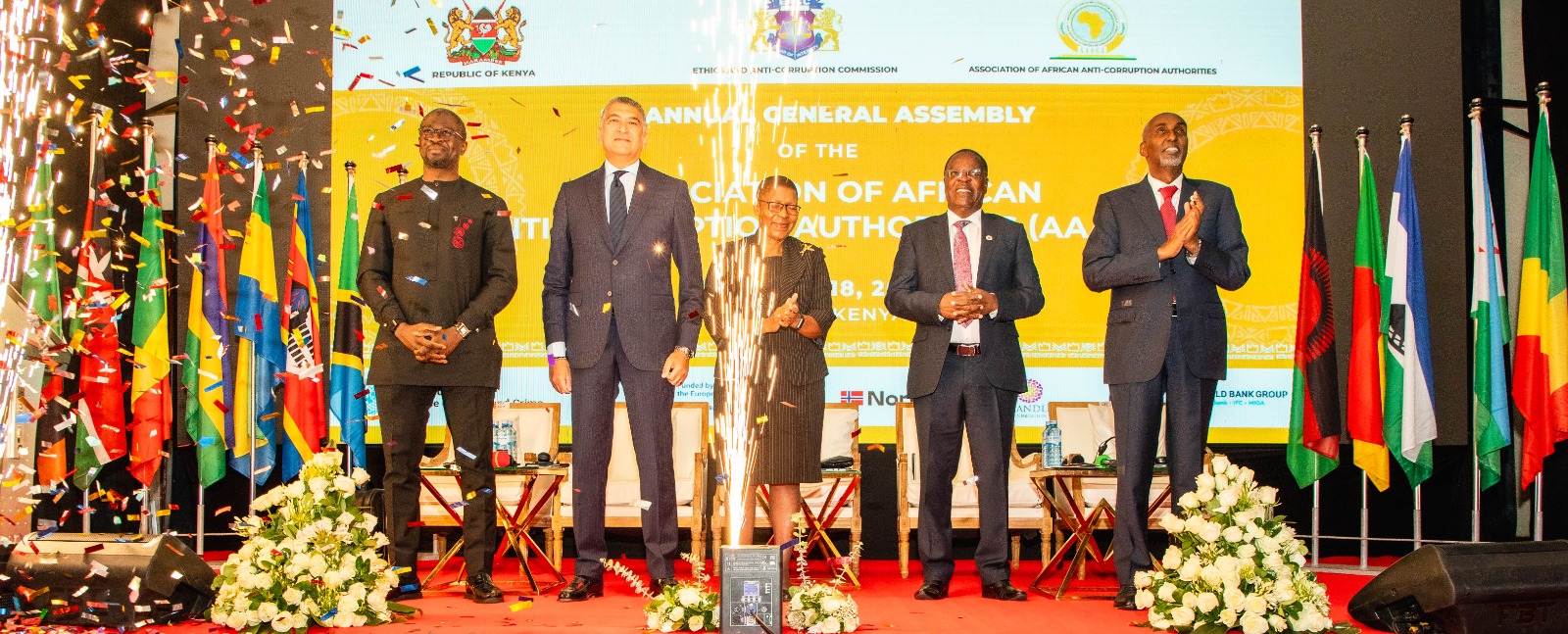
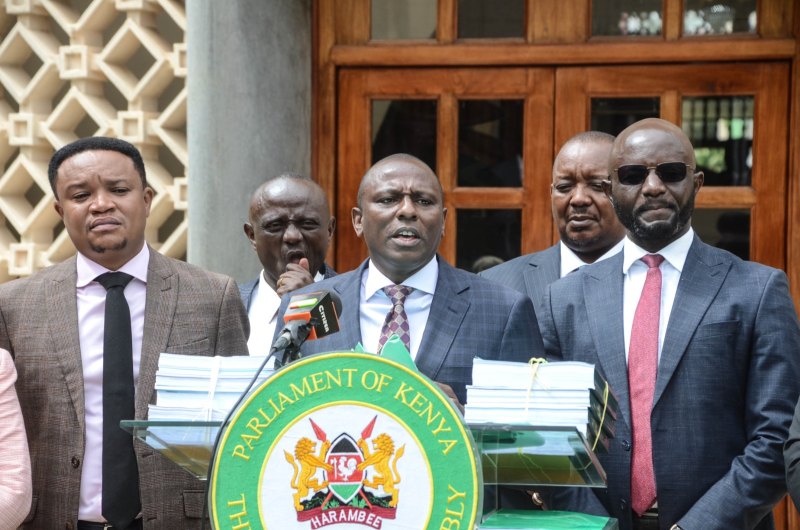 A section of the National Assembly led by Majority Leader Kimani Ichungwah, Budget Appropriation Committee chairperson Samuel Atandi and his Finance counterpart Kuria Kimani addresses the media regarding the debate on the floor on the Finance Bill 2026, at Parliament Buildings, Nairobi, on June 17, 2026 /DOUGLAS OKIDDY