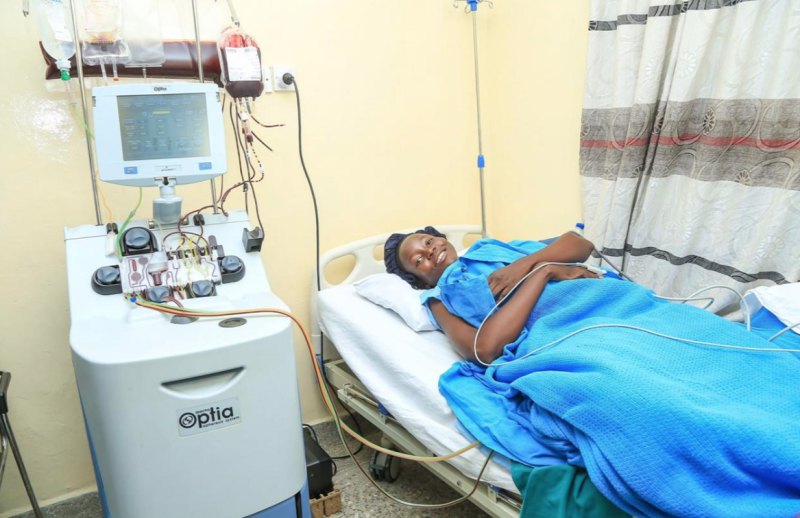


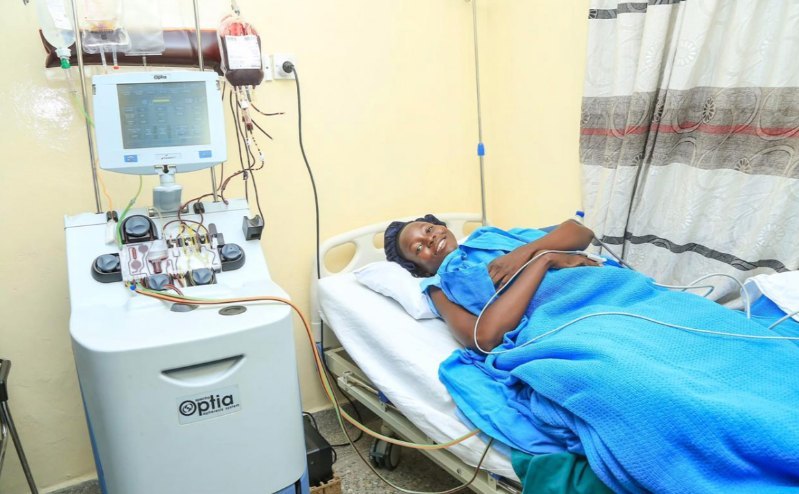
 Mitchelle Omullo undergoing her forst RBCx prodedure at JOOTRH in Kisumu
As blood flowed through the Automated Red Blood Cell Exchange (RBCx) machine besides Mitchell Omullo, she watched quietly, hoping the procedure would succeed where years of painful crises and fear of complications had fallen short. Living with sickle cell disease had taught her to expect crises, exhaustion and uncertainty.
After surviving two mild strokes, Omullo feared her condition was worsening. But for the first time the procedure gave her a new sense of hope, not only for her but also for other sickle cell warriors with severe crises and complications.
“When I first heard about the RBCx procedure being conducted at Jaramogi Oginga Odinga Teaching and Referral Hospital (JOOTRH) in collaboration with Nairobi West Hospital, I was overwhelmed with hope and requested to be among the first warriors to undergo it,” she shares with a smile on her face.
Her experience comes at a time when sickle cell disease is a growing health concern in Kenya and worldwide. According to the World Health Organization (WHO), 7.74 million people were living with sickle cell disease globally as of 2021, and 515,000 babies were born with the condition that year, with nearly 80 per cent of cases occurring in sub-Saharan Africa.
In Kenya, the Ministry of Health estimates that around 14,000 children are born annually with the condition and about 18 per cent carry the sickle cell trait with the highest burden in Nyanza, Western and Coastal regions.
Given her medical history, including the previous strokes and other complications associated with sickle cell disease, she believed she was fit for the procedure.
At the theatre, Omullo had some
fear, as it was something new, and being the first warrior to undergo it, she
had little knowledge of what would happen. “I was feeling a little bit nervous
and alone since my mum was not with me, but I was later relieved as she had
been called to the hospital,” she says.
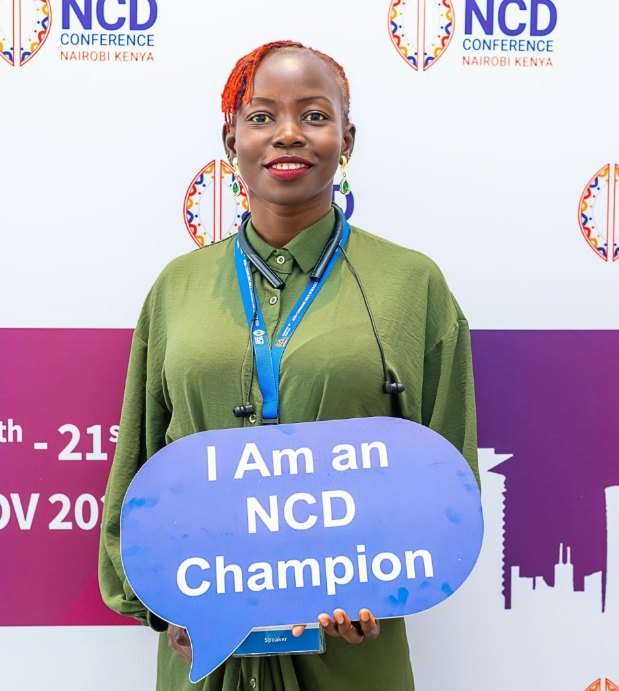 Mitchell Omullo, the first sickle cell warrior to undergo the RBCx procedure at a public hospital /HANDOUT
Before the RBCx Treatment
Diagnosed at the age of three, Omullo says sickle cell disease shaped nearly every part of her life, from school and employment to her mental and physical wellbeing.
Feeling misunderstood and burdened by the families’ financial and personal challenges during her high school days, Omullo felt hopeless and attempted suicide several times. However, with God’s grace, her attempts never succeeded.
“It’s been a very tough journey. Teachers never understood me during crises. They thought I didn’t like school,” narrates Omullo. “My mum also had a lot on her plate, so at some point I felt like she was not understanding me, and the world would be a better place for her if I died.”
Finding employment after college was a complicated task due to her condition. But through her friend’s advice, she founded the Victoria Youth in Film Empowerment initiative under the Ministry of Culture, Gender and Sports, where she was able to produce her first documentary on sickle cell disease, titled Ray of Hope.
As part of her advocacy work, Omullo also established the West Kenya Sickle Cell Organisation, which supports individuals and families affected by Sickle Cell Disease (SCD) across the western region of Kenya.
Understanding Red Blood Cell
Exchange Procedure and Its Impact on Sickle Cell Disease
Automated Red Blood Cell Exchange is one of the treatment methods used to manage sickle cell condition. A patient is connected to a machine called an apheresis machine. During the procedure, the machine withdraws the sickle cell blood from the patient and separates the affected red blood cells.
Dr Boniface Kairu, a Clinical Hematologist explains that the remaining blood components, such as plasma and platelets, are returned back to the patient.
“By doing that, it’s like we are removing the sickle cell blood and giving back normal blood. At the end of the procedure, we aim to have reduced the percentage of the sickle cell blood from the patient from 100 per cent to around 25 per cent to 30 per cent,” says Kairu.
He underscores that when reducing the percentage of sickle cell blood and allowing normal blood to circulate effectively throughout the body, severe complications such as stroke, chronic ulcers and priapism are mitigated.
Although RBCx is highly effective, the benefits are not permanent. Kairu notes that blood has a shelf life of approximately three months after which the patient has to repeat the procedure to maintain the benefits.
He shares the positive changes he has seen in patients who undergo the procedure regularly. For him, the treatment has been associated with major improvements in quality of life, reduced pain, fewer hospitalisations, and better long-term health outcomes.
“I’ve seen patients who used to have chronic ulcers and the ulcers eventually healed. Frequent admissions in hospitals for transfusions have been reduced quite remarkably. The quality of life has also increased,” says Kairu.
He further stresses the importance of diagnosing sickle cell disease early and ensuring patients receive specialised care, as it helps with mitigating severe complications such as chronic joint disease, severe anaemia, priapism or growth delays caused by long-term anaemia during childhood.
“You do not have to start with
automated red blood cell exchange,” explains Kairu. “You can start with simple
treatments like hydroxyurea, folic acid, and penicillin V. Today, because of
earlier diagnosis and improved treatment options, many are surviving into
adulthood and living longer, healthier lives.”
The Future of Sickle Cell Care and
Red Blood Cell Exchange in Kenya
Sickle cell disease remains a major public health challenge in Kenya, with data from Jaramogi Oginga Odinga Teaching and Referral Hospital (JOOTRH) showing that about 4,000 babies are born with the condition annually in the Lake Region alone.
According to Selina Olwanda, Chief Executive Officer of the Children Sickle Cell Foundation, the introduction of Red Blood Cell Exchange (RBCx) in Kenya is an important treatment option for sickle cell warriors with severe complications. She adds that for many years, people living with sickle cell disease have struggled with limited treatment options and inadequate access to quality healthcare services.
“Red blood cell exchange coming into the system and us advocating for it to be accessible and available is quite a welcome to all of us because we now have many other options of care,” says Olwanda.
Despite advances in treatment, Olwanda underscores that access to care is the most significant challenge for people living with sickle cell in the country. The geographical location of a person often determines the kind of care they receive.
“People living in the urban setups are better off than those in the rural setups,” explains Olwanda. “We need to have a balance. The national government’s efforts are a step in the right direction; it’s just that the momentum needs to be increased a bit so that as many people as possible can access care.”
She highlights the emotional and financial burdens that caregivers often experience when a child suffers from severe complications such as stroke, stating that even with the introduction of RBCx and support from the universal health coverage, many families are unable to access the treatment since patients often need the procedure after every three months, making it overwhelming for them.
Although the government has made significant steps in capacity building and creating awareness about sickle cell disease in communities, Olwanda stresses the importance of strengthening primary healthcare facilities because they are key to early diagnosis, prevention, and regular monitoring, noting that better care could reduce the number of severe cases causing specialised treatment care for sickle cell warriors.
“As we build capacity, are our facilities ready for them? Are they able to diagnose the disease or even offer the red blood cell exchange treatment? If our primary health facilities were well equipped, then we would reduce the number of people who go for specialised care,” she adds.
Despite the challenges, Olwanda
remains hopeful that sickle cell care will significantly improve in the next
five to ten years if the government, healthcare providers, and communities
continue working together. She also shares her excitement that sickle cell
disease is receiving more attention than it did in the past.
Life After the RBCx Treatment
For Omullo managing the condition has largely relied on hydroxyurea, folic acid and paludrine alone. “Before learning of the RBCx, I was using hydroxyurea, which I used to really miss out on most of the time because of the cost and lack of a health cover,” she says.
As a result of the procedure, she has experienced some changes in her body, and she encourages other warriors with painful crises and serious complications to also take the bold step.
“I’m proud to be the first one to
take this bold step for the warriors to at least get some help and motivation,
especially for those who experience numerous crises each year. It is a
life-changing procedure. I’m a witness that it has changed my life completely,”
she adds.