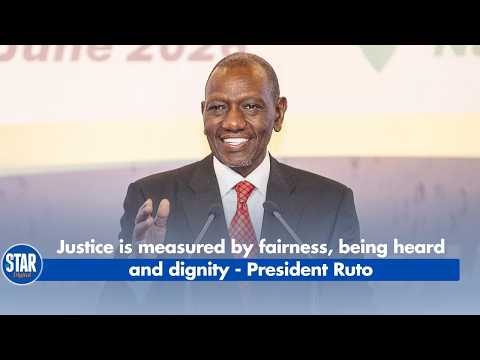


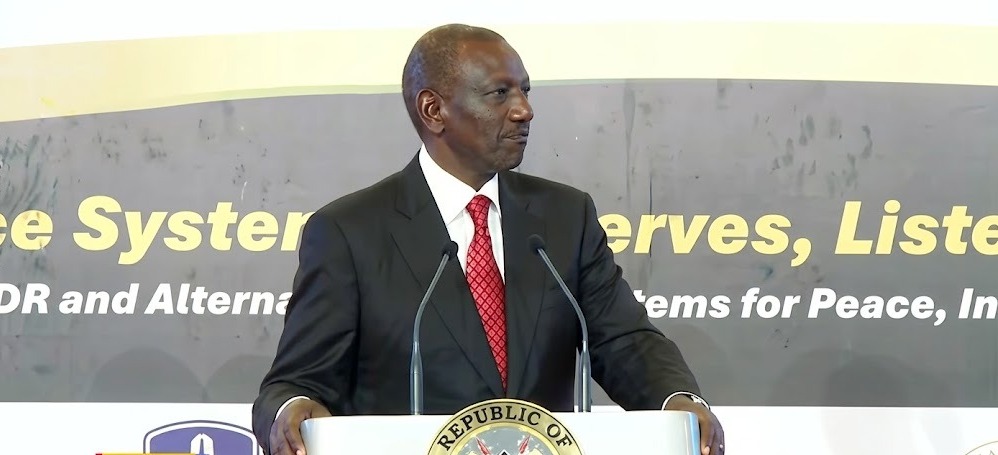
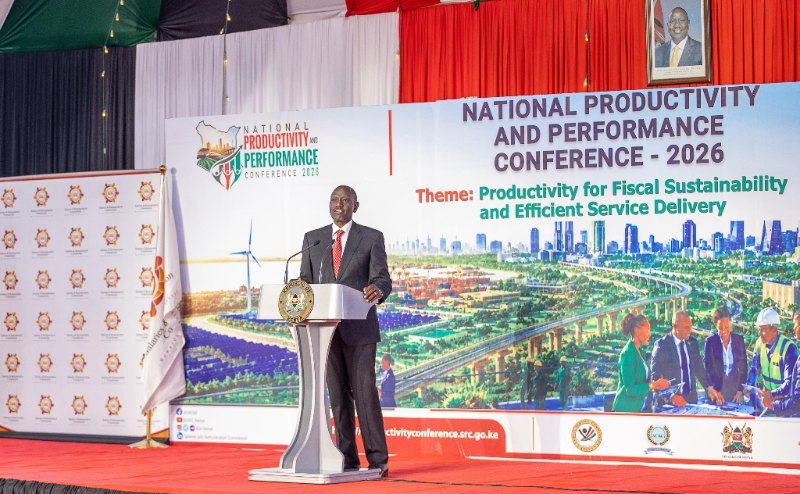
 President William Ruto/PCS
President William Ruto has cautioned that Kenya cannot achieve its development ambitions unless it addresses what he described as persistently low productivity across the economy.
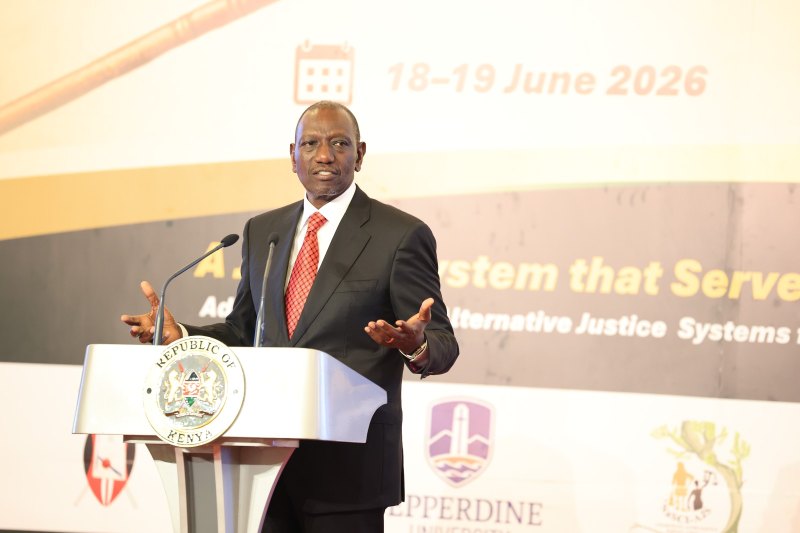
Speaking at the 1st National Productivity and Performance Conference 2026, the President called for a shift toward a performance-driven system anchored on merit, skills development, technology adoption, and results-based public service delivery.
He said Kenya’s economic transformation will depend not on natural resources or public spending, but on the output of each worker per hour.
“You cannot reach a first-world destination on third-rate productivity,” Ruto said, underscoring that prosperity is determined by what a country produces rather than what it possesses.
He pointed to global comparisons showing the stark gap between advanced and developing economies.
According to OECD data cited in his remarks, workers in advanced economies generate an average output of about $59 (Sh7,600) per hour, with countries such as Norway and Ireland exceeding $100 (Sh13,000).
He also highlighted Singapore’s economic model, noting that despite limited natural resources, the country has achieved productivity levels higher than those of the United States.
Ruto used these comparisons to reinforce his argument that economic success is rooted in efficiency, skills, and human capital rather than resource endowment.
“Prosperity is not what you possess; it is what you produce,” he said.
The President warned that Africa’s productivity growth, averaging between 1% and 1.5% annually, lags far behind Asia’s 3% to 4%, creating a widening development gap.
He further noted that millions of young Africans enter the labour market each year, but formal job creation remains insufficient to absorb them.
Kenya, he said, is not exempt from this challenge.
The country’s average worker productivity is placed at 142nd out of 189 countries globally, he highlighted.
Ruto also pointed to inefficiencies within the public sector, stating that private sector workers produce more than three times the output of their public sector counterparts.
“This tells us how much work we have to do to meet our aspirations,” he said.
To address the gap, the President outlined a broad reform agenda anchored on five pillars.
They include human capital development, merit-based public service, technology adoption, devolved county delivery systems, and national mobilisation.
He said Kenya must invest more in education quality, continuous reskilling, and workforce adaptability.
He also called for strict meritocracy in recruitment and promotion across the public service, warning against advancement based on seniority rather than performance.
“We will reward performers and innovators, and we will sanction non-performance without apology,” Ruto said.
On governance reforms, he directed the Public Service Commission to embed constitutional values of efficiency, transparency, and accountability in all public offices.
The President also announced a stronger shift towards technology-driven governance, including artificial intelligence, automation, and data systems, describing them as “productivity multipliers.”
However, he stressed that culture and discipline would remain central.
He further urged county governments to adopt productivity benchmarking frameworks and compete on service delivery outcomes, particularly in health, water, agriculture, and education.