“We lack the diversity that made us share ideas during fieldwork,” Wambulwa says.
by WILLIAM INGANGA
Audio By Vocalize
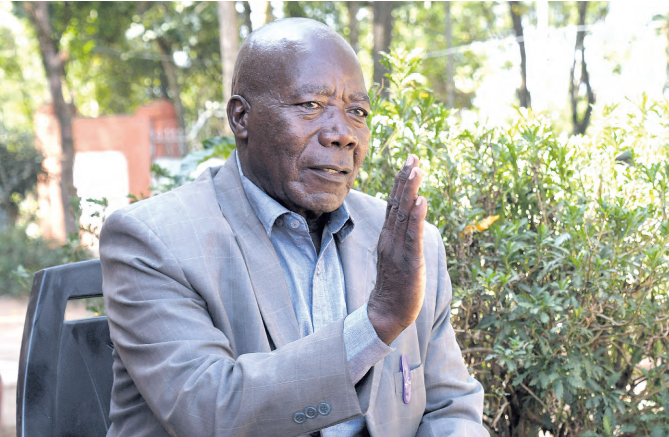
John Wambulwa, retired sound instructor at the Kenya Institute of Mass Communication, at his home in Mapera village, Tongaren /BENEDICT WASICHE /KNA
Former film cameraman
Henry Bwoka is not alone in
mourning the death of film
in Kenya. John Wambulwa,
a fellow retiree sound instructor at
the Kenya Institute of Mass Communication, who lives in Mapera village
in Tongaren constituency, sings the
same dirge.
He trained alongside Bwoka in the
same intake from 1979-1981. The
Friedrich Ebert Foundation of Germany was fronting what would be the
pioneers of filmmaking in Kenya.
The
training had originally been set up at
the then Voice of Kenya and Mombasa House near Jevanjee Gardens, was
the base used for the training.
Relocation to KIMC followed thereafter.
In allowing the filmstrip to be shot
down by video, Wambulwa says, “We
have gone the wrong direction.” He
adds, “Sound in itself was an art.”
It’s
perturbing for him that nowadays
anybody can call himself a soundman,
as long as they can record some sort
of sound.
Wambulwa says during his time, a
sound recordist visualised the sound
and music to be incorporated into a
production.
He could even advise the
film producer on the kind of artist
to be used to record the appropriate
music track.
In November 2022, Wambulwa
visited his daughter who lives and
works in the US. While there, he
was in for a pleasant surprise. His
daughter, a film enthusiast who coincidentally was trained at the Film
Production Training Department at
KIMC asked him, “Do you still enjoy
watching films the way you used to?”
His response paved the way for him
to be taken to a movie theatre.
When the silver screen was illuminated with projection, the fond
memories of his filmmaking skills
back home were rekindled. It was
nostalgic.
As a result, when he was
there, “I was a regular visitor to the
film theatres,” he says. “Cinema halls
there are filled!”
Watching movies at Kenya, Nairobi, and 20th Century cinemas, was
marvellous for Wambulwa.
“You sat
there, watched and felt that you were
at the real place where the action was.”
He says the choice of the locations
was fantastic. “When foreign crews
used to come for filming in the country, we would accompany them on location,” he says.
After post-production, the locations used would stand
out even more.
Mobile cinema vans would traverse the country showing movies in
open-air theatres at night. “They used
to start with Kenya Newsreel productions,” Wambulwa says.
“You would
see something interesting about say,
wildlife.”
Wambulwa retired in 2016 from
the Ministry of Information and
Communications under which the
KIMC was. He had worked as a lecturer for 37 years.
Wambulwa vividly recalls his classmates in the sound class. Jane Lusabe,
who is also retired and lives in Bungoma, Johnson Barasa, was formerly
a cameraman at KTN and SABC, and
Pius Kilaiti of KTN are some of them.
“We had students from the Gambia,
Sudan, Zimbabwe, Zambia and Zanzibar,” he says.
LOCAL FILM TRAINERS
Production, techniques in camera,
sound, editing and the laboratory were the various aspects of film
production taught during the KIMC
training.
Every section had its specific prerequisites for entry. Sound and camera were craved by those who had
performed well in mathematics and
physics, particularly at ‘A’ levels.
Editing required proficiency in English
and geography. For the laboratory,
chemistry was crucial.
“The first
two-three months, we used to have
general orientation where we needed to understand what went on in each
section,” Wambulwa says.
The orientation fostered teamwork.
When Wambulwa completed his
course, the German trainers desired
locals to take over from them.
Students to be trained to equip them
with the technical skills to serve as
instructors were picked from each
section.
Wambulwa was selected
from sound. His further training
included how to teach. The training
was local though foreign trainers
would occasionally be invited to
Kenya.
Wambulwa taught many sound
classes. On average, no more than
10 would be taken in every intake that
took place after two or three years.
KIMC was multisectoral. Courses
were offered in television and radio
production and mass communication.
Each of these could admit up to 30
students.
Wambulwa took the students
through their theory and practical
sound lessons.
“The number of students I taught is enormous because
I was the key person in sound production.”
One of the trainees who came under Wambulwa’s tutelage was Danson
Siminyu.
He works at the Presidential
Music Commission. He undertook
the film sound techniques course
from 1989 to 1991. His class was composed of classmates from Kenya,
Zimbabwe, Tanzania, Ethiopia and
Sudan.
“Mr Wambulwa is one of those
who belonged to a generation of
well-equipped trainers,” Siminyu
says.
“He shaped a sizeable number
of practitioners who contributed to
the growth of film in Kenya.”
Film sound training infrastructure
and equipment were adequate, fairly
new and well-maintained.
“Whether
it was acoustics, sound editing, varied microphone placements, filtering,
camouflaging or sound mixing, Mr
Wambulwa could deliver each of
these theoretically and practically
with finesse,” Siminyu says.
He likens Wambulwa to a mobile sound
textbook.
Wambulwa was the supervisor of
Siminyu’s crew’s final project production, “Ngikaala,” a documentary film
on the camel economy in Turkana.
The producer of this documentary
was Brutus Sirucha, whom Siminyu
describes as, “A very creative mind, a
go-getter and the first person to make
me know what it means to think outside the box.”
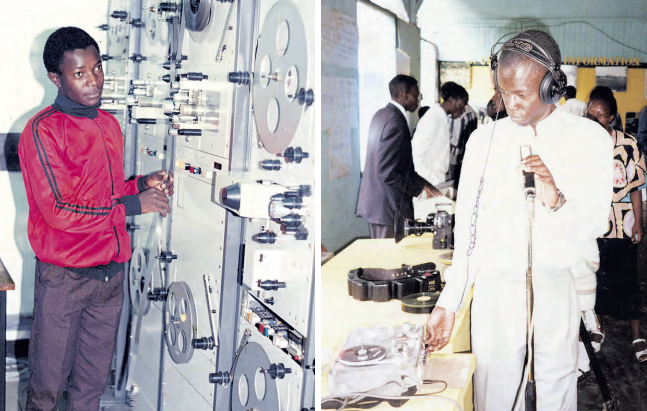
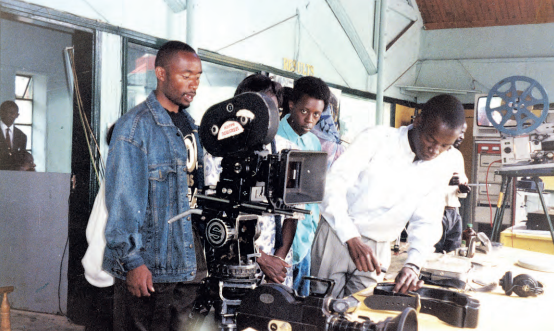
Left, Sound technique trainee Danson Siminyu mixes soundtracks. He is using the Tascam reel-to-reel machine that has three players and
one recorder. Right, A technician sets and tests out a Nagra at the stand of the Ministry of Information and Broadcasting during a past
Agricultural Society of Kenya show /DANSON SIMINYU /DFS
SOUND RECORDING SYSTEMS
Wambulwa ensured that Siminyu captured all the desired sounds and guided him through the post-production
process.
“This training was so elaborate that I needed no supervision
during my initial assignments upon
absorption in the Film Production
Department as a soundman attached
to the Kenya Newsreel,” Siminyu confidently says.
Wambulwa is still conversant with
the 16 and 35mm cameras. Whereas
these cameras recorded the pictures,
“We had a separate sound recorder
called the Nagra,” he says.
“These
used open reel tapes that we used to
call quarter-inch tapes.”
This was the double system. The
single system was designed to record
sound on film using either optical or
magnetic methods.
In the double system, the tapes were threaded on the
recorder and then linked up to the
camera using a sync cable for synchronisation of the sound and the
rolling camera.
If the raw material shot was 16mm,
upon return from the location, the
sound was transferred to a similar
16mm sound tape that had some
sprockets. The editor could synchronise the two and edit the film.
The use of a clapper board during
the shooting came in handy.
It helped
in the synchronisation of the picture
with the sound.
Siminyu, his peers and predecessors were prepared to handle video
sound. Even though an obliterating
shot was aimed at the film magazine,
there was some solace.
“The initial
video cameras were detached from
the recorders,” Siminyu says. “In the
U-matic era, we soundmen were now
entrusted with carrying the recorders
while the cameramen remained with
the camera.”
Further changes crept in. More
devastating shots followed at film recording equipment. Instead of having
a camera and recorder operated separately, the two—camera (short-form
cam) and recorder (short-form corder)—were combined to produce the
camcorder.
The short-lived U-matic
tape was a casualty. It was shot out
of scenes.
The words ‘filming’ and ‘footage’
are some of the expressions that
crossed over to the world of camcorders that took over the centre stage of
capturing events.
The camcorders
used a variety of tapes depending on
the brands and models. Among the
main ones are Betacam and DVCAM
series.
These used a variety of smaller
tapes than the U-matic system.
Tape-based camcorders have also
been shot down.
They have been replaced by disc, Secure Digital (SD)
cards and Solid-State Drive (SSD)-based camcorders, among others.
These shots have cumulatively kept
confining film to a state where the
hope for revival keeps dwindling.
The current generation of camcorders has forced crews to be condensed from two or three persons
going out to the field to record the
picture and sound to just one.
A cameraman can be the producer and the
soundman. He could even be the editor of his shots!
FILM QUALITY
“We lack the diversity that made us
share ideas during fieldwork,” Wambulwa says. “Sound has been mutilated. The artistic part of the sound
is no longer there.”
On working with Bwoka, Wambulwa says, “It was mutual understanding. If he said he was going to
pan from left to right, then on which
side would I stand so that my microphone does not appear in the scene?”
Or, “How far was he going to move
so that I don’t appear in his shots?
We had a lot of understanding and
respect for each other’s role.”
Siminyu bears memorable moments working at the Kenya Newsreel. “It’s here that I gained the experience that has sustained my career to
date,” he says.
“By interacting with
senior cameramen, amongst them
Henry Bwoka, this unit taught me
how to multitask.”
He adds, “Bwoka
trained me to love and care for all
production equipment.”
The filming equipment was quite
heavy and so were the sound recording tools.
“The sound recorder and
associated equipment I used to carry
weighed around 15 kilos. I could go
out to the field for a month or two,”
Wambulwa says.
“But once you got
used to it, it became some form of a
gym and an exercise.”
His sentiments about film echo
Bwoka’s. 35 or 70mm (used in the US) have wider space for image
registration. Upon projection, they
give better pictures.
The narrower
16mm film, upon projection on a
bigger screen, becomes grainy. “If you
project 35mm on a smaller screen,
the quality is very nice and so is its
sound,” Wambulwa says.
Even though Kenya never had a
35mm laboratory, the 16 mm facilities at KIMC were working quite
well in 2016 when Wambulwa hung
his instructive Nagra upon exiting
service.
Regrettably, the processing
equipment at KBC was dismantled
and dumped at KIMC. He doesn’t
know if the one in Mombasa is still
intact.
In 2006 President Mwai Kibaki
desired to explore the possibility of
modernising the film facilities in Kenya and maximise their use.
“Three
of us were sent by the ministry to
South Africa (Waterfront Studios),”
Wambulwa says.
They learned that all that was needed was a film telecine. This machine
would allow the digitisation of the 16
or 35mm films after processing.
The
separately recorded sound would be
edited and synchronised later with
the film footage. If duplicates were
needed, it would be easier to get them
from the master.
“When we came back, we gave our
report. I don’t know how far it went,”
Wambulwa says.
He believes that the
revival of the film industry lies with
the policymakers and that filmmaking could keep the youth busy.
“The
people who used to make films are
still there. They can give advice,” he
says.
Showgoers
used to flock
the Ministry of
Information and
Broadcasting
stand during
past Agricultural
Society of
Kenya Shows
to see filming
and projection
equipment. A
technician sets
up a belt battery
pack to fire
the BL movie
camera
/COURTESY /DFS
TO THE YOUTH
He’s concerned that most of what we
watch from the archives has faded so
much that it’s no longer appealing.
If
only the government could invest in
film production! His fellow lecturer
(retired) at KIMC Eston Munyi was a
laboratory techniques instructor. He
used to refer to pictures as, “Seeing
for keeps.”
If well stored, he’d tell
his students, “Motion pictures can
be stored for even 100 years.”
Production of food through subsistence farming of maize, bananas,
small-scale sugarcane, cattle and
chicken is what majorly now sustains Wambulwa.
He keeps in touch
sometimes face-to-face with his former film production colleagues. Most
of them have also retired.
Some are
deceased.
Wambulwa’s message to the youth
is, “As you prepare for a story, think
of the future.
Several films were made
long ago but when you watch them,
they still have a story.” He cites Charlie Chaplin’s films that have stood the
test of time.
The more film is relegated to the
distant past, the more video seems
to thrive. Furthermore, entry of still
cameras capable of shooting video
has compounded the injuries inflicted
on filming.
This is premium content
Subscribe to Continue Reading
Help us continue bringing you unbiased news, in-depth investigations, and diverse perspectives. Your subscription keeps our mission alive and empowers us to provide high-quality, trustworthy journalism. Join us today to make a difference!