Ten years after losing her arms, Jackline Mwende still carries the scars of intimate partner violence
Today, the mother of one lives with permanent disability, says emotional wounds fresh
by Charity Chigulu
Audio By Vocalize
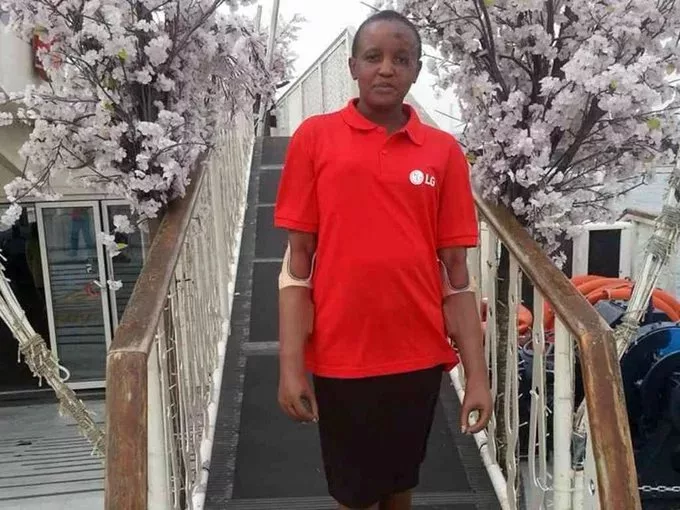
Jackline Mwende after prosthetic limbs were fitted in South Korea / FILE
Ten years have passed since Jackline Mwende's life changed
forever.
Her story shocked Kenya in 2016 after her then husband
chopped off both her arms in a brutal act of intimate partner violence.
Today, the mother of one has learnt to live with a permanent
disability, but says the physical and emotional wounds remain as fresh as ever.
She says accepting her new reality was the first step
towards rebuilding her life.
Although she underwent several corrective surgeries and
later travelled to South Korea, where donors fitted her with custom-made
electronic prosthetic arms, the devices never became part of her daily life.
"They helped me for a short time, but they were too
heavy," she says.
Each prosthetic arm weighed about five kilogrammes, making
even simple movements exhausting. Sometimes they slipped off unexpectedly,
forcing her to rely on other people to pick them up.
Because they were electrically powered, she also could not
use them when handling water, and keeping them charged became another
challenge.
Eventually, she made the painful decision to stop using
them.
"I asked God to give me the strength to live without
arms," she says.
At first, walking without the prosthetics affected her
balance, but she gradually adapted. She says she informed her donors when the
artificial limbs were damaged, and they understood why she could no longer use
them.
Despite her resilience, she still depends on others for many
daily tasks.
Mwende says one of the hardest parts of her life is watching
her elderly mother do things many adults take for granted, including bathing
her, dressing her and helping her change sanitary pads during her menstrual
cycle.
The attack also left lasting injuries beyond the loss of her
arms. One of her eyes was damaged and occasionally becomes painful, while the
areas where her arms were amputated often become numb during cold weather.
"Sometimes I feel as though all my fingers are still
there, but they itch terribly," she says, describing the phantom limb
sensations she continues to experience.
The trauma also affected her family.
She says her father developed high blood pressure after
witnessing what happened to his daughter and continues to receive treatment.
In 2018, the Merck Foundation built her a house and helped
her establish a business to support her independence.
However, the business lasted only three years.
When the Covid-19 pandemic struck, business slowed
significantly. Combined with high operating costs and a monthly rent of
Sh12,000, the venture became unsustainable.
"There were times I couldn't even raise the rent
because the business wasn't making enough profit," she recalls.
Even so, Mwende remains grateful to the organisation.
"They gave me a net to fish, not the fish itself,"
she says, adding that she believes the business would still be running if
circumstances had been different.
Today, she survives mainly through support from
well-wishers.
She also says despite living with a permanent disability,
she does not receive support under the government's cash transfer programme for
persons with severe disabilities.
"They told me only people with severe disabilities
qualify. I wondered, if this isn't severe disability, then what is?" she
asks.
For Mwende, marriage is a chapter she has permanently
closed. "No. Until the day I die, I never want to get married again,"
she says firmly.
She believes her life would have been very different had she
never entered that marriage. "I would not have become disabled if not for
marriage. I've put a permanent X on it."
Although a decade has passed, she remembers crying until she
had no tears left. "Being cut with a machete is extremely painful,"
she says.
Counselling, she says, became one of the few lifelines that
helped her survive emotionally. "I would look at myself in the mirror and
cry, wondering what my life would become."
Even today, certain memories trigger overwhelming emotions.
Sometimes she cries so much that her son asks why she is crying.
Asked whether she has forgiven her former husband, Mwende
pauses.
She says she has left the matter to God but cannot honestly
say she has forgiven him.
"If it had been an accident, I would understand. But he
intended to kill me. If he had any mercy, wouldn't he have left me with at
least one hand?" she asks.
Her former husband, Stephen Ngila, has been serving a
30-year prison sentence since 2021 after being convicted of attempted murder.
Today, Mwende has turned her experience into advocacy.
In Kathama village, Machakos county, she counsels women in
abusive relationships, urging them to leave before the violence becomes worse.
"When I see a woman staying in a marriage where she is
constantly beaten, I ask her, 'Are you waiting to die? Were you born into that
marriage?'"
She says many women confide in her after suffering physical
abuse but remain in violent relationships because they have invested years in
the marriage or fear leaving with their children.
Her message is simple. "If your partner threatens to
kill you, that alone is enough reason to leave."
She also discourages women from returning to abusive
partners after separation.
"Sometimes they don't want you back because they love
you. They want another opportunity to finish what they started."
While not everyone follows her advice, she says many women
have listened and rebuilt safer lives.
She insists that children should never be a reason to remain
in a dangerous relationship.
Instead, she urges couples who can no longer live together
peacefully to separate without resorting to violence.
Relationship expert Wanjiku Waititu says intimate partner
violence is often driven by several factors, including alcohol and drug abuse,
poor anger management, unresolved conflict and growing up in homes where
violence was normalised.
"Some people learn from childhood that violence is an
acceptable way of resolving conflict," she says.
She adds that some perpetrators may also be living with
untreated depression or other mental health conditions, making it difficult for
them to regulate their emotions.
Waititu says the effects of intimate partner violence go far
beyond physical injuries.
Survivors often struggle with trauma, stigma, low
self-esteem and long-term psychological distress, while their families also
experience lasting emotional effects.
She recommends immediate and ongoing counselling to help
survivors develop healthy ways of coping.
Although forgiveness is deeply personal and often takes
time, she believes it can become an important part of healing.
"It doesn't erase what happened," she says.
"But forgiveness helps free the survivor from remaining emotionally
imprisoned by the offender."
Mwende's story reflects a wider crisis.
According to the 2024 Kenya Demographic and Health Survey
(KDHS), 41.1 per cent of women of reproductive age have experienced at least
one form of intimate partner violence—physical, sexual or emotional. This is
slightly higher than the 40.7 per cent recorded in the 2022 survey.
Globally, the World Health Organization estimates that about
27 per cent of ever-partnered women aged between 15 and 49 have experienced
physical or sexual violence by an intimate partner at least once in their
lifetime.
For Mwende, those statistics are more than numbers.
They are a reminder that many women continue to live with
the same fear she once ignored—and that leaving an abusive relationship can
mean the difference between life and death.
INSTANT ANALYSIS
Jackline Mwende's story highlights the lifelong impact of
intimate partner violence, showing that survival does not always mean full
recovery. A decade after the attack, she continues to live with physical
disability, emotional trauma and financial hardship despite undergoing
surgeries and receiving support. Her experience also reveals the burden placed
on families, gaps in government support for people with disabilities and the
difficult journey towards healing. By using her experience to counsel women in
abusive relationships, Mwende transforms personal tragedy into advocacy. Her
story reinforces the importance of early intervention, counselling and leaving
abusive relationships before violence escalates into life-threatening attacks.