


I recently had visitors from Nairobi, and I entertained them at my club. While we were there, we witnessed a scene between a wealthy employer and her domestic worker that might have been lifted from colonial Kenya, or indeed from modern-day Saudi Arabia.
What made the moment even more poignant was the stark power imbalance and the sheer disrespect on display. The domestic worker, a nanny, appeared to be treated less like an employee and more like a slave.
Let me paint the scene. A group entered the club: an elderly woman accompanied by a younger woman, whom we later established was her daughter-in-law; a child of about twelve; and a third woman, who was left hovering uncertainly, leaning against a pillar at the entrance to the bar and dining area while the other three chatted with club members seated at the bar.
My guests were seated in such a way that they could clearly see the elderly woman, her daughter-in-law and the young girl. I, however, was positioned so that I was more aware of the nanny’s presence than able to see her directly.
At some point, it seemed the elderly woman wished to instruct the nanny to sit somewhere she would have considered less obtrusive, yet still within her line of sight.
However, rather than conveying this politely in words, she crooked a finger at her employee. If you are from North America or Europe, beckoning someone with a single raised, curled finger may seem perfectly ordinary. In many African and Asian cultures, however, the gesture is regarded as highly offensive and demeaning, and when directed at a person, it implies inferiority.
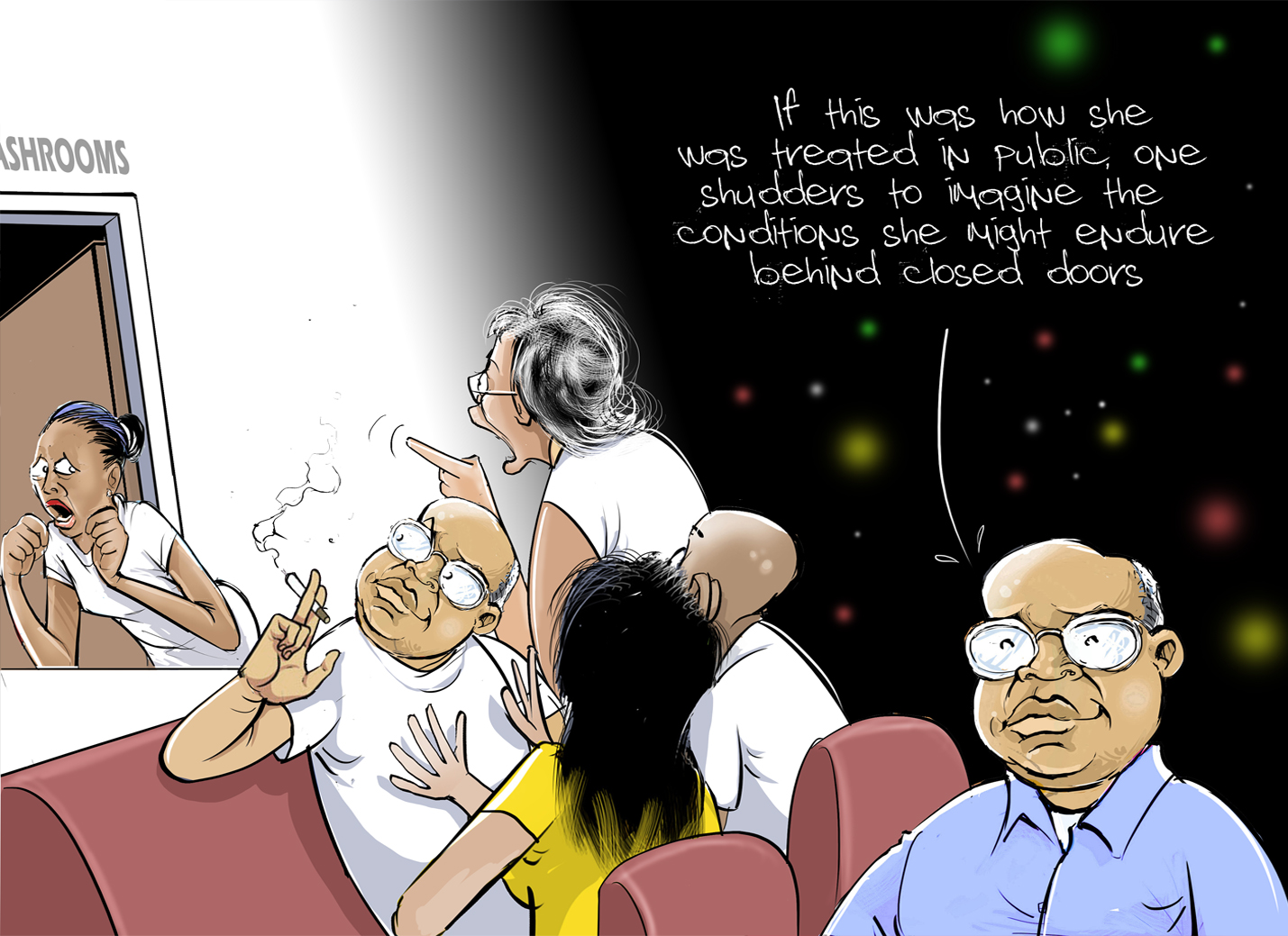
As the nanny stepped forward, the employer reversed the gesture, which resembled a flicking motion, to indicate that she should go and sit by the wall at the entrance, near the club toilets. This made it seem to us as though the nanny were being dispatched to a humiliating “time-out” corner.
My guests’ jaws dropped at the blatant disrespect, and they began to speak about it loud enough for the old woman to hear us. The elderly woman, who belongs to a well-known Kenyan family that prides itself on its commitment to philanthropy and service, realised she had been observed behaving so discourteously.
She had enough awareness to appear briefly embarrassed and somewhat discombobulated before quickly regaining her composure. That reaction alone told us all we needed to know: she understood that she had behaved improperly, and one hoped she felt ashamed.
Beyond the disgraceful treatment itself, I could not fathom why they felt it necessary to bring the nanny out at night at all, placing her in a situation where her services were plainly surplus to requirements. Surely it would have been more reasonable for her to remain at home, resting after what must have been an exhausting day.
If this was how she was treated in public, one shudders to imagine the conditions she might endure behind closed doors, beyond the scrutiny of others, where mistreatment can flourish unseen.
I was reminded that psychologists often observe how those who have been bullied may, in turn, bully others in an attempt to reclaim a sense of power, control and social standing, perpetuating a learned cycle of abuse to mask their own insecurities and fragile self-esteem. For a fleeting moment, I wondered whether this might have been the case here, though I suspect I was being far too charitable.
We were left reflecting on how many employers in Kenya treat domestic workers as personal property rather than contracted employees.
It would be too easy to invoke the famous 1926 line attributed to F. Scott Fitzgerald, “The rich are different”, as I have observed similar behaviour in households facing financial hardship. Ernest Hemingway’s oft-quoted reply to Fitzgerald was, “Yes, they have more money.”
The exchange highlights the isolating effects of extreme wealth: beyond financial resources, the wealthy inhabit entirely different social realities and life experiences from the rest of us.
The nanny at the club seemed to be facing the same indignities that many Kenyan women who migrate to the Middle East for domestic work encounter. Abusive, “modern-day slavery” conditions are an abomination, whether they occur under the Kafala (sponsorship) system or here in not-so-magical Kenya.