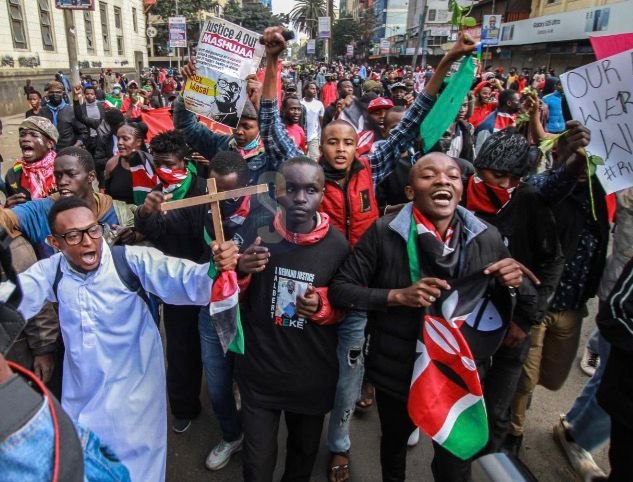
The teargas that choked the capital two years ago has dissipated, yet a new, more insidious asphyxiation grips the populace—this one born of ledgers, debt schedules and the quiet, grinding collapse of the social contract.
The state survived the youthful insurrection, but the question haunting the political elite ahead of the 2027 polls is whether a government can endure when its economic policies systematically hollow out the very lives it is sworn to protect.
At the centre of this tension sits the Finance Act, 2026, which President William Ruto signed on Tuesday against a torrent of public opposition.
The Sh4.8 trillion budget it unlocks is a masterclass in fiscal necessity, passed by a margin of 122 votes to 40, with another 100-something legislators skipping the vote altogether (crying shame).
For the executive, the arithmetic is brutal and non-negotiable: the national debt has metastasised to a staggering Sh13 trillion.
Servicing this behemoth now devours nearly 70 per cent of ordinary revenue.
To put a face to that statistic, it means that for every Sh1,000 a taxi driver earns, or a market trader counts at dusk, nearly Sh700 is siphoned away before it can ever reach a public hospital bed or a child’s desk in a congested classroom.
The brutal irony is that the cure is killing the patient.
By channelling Sh1.35 trillion in debt repayments against total receipts of Sh3.21 trillion in the first nine months of the financial year, the government has turned a macroeconomic headache into a humanitarian haemorrhage.
Health workers in county facilities report dwindling supplies of essential drugs, while teachers' unions warn that the freeze on hiring has left pupil-to-teacher ratios at breaking point.
This is the tangible face of Article 43—the constitutional promise of health, housing and freedom from hunger—being systematically dismantled not by a coup, but by a calculator.
As the state squeezes the informal sector dry with punitive levies, the mama mboga watching her stock rot and the boda boda rider grappling with new digital service taxes are not just losing income; they are losing faith in the idea of national progress.
This economic siege has produced a chilling but inevitable outcome: the violent contraction of civic space.
As civil society groups and the Law Society of Kenya petitioned police commanders to exercise restraint ahead of Thursday’s memorial processions, their pleas carried the weight of recent memory.
The state’s belated compensation cheques to victims' families, though welcome, cannot erase the trauma of live rounds and baton charges.
The security apparatus, emboldened by a treasury that views dissent as a liability, seems to have forgotten that the right to peaceful assembly under Article 37 is not a privilege granted by the executive, but the bedrock upon which the 2010 constitution was built.
The warning from police reformers is stark: commanders who sanction brutality today will find themselves accountable tomorrow.
Yet the pattern of arbitrary arrests and disproportionate force persists, fuelling a cycle of grief and resentment that no amount of budgetary allocation can pacify.
Perhaps the most devastating aspect of the state of Kenyans is the desperate ambition.
With youth unemployment hovering at crisis levels and micro-enterprises suffocating under the weight of new taxes, thousands of young Kenyans are viewing overseas job offers as their only lifeline.
But that lifeline has become a noose.
The desperation has fed a burgeoning trafficking pipeline, ensnaring citizens in the infamous 'Golden Triangle' of Southeast Asia.
From the squalid cyber-slave camps of Myanmar to the coercion factories in Cambodia, the narrative is heartbreakingly uniform: a young graduate, lured by a fake job advertisement, ends up stripped of their passport and forced to scam strangers online.
According to government records, over 750 Kenyans have been rescued from this nightmare since 2022, with 406 plucked from Cambodia alone in the first four months of this year.
The fact that diplomatic missions are now spending more time managing international rescue missions than fostering bilateral trade is a damning indictment of a domestic policy that has failed to secure the most basic economic right: the right to stay home and thrive.
As the political class accelerates its ethnic arithmetic and regional realignments for 2027, the old order is missing the real revolution.
The Gen Z movement that stormed the barricades has fractured the tribal calculus, giving rise to a value-driven coalitions that care less about which community holds the executive and more about who holds the treasury accountable.
Likewise, faith-based organisations and governance watchdogs are demanding a radical pivot towards fiscal transparency, arguing that debt sustainability and human dignity are not mutually exclusive.
The great awakening seems to have arrived, and with it, the administration stands at a precipice.
It must choose to either view the constitution as an obstacle to revenue collection, or recognise that the enduring stability of this nation rests not on the size of its tax base, but on the depth of its compassion.
Ultimately, the durability of the political system depends on whether the administration chooses to view constitutional rights as a barrier to development or as the very foundation of national progress.





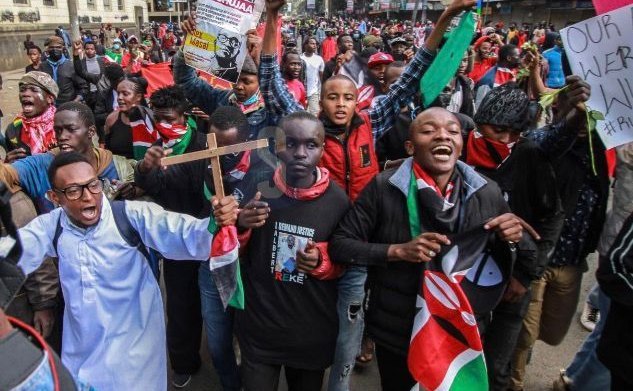 Protesters during a march /FILE