


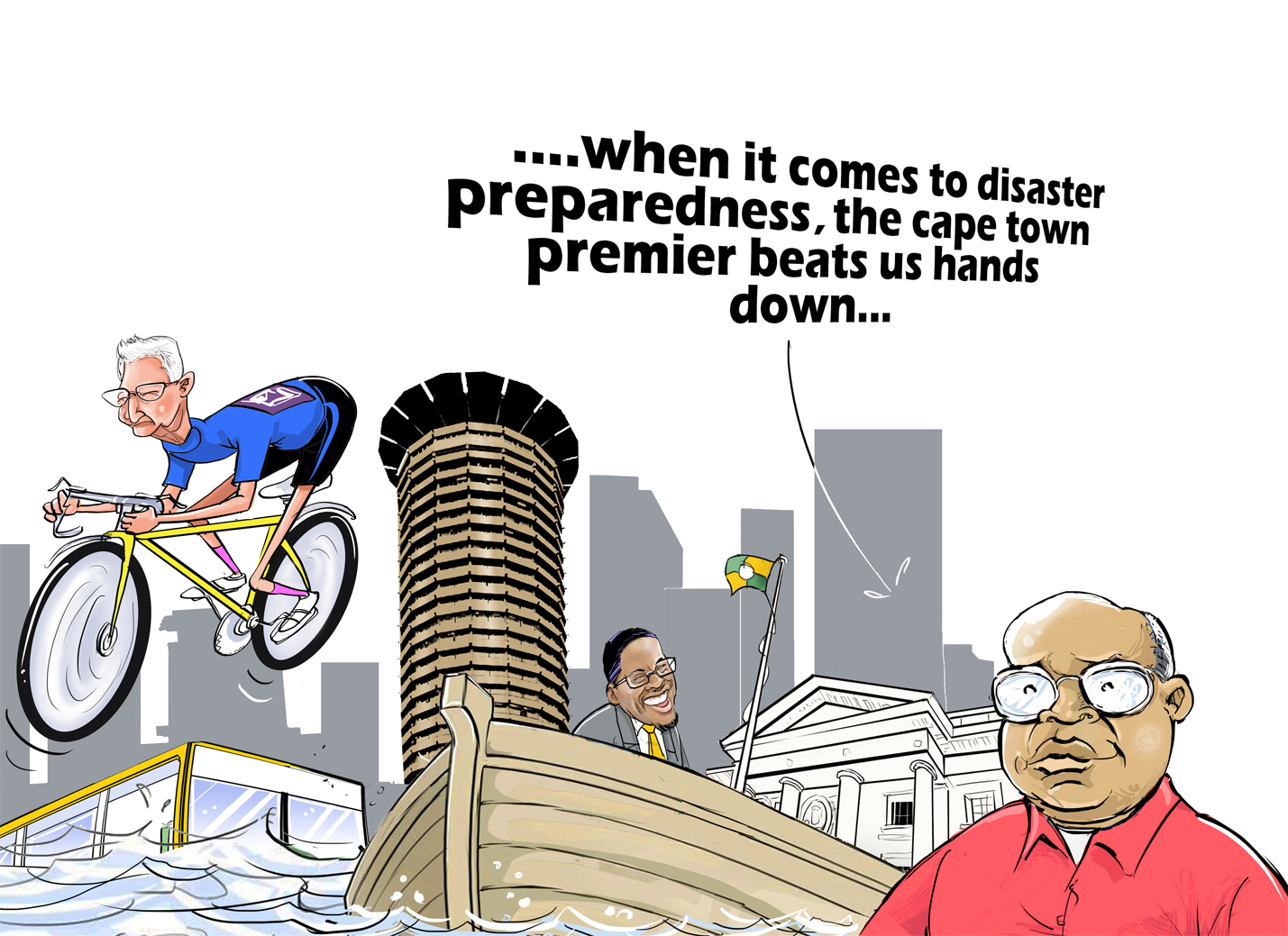
Once again, Kenya’s Disaster Risk Management system — and I use the term loosely — has shown us its favourite personality trait: Lots of policy documents, very little actual “managing disasters”.
On paper, the frameworks look impressive. There are strategies, committees, task forces and maybe even a PowerPoint somewhere with arrows and flowcharts.
In real life? The system often runs on vibes and the hope that the weather might change its mind.
After last weekend’s deaths and destruction caused by previously predicted rains in Nairobi, it’s painfully obvious that this unpreparedness strategy is not working.
Our disaster response model often seems to follow a four-step process: Wait for disaster; act surprised; blame the victims; hold a press conference promising to do better next time.
Until and unless we change how we do things, we can expect the same story
to repeat every time.
Regular readers know I spent about 15 years working as a media practitioner in Cape Town, and I have to say that city handles disasters very differently.
Now, before anyone starts sharpening their barbs, let me say this: Cape Town is far from perfect. I’m sure there are many things they could learn from us in other areas. But when it comes to disaster preparedness, they beat us hands down.
From my time there, I remember that when bad weather was predicted, Cape Town’s disaster management teams would swing into action before the chaos began.
They would clear storm drains and rivers, distribute sandbags in flood-prone areas, warn residents in informal settlements and advise them on digging diversion trenches, and trim trees to prevent storm damage.
Once the event began, they would monitor flood risks closely, coordinate emergency services and prepare crews to clear roads and repair infrastructure. In other words: preparation. A truly revolutionary concept. Just imagine if we tried it.
Speaking of Cape Town and how they do things, something happened there last week that had me laughing out loud while scrolling through social media.
But first, a quick disclaimer. Anyone who knows me will tell you I am not what you’d call a fitness influencer. My exercise routine is simple: I walk every day. Tosha.
Over the years, I have attempted jogging several times, but the older I got, the more my body began quoting a lyric from Englishman in New York by Sting, released in 1987. The lyric goes: “A gentleman will walk but never run.”
Also, my knees are basically two expired shock absorbers from a 1989 Toyota.
In theory, I suppose I could get into cycling. In practice, the “entry requirement” appears to be a very expensive bicycle and a wardrobe made entirely of tight Lycra.
I may have reached the age where I shouldn’t care what people think. But I’m vain, so I do care. The body I currently inhabit is not exactly what the cycling industry had in mind when they invented those outfits.
Someone who clearly does not share my concerns is Alan Winde, the Premier of Western Cape Province in South Africa (basically the equivalent of a governor in Kenya).
Last week, he walked into the provincial legislature wearing his full cycling kit. By this I mean loud, brightly coloured cycling shorts, jersey, glowing pink socks and, because rules are rules, a formal suit jacket on top.
This happened right as the provincial finance minister was about to present the Municipal Economic Review and Outlook. Peak serious government paperwork energy.
Back when I worked at a newspaper in Cape Town, covering the legislature was one of my beats. Watching the whole drama unfold online, I briefly felt nostalgic because reporting on that moment would have been chef’s kiss journalism content.
Naturally, the Internet turned the moment into political WWE. Supporters of the opposition ANC in the Western Cape described the legislature as turning into a circus run by clowns.
Meanwhile, supporters of Winde’s party, the Democratic Alliance, came to
his defence. Their argument: the man
literally cycles to work instead of using a “blue light brigade” convoy of
official cars.
Winde himself leaned into it. On Facebook, he proudly described himself as a cycling ambassador and used the moment to wish participants good luck in the upcoming Cape Town Cycle Tour. Which, honestly, is elite-level political brand consistency.