


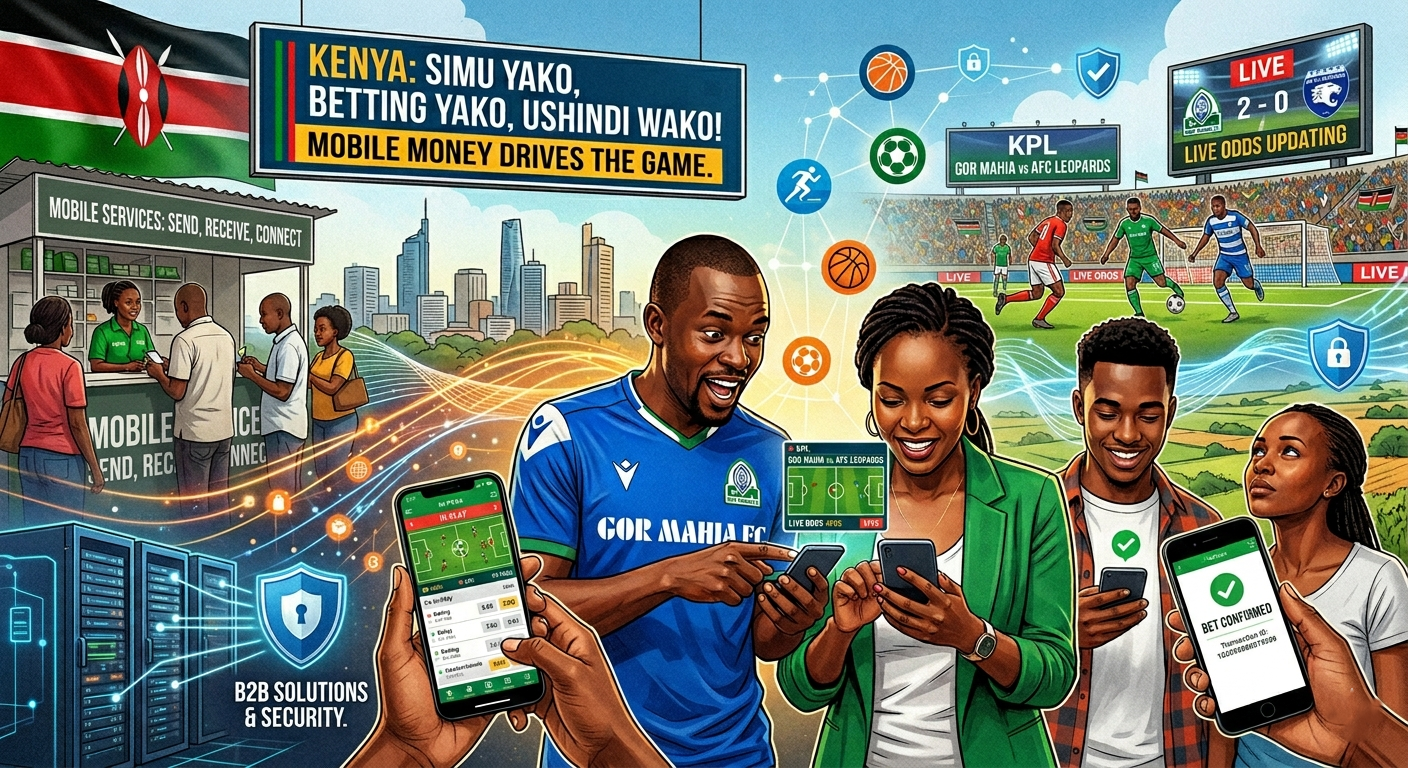
Kenya has firmly established itself as the most advanced and dynamic sports betting market in sub-Saharan Africa. While several factors contribute to this rise, one element stands out as the primary engine of growth: the widespread adoption of mobile money. By turning every mobile phone into a digital wallet, Kenya has bypassed traditional banking hurdles and created a seamless environment for the iGaming industry to flourish.
To stay competitive in this fast-paced environment, operators are increasingly turning to advanced sports betting b2b solutions to manage their operations. These professional platforms provide the necessary speed and security to handle millions of transactions, ensuring that the technology can keep up with the high demands of the Kenyan bettor.
The mobile money revolution
Before mobile money, the betting industry in Kenya was limited. Users had to visit physical shops or deal with complicated bank transfers that often took days to process. The arrival of services like M-Pesa changed everything. Suddenly, any Kenyan with a basic mobile phone could send and receive money instantly.
This digital financial inclusion was the "spark" the betting industry needed. It allowed operators to move their services online and reach people in both busy cities and remote rural areas. Today, the connection between a user’s mobile wallet and their betting account is so smooth that depositing funds takes less than thirty seconds. This level of convenience is a major reason why Kenya has one of the highest betting participation rates in the region.
The role of technology in scaling operations
As mobile money made betting more accessible, the volume of users grew exponentially. For a sportsbook to survive in Kenya, its backend technology must be world-class. It is not just about having a website; it is about having a system that can process thousands of micro-transactions per second without a glitch.
Professional technology providers play a critical role here. They offer scalable infrastructure that grows alongside the operator. These systems manage risk, detect fraud, and ensure that every shilling moved via mobile money is accounted for and safe. Without these robust B2B solutions, the sheer volume of mobile traffic would overwhelm a standard betting site, leading to crashes and lost revenue during major sporting events.
Popular sports and betting preferences
Kenyans are among the most passionate sports fans in the world. While many sports have a following, football remains the undisputed king of the market. From the English Premier League to the local Kenyan Premier League — where title races like Gor Mahia's push for a record 22nd crown keep fans on the edge of their seats — football matches generate the highest betting turnover. When analyzing the market, it is clear that Kenyans prefer betting on football more than any other discipline, though basketball and athletics are also seeing a steady rise in interest. The availability of 24/7 mobile access means that fans can follow and bet on matches across every time zone, from the Americas to Asia.
The rise of real-time betting
The marriage of mobile money and high-speed internet has led to the explosion of "In-Play" or live betting. In the past, bets were placed before a game started. Now, the majority of betting activity happens while the match is in progress. Fans can bet on the next goal, the number of corners, or even the next player to be cautioned.
This fast-paced style of betting requires even faster information. This is why we are seeing a massive increase in the demand for real-time football predictions, which give users the data they need to make split-second decisions. For operators, this means their software must update odds instantly to reflect what is happening on the pitch, requiring a high level of technical precision.
Regulation: keeping the market safe
With so much money moving through digital channels, strong regulation is essential. The Kenyan government has worked hard to create a framework that protects the player while allowing the industry to contribute to the national economy.
The Betting Control and Licensing Board (BCLB) serves as the primary regulatory body. They are responsible for issuing licenses, auditing operators, and ensuring that all platforms adhere to strict responsible gaming standards. This official oversight gives users the confidence that their money is safe and that the games are fair. Furthermore, both operators and players have seen a positive shift in market stability as Kenyan betting sites and bettors benefit from updated legal frameworks that clarify tax obligations and operational requirements. Recent updates to the regulatory framework have focused on tighter controls over mobile advertising and the implementation of higher taxes, which the government uses to fund sports development and social programs.
Why data security is the new priority
In 2026, data is as valuable as money. Because Kenyan bettors share their phone numbers and financial details with betting platforms, cybersecurity has become a top priority for B2B software providers. Modern platforms now use advanced encryption and AI-driven security tools to protect user accounts from hackers.
Furthermore, these platforms must be "lightweight." Not everyone in Kenya has the latest expensive smartphone or a 5G connection. The sportsbook software is optimized to work perfectly on older devices and 3G networks. This ensures that the operator doesn't lose customers simply because their app is too "heavy" or slow to load.
Economic impact and job creation
The growth of the mobile-driven betting industry has had a significant ripple effect on Kenya’s economy. Beyond the taxes paid by operators, the industry has fueled the growth of the fintech sector and directly funds major sporting events. A prime example is the Mozzart Bet Cup, which has become one of the country's most prestigious knockout tournaments thanks to significant corporate sponsorship from the iGaming sector.
Additionally, betting shops have become centers for digital literacy, as many users learn how to use mobile wallets and digital apps through their betting experiences. This has contributed to Kenya’s reputation as the "Silicon Savannah" of Africa.
Looking toward a digital future
The future of sports betting in Kenya will continue to be defined by mobile innovation. We are likely to see more integration with social media platforms, allowing users to share their bets and compete with friends in real-time. We can also expect to see the introduction of more "Gamified" experiences, where betting feels more like a social game than a traditional wager.
As AI continues to improve, platforms will become even more personalized, offering users the exact matches and odds they are interested in based on their past behavior. This will make the experience even more engaging and efficient for the user.
Final thoughts for operators
For any operator or investor looking at the Kenyan market, the lesson is clear: mobile money is the foundation, but technology is the key to growth. Success in this region requires a deep understanding of local payment habits combined with a high-performance, secure sportsbook engine.
By prioritizing mobile optimization, regulatory compliance, and real-time data, businesses can tap into one of the world's most exciting and innovative betting ecosystems. Kenya has shown the world that when you combine mobile technology with a passion for sports, the growth potential is limitless.