


During a visit to Sarah Kendi’s homestead in Tharaka Nithi County, one cannot help but marvel at her green rush farm.
Despite the bare condition of many farms across the country due to recurring drought, Kendi‘s farm in Ngage village, Mukothima ward, is laden with diverse farm crops at different stages of growth, with some mature and ready for a bumper harvest in two weeks or so.
On her acre piece of land, Kendi has adopted a mixed farming model, where she grows crops, rear goats and does poultry farming.
The layout on her farm is substantially defined by maize, which she prefers intercropping with beans, cow peas and pearl millet.
Unlike many seasonal crop farmers, who have shelved their farm tools and taken a break from their farms due to the dry spell, Kendi is no ordinary farmer and hardly relies on the weather calendar due to her extraordinary farming practice known as conservation agriculture.
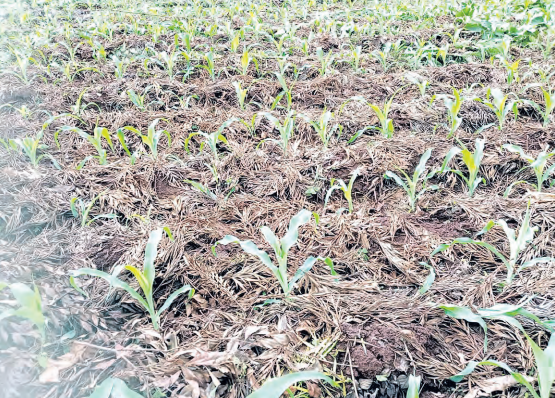
Conservation agriculture is a farming system that promotes minimum soil disturbance through minimal tillage to enhance soil fertility, water infiltration into the soil and soil erosion reduction.
In the wake of erratic rains caused by the adverse effects of climate change, crop diversification, use of cover crops and mulching enhances water retention in the soil, which comes in handy for the plant during dry seasons.
Kendi was introduced to the climate smart farming model in 2020 through an agricultural initiative by the National Council of Churches of Kenya targeting rural farmers.
“I set aside a small portion of my farm, where I applied the newly acquired training to ascertain its productivity,” she said.
“I was amazed by the yields I got from the portion, so I decided to adopt it on the entire farm in the following planting season.”
Since then, she has never looked back but has instead recruited more farmers to learn from her so they can replicate the system on their farms.
“Since I embraced conservation agriculture, farming now makes sense,” she said.
“Besides being less labour-intensive, I get value for my investment through reaping maximum and high-quality yields, which are sufficient for both subsistence and commercial use.”
Unlike conventional farming, where she frequently harvested one or two bags of maize, through conservation agriculture, she reaped 16 bags of maize and nine bags of cow peas last season.
The plant residue, after she harvests, is left to decompose in the farms to enhance soil fertility.
“Thanks to this time-saving system of farming, I now have valuable time to venture into other farming activities like livestock rearing and horticulture, where I have established a kitchen garden,” she said.
DOUBLED YIELD
Through the NCCK agricultural programme, Kendi and 82 other farmers practising conservation agriculture from the area have registered a community group where, courtesy of the initiative, they were helped to set up kitchen gardens in their homes.
Additionally, they were supplied with liners that have helped them establish water ponds from excess rainwater, and which provides the group with an incessant supply of water to feed their kitchen gardens.
All the farmers water their kitchen gardens twice a week because they have mulched their crops.
A stone’s throw away from Kendi’s home, we meet Margaret Kageni from Kaweru village, who has also elevated her farming experience through conservation agriculture.
Kageni embraced the smart farming model in 2017 after acquiring the knowledge from the NCCK agriculture programme.
“I’m a long-term farmer and my farming practices were wrong and less rewarding for many years,” she says.
“But after understanding and putting to test this farming concept, I have no regrets.”
In her initial planting season under conservation agriculture, she doubled her maize yield from 50kg to 100kg in her quarter-acre farm.
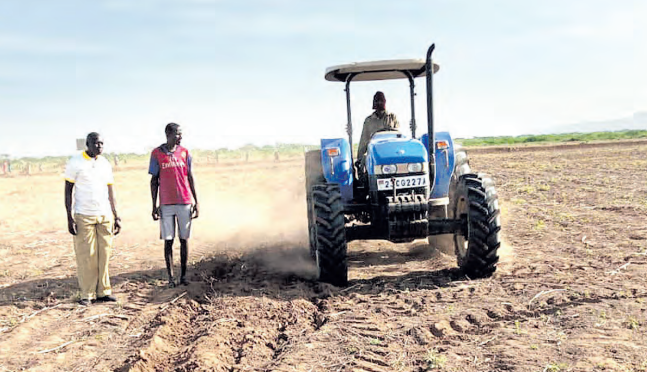
Additionally, she finds conservation agriculture cost-saving as farmers no longer have to hire workers or tractors to plough their land prior to the planting season.
“After harvesting, I sold the maize at Sh100 per kilogramme during the dry season. From the proceeds, I bought other farm equipment and input that have helped me boost my farming.”
Uptake of conservation agriculture is increasing in her village as her neighbouring farmers are steadily applying it on their farms.
She believed that with increased training, field days and capacity building sessions, the farmers will continue improving their skills.
Her dream is to go for a benchmarking trip to Brazil, where conservation agriculture is practised on a large scale.
TRAINER’S ADVICE
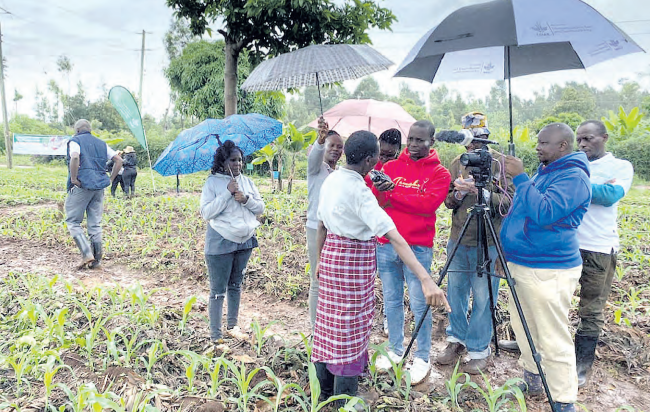
Fidelia Munyoki, an agriculture expert and trainer from the NCCK’s food security promotion programme, says they are training farmers about conservation agriculture in Tharaka Nithi, Kitui and Turkana counties.
This is through the like-minded partner driven sensitisation programme. The programme is well covered in Tharaka Nithi, where the group is working with 500 farmers, as compared to Kitui and Turkana.
“We have partnered with the Church of Canada and Canada Food Grains Bank to train farmers to improve their farming practices through conservation agriculture,” Munyoki said.
“This will help them to realise better yields and consequently boost food production in their farms.”
To track the effectiveness of the model, the trainers undertake an agro-ecological zone analysis to advise farmers on how to effectively apply the system on their farms.
They also compare the output from conservation and conventional agriculture to show effectiveness.
They train farmers on how to restore their farms’ soil fertility through the adoption of crop rotation, dry mulch and appropriate use of inorganic fertilisers.
Through crop rotation, farmers provide the soil with much-needed nutrients like nitrogen from legumes, while planting cover crops and mulching prevents soil erosion and enhances water retention to ensure the survival of the plants.
“We advise farmers not to plant one type of crop consistently because some plants like maize consume too much from the soil,” Munyoki said.
“To restore the fertility, we instead encourage crop rotation for various seasons with nitrogen-fixing crops, such as beans, cowpeas, green grams, peanuts, soybean and other legumes.”
Additionally, decomposed matter from mulching helps to restore soil fertility. “We train farmers on the type of crops to grow depending on their soil types and climate as well as how to tend to them,” she said.
“For example, in Turkana, we encourage them to grow climate-resilient crops, while in water-logged areas, we advise farmers to ensure that their crops are not fully mulched or covered.”
Through the forums, farmers get timely interventions on how to tackle the pest menace and the appropriate inorganic farm inputs to use for various agricultural value chains.
MILLION FARMERS TARGET
Dr Boaz Waswa, a conservation agriculture specialist from CA Hub Kenya, describes the system as a game changer amid its low uptake in the country since it was introduced in the 1980s.
Only 30,000 farmers across the country (which is equivalent to 1 percent) are implementing conservation agriculture on their farm, he said.
The expert singled out Laikipia, Makueni and Machakos as counties where conservation agriculture has been adopted significantly, with several counties in Nyanza and Western also taking up the model.
“Whereas the system has had massive productivity in terms of soil regeneration, climate resilience and food security, its traction has been seemingly low and its take-off a little bit slower,” Waswa said.
Citing Brazil’s long, painstaking 17-year journey to attain more than a million farmers under the conservation agriculture, Dr Waswa remains hopeful with Kenya’s ability to hit that goal. Stakeholders should work together to achieve this million-plus farmers goal, he says.
This should not be limited to the sensitisation of farmers, technology and mechanisation application among other enablers of conservation agriculture.
“We have various agriculture policies that touch on sustainable agriculture management but we lack one that specialises in conservation agriculture,” Waswa said.
“Working with both levels of governments, we hope to develop a very practical and functional strategy for scaling up conservation agriculture.”
Mechanisation can also be applied towards enhancing the farming system. Waswa said simple to complex machinery can be used for both smallscale and large-scale farms.
Unlike conventional agriculture, which involves digging or ploughing the whole land during land preparation, conservation agriculture restricts the farmers to only dig using a hand hoe the holes they want to put the seeds or seedlings in, while leaving the rest of the land untouched or undisturbed.
Alternatively, farmers can plant using reapers that can be attached to farm oxen, tractors and seeders. The reapers, Waswa said, only reap the sections for planting the seeds.
Efficient weed control management in conservation agriculture has also evolved with time from heavy reliance on herbicide, pulling out the weeds prior to their flowering stage to the current usage of scrapers.
Through scrapers, Dr Waswa says farmers can only scrap the surface of their farms without tilling deep into the soil.
Weed control management requires discipline to ensure that the weed population is significantly low at all times.
Conservation agriculture is being popularised to ensure a mindset shift from among millions of farmers doing farming the wrong way. This is through demonstration sites, farmers’ field day, symposiums and mechanisation trainings.
Additionally, the NCCK is partnering with various government agencies, such as Kalro, as well as NGOs and county governments to boost the uptake. Prof Saidi Mkomwa from the African Conservation Tillage Network also supports the model.
“Almost 80 per cent of Brazil is currently under conservation agriculture courtesy of more than four million farmers who have fully adopted the model, thus making the country food secure,” he said.
“Besides lowering the cost of production, there is surplus food production that highly encourages exportation of food to food-insecure countries.”
Mkomwa encourages African governments to explore sustainable methods for the promotion of this model in their efforts to prevent famine, a key catastrophic impact of climate change.
He said South Africa and Zambia are among the leading Africa nations that have adopted the system. South Africa leads with 1.7 million hectares under the model, while Zambia has it on half a million hectares.