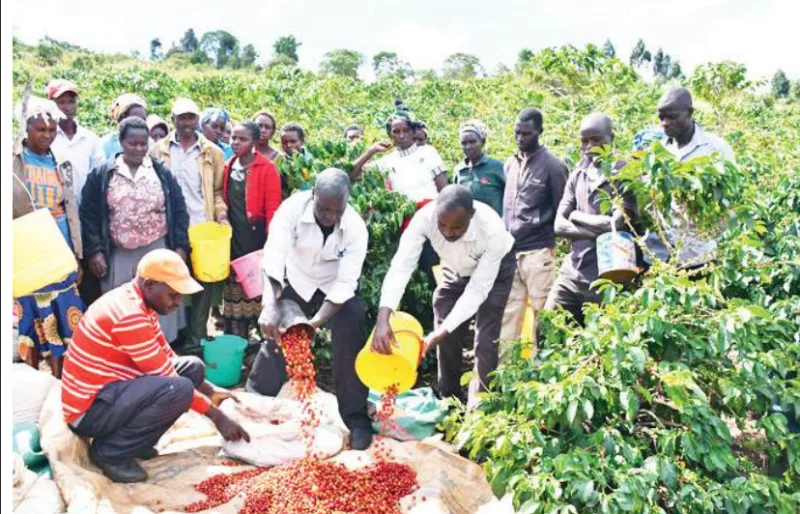
EDWARD Njoka is passionate about coffee. When some growers were abandoning the crop due to
high costs and poor prices, Njoka worked patiently on his farm in Baragwi,
Kirinyaga county, increasing his acreage from one to 10.
His patience and dedication paid off and now pay him handsomely. In the
last season, Njoka harvested 46,000 kilos from eight acres. The crops in the remaining
two acres have not matured. Sometimes he hires as many as 70 workers.
“My experience as a coffee
farmer over the years is that it is difficult. It is not an easy task
because, first of all, the cost [of production] is too high,” Njoka told the Star.
He cited other challenges such as price fluctuation, climate change and
lack of enough agronomists to advise and support farmers.
Njoka is one of thousands of coffee farmers in Kirinyaga who shared
Sh7.4 billion for last season’s crop, the highest ever recorded in the
region. Payments ranged between Sh104 and Sh157.40 per kilo
of cherry.
But the good news is not just in Kirinyaga. Coffee is back around the
country. More than 210,000 acres are under cultivation in 35 counties.
“The future of coffee farming in Kenya is promising,” Jacqueline
Kandagor, a coffee grower in Baringo North, said. She is also a lecturer in
French at Kibianga University in Kericho county.
“As long as farmers continue to access reliable markets and receive the
necessary technical support, coffee has the potential to become one of the
country’s most rewarding cash crops,” she told the Star.
The improved prices and increased interest in coffee farming are due to
a raft of strategic legal, regulatory and institutional reforms implemented by
the Kenya Kwanza administration under the Bottom-up Economic Transformation
Agenda.
“We have gained so much
from the government. It has been able to get rid of cartels from the coffee
subsector,” Njoka said.
As at Sale 29 of the
2025-2026 season, Kenya has sold 42.4 million kilogrammes (42.4 tonnes) of
clean coffee, earning $297 million (Sh38 billion).
The Nairobi Coffee
Exchange accounts for 36 million kilos valued at $248 million (Sh32 billion),
while direct sales contribute a further 6.07 million kilos valued at $49.24
million (Sh6.35 billion).
A 50kg bag of clean coffee
averages $405.87 (Sh52,400) in direct sales compared to $340.55 (Sh43,900) at
the auction.
Kirinyaga accounts for
2.37 million kilos, or 39 per cent of all direct sales which, combined with its
auction deliveries, makes it the leading coffee-producing county
overall at 6.97 million kilos, ahead of Kericho at 6.10 million.
Henry Kinyua, presidential adviser on crops and value chains projects, said that coffee sales will reach 62.4 million kilos by the close of the season,
“meaning Kenya is firmly on course to surpass the 60-million-kilogramme mark of
clean coffee sold, which has not happened in the last two decades.”
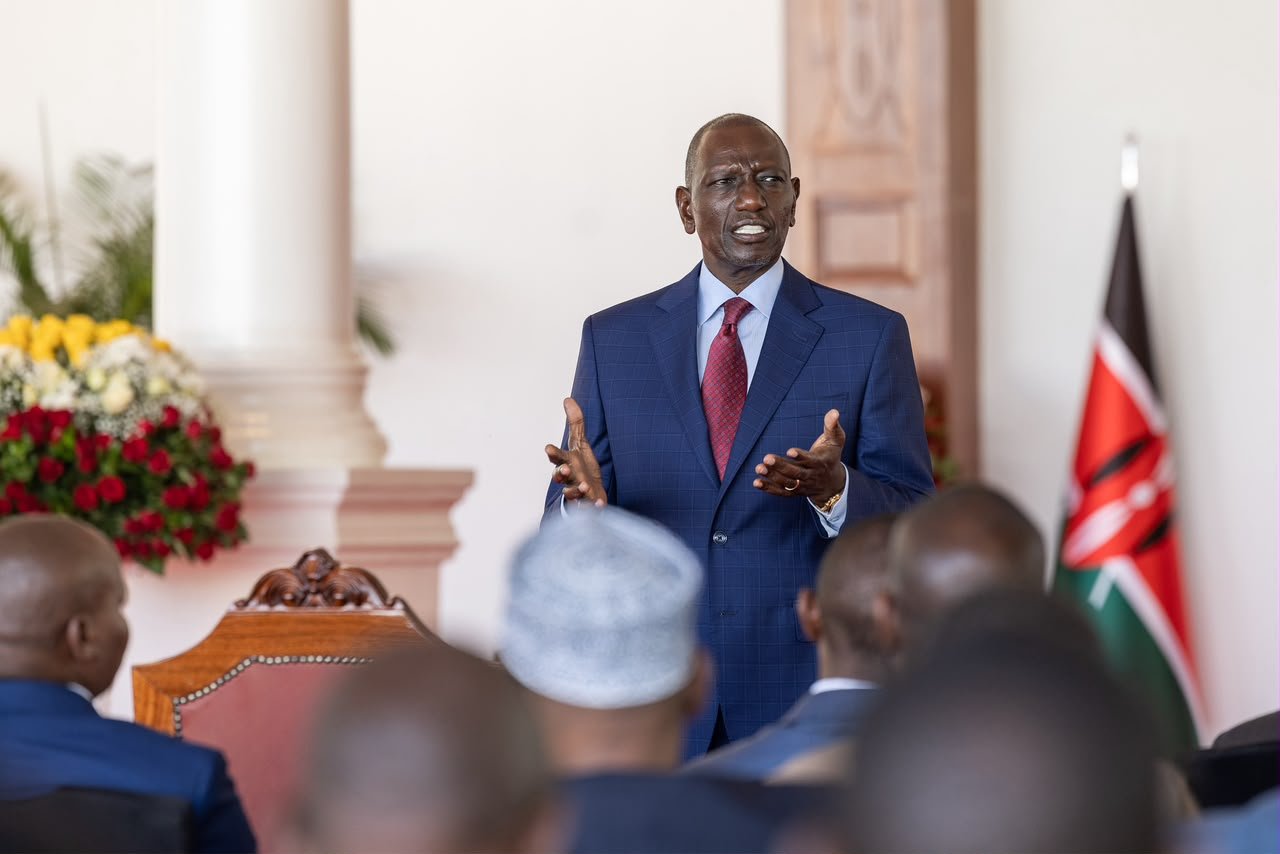
Through Executive Order No.2 of 2023, President William Ruto placed
coffee subsector reforms under the office of the Deputy President.
“This prioritisation sent a strong message nationally to farmers on the
importance of coffee as a priority value chain and the serious intention of the
Fifth Administration to revive coffee farming in Kenya,” Kinyua said the Star.
The reforms include full implementation of the Coffee General
Regulations, 2019, and signing into law of the far-reaching Coffee Act in March.
The Cooperatives Bill 2024 has been passed by the National Assembly and
is currently before the Senate.
The Capital Markets Authority oversees the Nairobi Coffee Exchange,
where 16 farmer-owned cooperatives sell coffee at the auction.
The Agriculture and Food Authority has licensed 134 coffee buyers, with
about 40 who are active in the auction.
The Direct Settlement System has shortened payment periods to farmers
from six months to five days.
“As a result of increased transparency, coffee prices have improved by
40 per cent, with most cooperative societies paying over Sh100 per kilo of
cherry,” Kinyua said.
Since coming to power in 2022, the Kenya Kwanza government has invested
Sh8.2 billion in the Coffee Cherry Advance Revolving Fund to provide affordable
seasonal financing to coffee farmers.
The fund has improved farmers’ liquidity, reduced reliance on high-cost
borrowing, and enabled timely payment for coffee deliveries.
As of June 2026, the fund has disbursed Sh14.5 billion to 668,414 coffee farmers through
cooperative societies, Cooperatives Principal Secretary Patrick Kilemi told the Star.
“Against a government investment of Sh8.26 billion, this represents a
176 per cent disbursement rate, reflecting the revolving nature of the fund,
where recovered resources are recycled to finance subsequent lending cycles.”
The fund is open to all eligible coffee farmers and cooperatives that
deliver coffee cherry.
The average advance per farmer over the period was Sh21,758, although
the actual amount varies depending on the volume of coffee cherry delivered.
Repayment performance has remained strong at about 95 per cent, largely
due to recoveries made through the Direct Settlement System in which loan
repayments are deducted directly from coffee sales proceeds before payments are
remitted to farmers, Kilemi said.
“A total of 49 coffee cooperative societies, comprising 100 coffee
factories, were strengthened through the government’s coffee factory
modernisation and rehabilitation programme between September 2022 and June 2026.”
Previously, many farmers received payments only once a year after the
marketing cycle.
“Under the coffee sector reforms, farmers now receive payments up to
three times annually, with proceeds disbursed within five days after coffee is
sold at the auction through the Nairobi Coffee Exchange,” the PS said.
“The Direct Settlement System has
played a key role in accelerating payments, improving transparency, and
ensuring timely remittance of proceeds to farmers.”
Governance reforms have focused on strengthening transparency and
accountability within coffee cooperatives through the Cooperative Bill, which
will serve as the anchor law for cooperative governance once enacted.
The Bill provides for stronger financial oversight through mandatory
audits, fit-and-proper criteria for directors and managers, regular elections,
enhanced management accountability, and improved regulatory oversight by the commissioner for
Cooperatives.
The reforms are intended to strengthen governance, safeguard members’
interests and improve the performance and sustainability of coffee
cooperatives.
The Coffee Act, 2026, assented by President Ruto in March, strengthened
the coffee subsector by establishing the Coffee Board of Kenya as the regulator
and the Coffee Research and Training Institute. It also enhanced governance,
licensing, and market oversight.
“The law has improved transparency and accountability within
cooperatives, strengthened research and extension services, and created a more conducive
environment for higher farmer incomes, increased investment, and sustainable
sector growth,” the PS said.
The government waived Sh6.8 billion in historical debts owed by coffee
cooperatives, restoring their financial viability and enabling them to better
serve farmers.
Through the Kenya Planters Cooperative Union, the government has hired
and trained two coffee experts in every coffee-growing ward in 35 counties.
Coffee farmers are beneficiaries of the government’s subsidised
fertiliser and seedlings. The President directed KPCU to work with the National
Cereals Board, which distributes the fertiliser across the country.
“KPCU is working with our
cooperatives to ensure that we take the fertiliser as near as possible to our
farmers,” Kilemi said.
The government is also
discussing distributing subsidised pesticides to farmers.
The State Department for
Cooperatives is looking for new markets for coffee abroad, in addition to the
United States and Europe, which already buy Kenyan coffee.
Local consumption remains low, at about four per cent compared to 50 per
cent in Ethiopia.
“The government is promoting local coffee roasting, processing and
domestic consumption, expanding access to affordable finance through the CCARF
(Coffee Cherry Advance
Revolving Fund),” Kilemi said.
The PS said it is also “supporting cooperative modernisation and value
addition infrastructure, strengthening women and youth inclusion in cooperative
leadership, and implementing programmes to increase productivity and create
more employment opportunities along the coffee value chain.”

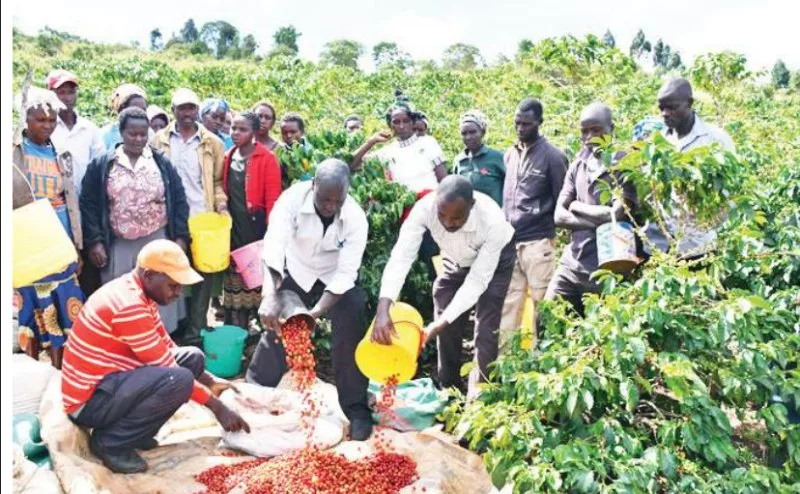 Members of the Sailo youth group in Kipkelion East, Kericho County, collect harvested coffee cherries /KNA