If one were to believe the latest stories making the rounds in Mombasa
and across the Coast region, then walking through the streets has suddenly
become one of the most dangerous activities for men.
Not because of armed
robbers, reckless drivers or pickpockets, but because apparently a simple
handshake or a friendly tap on the shoulder can cause a grown man to lose his
private parts.
Indeed, in recent weeks, men across Kisauni, Kongowea and Markiti
areas of Mombasa County have raised alarm claiming that their manhood
mysteriously disappeared moments after being greeted by strangers. Similar
allegations have also emerged from Malindi in Kilifi county and Diani in Kwale county.
For many Coast residents, it has become a frightening tale. For
others, it has become a source of endless jokes. One can hardly walk into a
restaurant, matatu stage or barber shop without hearing men discussing
protective strategies. Some have reportedly abandoned handshakes altogether.
Others now inspect themselves immediately after greeting strangers. A few have
become so suspicious that they treat every innocent passerby as a potential
“private parts thief”.
If the situation were not so dangerous, it would almost be comedy
material. However, beneath the laughter lies a very troubling reality.
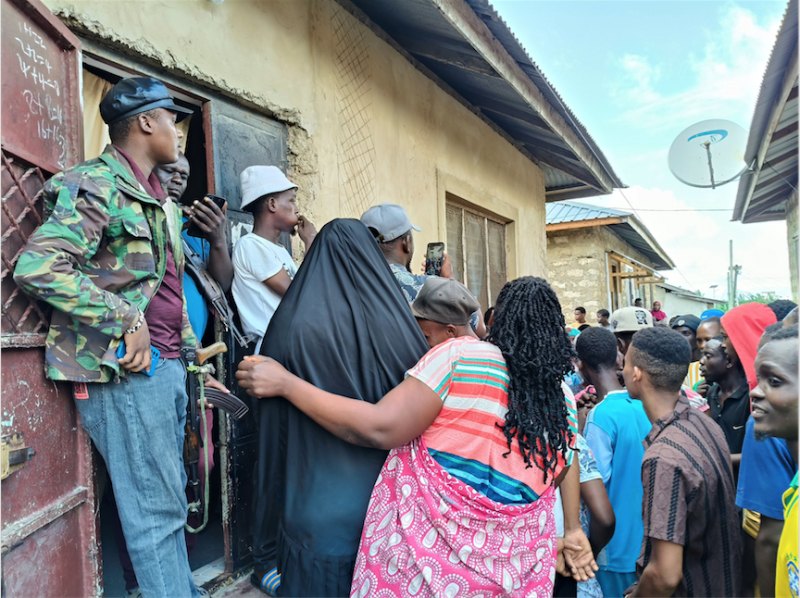
These allegations have sparked public fury and panic, leading to
several incidents of mob justice. Individuals accused of stealing private parts
have been chased, beaten and humiliated by angry crowds. In Mombasa, at least
one person has reportedly lost his life after being attacked by a mob over such
accusations. The question that every reasonable person must ask is simple: where
is the evidence?
VOCAL Africa has closely followed these incidents and engaged security
authorities regarding the allegations. The information we have received paints
a very different picture from the stories circulating on social media and in
public spaces. According to security authorities and medical personnel consulted on
the matter, there has not been a single medically confirmed case of a person
permanently losing his genital organs after being touched, greeted or brushed
against by another individual. Not one.
In fact, authorities have already charged at least two individuals
who falsely claimed that their organs had been stolen. Security officials
further indicate that some of these incidents are orchestrated by criminal
gangs whose objective is not to steal body parts but rather to create confusion
and incite mobs. Once the crowd becomes distracted and emotions run high,
accomplices take advantage of the chaos to rob unsuspecting members of the
public. This
explanation makes far more sense than the supernatural claims being circulated.
Unfortunately, social media has become a powerful vehicle for spreading misinformation. Videos are shared without verification. Voice notes
are forwarded without evidence. Rumours travel faster than facts. Within
minutes, entire communities become convinced that a crime has occurred even
before any investigation is conducted.
Even more worrying is the role some religious leaders have played
in fuelling the hysteria. Several pastors and sheikhs have publicly claimed that
after praying for alleged victims, their missing organs mysteriously returned. While faith plays an
important role in society and many people derive comfort from prayer,
extraordinary claims require extraordinary evidence. If someone genuinely lost
an organ and later recovered it, medical professionals should be able to verify
such an occurrence. To date, no such medical confirmation exists.
As a society, we must be careful not to replace evidence with
speculation or allow fear to override common sense. History teaches us that
moral panic often creates more victims than the alleged crime itself. Innocent
people are profiled. Strangers become targets. Communities become suspicious of
one another. Before long, the real danger is no longer the rumoured crime but
the violence unleashed by those reacting to it.
The Constitution of Kenya guarantees every person the right to
life, dignity and security. These rights do not disappear simply because a
crowd believes a rumour. No citizen deserves to be assaulted, tortured or
killed based on allegations that have not been investigated and proven.
At the same time, those
who deliberately manufacture false claims should also be held accountable. If
indeed some criminal gangs are using these accusations to confuse crowds and
facilitate theft, then their actions are not only dishonest but criminal.
Exploiting public fear for personal gain endangers lives and undermines public
safety.
The Coast region is already grappling with genuine challenges, including
unemployment, poverty and rising economic pressures. Communities need solutions
to these real problems, not manufactured fears that pit neighbour against
neighbour. Kenyans must therefore remain vigilant and refuse to become easy
prey for gangs of criminals, hooligans, tricksters and con artists who thrive
on fear and confusion. The public should be especially cautious whenever
dramatic allegations are made in crowded places.
Criminals understand the psychology of mobs. They know that once
panic erupts, people stop thinking rationally. In that confusion, innocent
people can be attacked while the real criminals quietly disappear into the
crowd after stealing phones, wallets and other valuables. Times may indeed be
hard. Economic challenges may be everywhere.
However, hardship can never justify
working in gangs to falsely accuse innocent people, spread panic or manipulate
communities for criminal purposes. Equally, economic frustrations should never
be used as an excuse for taking the law into one’s own hands.
The public must remain vigilant against misinformation merchants and
criminal opportunists. Every allegation should be subjected to scrutiny and
every suspect should be handed over to the police rather than to an angry mob.
Justice can only be administered through the law, not through fists, stones and
lynch mobs.
A society governed by rumours soon becomes a society governed by
fear, and a society governed by fear inevitably becomes a society where innocent
people suffer. The next time someone claims that his private parts vanished after
a handshake, perhaps the first response should not be to form a mob. Instead,
let us seek evidence, consult medical professionals and allow the law to take
its course.
After all, facts are far more reliable than panic, and justice is
far more civilised than mob violence.
Executive director, VOCAL Africa